
 2,2
2,2- 1Institut Polytechnique des Sciences Avancées, Paris, France
- 2LIRA, Observatoire de Paris, Paris Sciences et Lettres, Paris, France
High-albedo crater rays are prominent surface features on both the Moon and Mercury. Radiating out from the progenitor craters, they are most frequently formed by immature terrain unearthed by secondary craters associated with the primary impact (Neish et al. 2013; Elliott et al. 2018).
The ejecta rays of Mercury were mapped by Lissoni et al. (2025) using EJMAP, a two-stage supervised deep-learning pipeline trained to not only recognize high-albedo ejecta but also identify their crater of origin. EJMAP was applied to the 665 m px-1 Enhanced Color mosaic of Mercury’s surface developed using multispectral imagery from the MDIS instrument of the MESSENGER mission (Denevi et al. 2009).
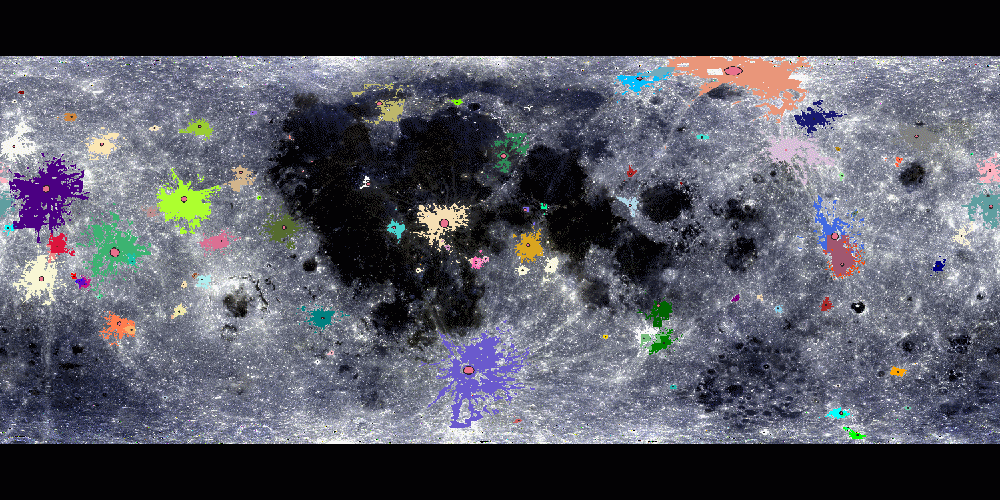
We build upon this work and evaluate how the deep learning model behaves on a different planetary body: the Moon. We applied it to a 399 m px-1 Hapke-corrected reflectance mosaic covering latitudes 70°N to 70°S generated from imagery from the Lunar Reconnaissance Orbiter Wide Angle Camera (Sato et al. 2017). We selected 100 craters with well-defined high-albedo ejecta and prepared a training dataset of ~150 224x224 px mosaic tiles where the ejecta of the craters were mapped manually. The EJMAP pipeline was then retrained from scratch on these lunar data, and a global ejecta map was produced. The EJMAP configuration used on Mercury reaches on the Moon a pixel-level F1-score of 0.647. Building on this baseline, the next step has been to revisit the pipeline itself by testing alternative architectures, loss functions and class-imbalance strategies, aimed at improving performance on both lunar and, eventually, Mercurian data. Several hyperparameter optimisation methods are being deployed in parallel such as Bayesian search, Hyperband pruning, and alternative loss families to systematically explore the search space.
A second part of the work consists in simulating the hyperspectral imagery of Mercury that will be produced by the SIMBIO-SIS/VIHI instrument (Cremonese et al. 2020) during the orbital phase of the BepiColombo mission. To this end, a multilayer perceptron neural network is under development to map the MDIS 8-band spectra to a VIHI-like 6-nm spectral resolution. This model is trained using spectra measured by MESSENGER MASCS/VIRS hyperspectral instrument (Cornet et al. 2022) and co-located with the MDIS global mosaic. Our aim is to produce a simulated VIHI hyperspectral mosaic of Mercury ahead of real BepiColombo data and use it to further improve the performance of EJMAP.
References
Cornet et al. 2020. Mercury 2022, 71-71.
Cremonese et al. 2020. Space Science Reviews, 216(5), 75
Denevi et al. 2009. Science, 324(5927), 613-618
Elliott et al., 2018. Icarus, 312, 231-246
Lissoni et al. 2025. EPSC-DPS2025-256
Neish et al., 2013. JGR: Planets, 118(10), 2247-2261
Sato et al. 2017. Icarus, 296, 216-238.
How to cite: Müller, R., Lissoni, M., and Doressoundiram, A.: Deep learning model for crater ray mapping on Mercury: application to the Moon and preparation for hyperspectral BepiColombo imagery, Europlanet Science Congress 2026, The Hague, The Netherlands, 7–11 Sep 2026, EPSC2026-701, https://doi.org/10.5194/epsc2026-701, 2026.


