
 1,
1,- 1Centre for Astrophysics, University of Southern Queensland, West St, Toowoomba, QLD 4350, Queensland, Australia (ylenia.mascolo@unisq.edu.au)
- 2Jet Propulsion Laboratory, California Institute of Technology, 4800 Oak Grove Drive, Pasadena, CA 91109, USA
- 3Instituto de Astrofisica e Ciencias do Espaco, CAUP, Universidade do Porto, Rua das Estrelas, 4150-762 Porto, Portugal
- 4Departamento de Fisica e Astronomia, Faculdade de Ciencias, Universidade do Porto, Rua do Campo Alegre, 4169-007 Porto, Portugal
- 5Dipartimento di Fisica e Astronomia, Università degli Studi di Padova, Vicolo dell’Osservatorio 3, I-35122 Padova, Italy
- 6INAF - Osservatorio Astronomico di Padova, Vicolo dell’Osservatorio 5, I-35122 Padova, Italy
Cool sub-Neptunes orbiting mid to late M dwarfs provide exceptional laboratories for testing potentially habitable scenarios with current facilities. LHS 6050 b is one of only two known sub-Neptunes within the habitable zone with an equilibrium temperature <300K (see Fig.1).
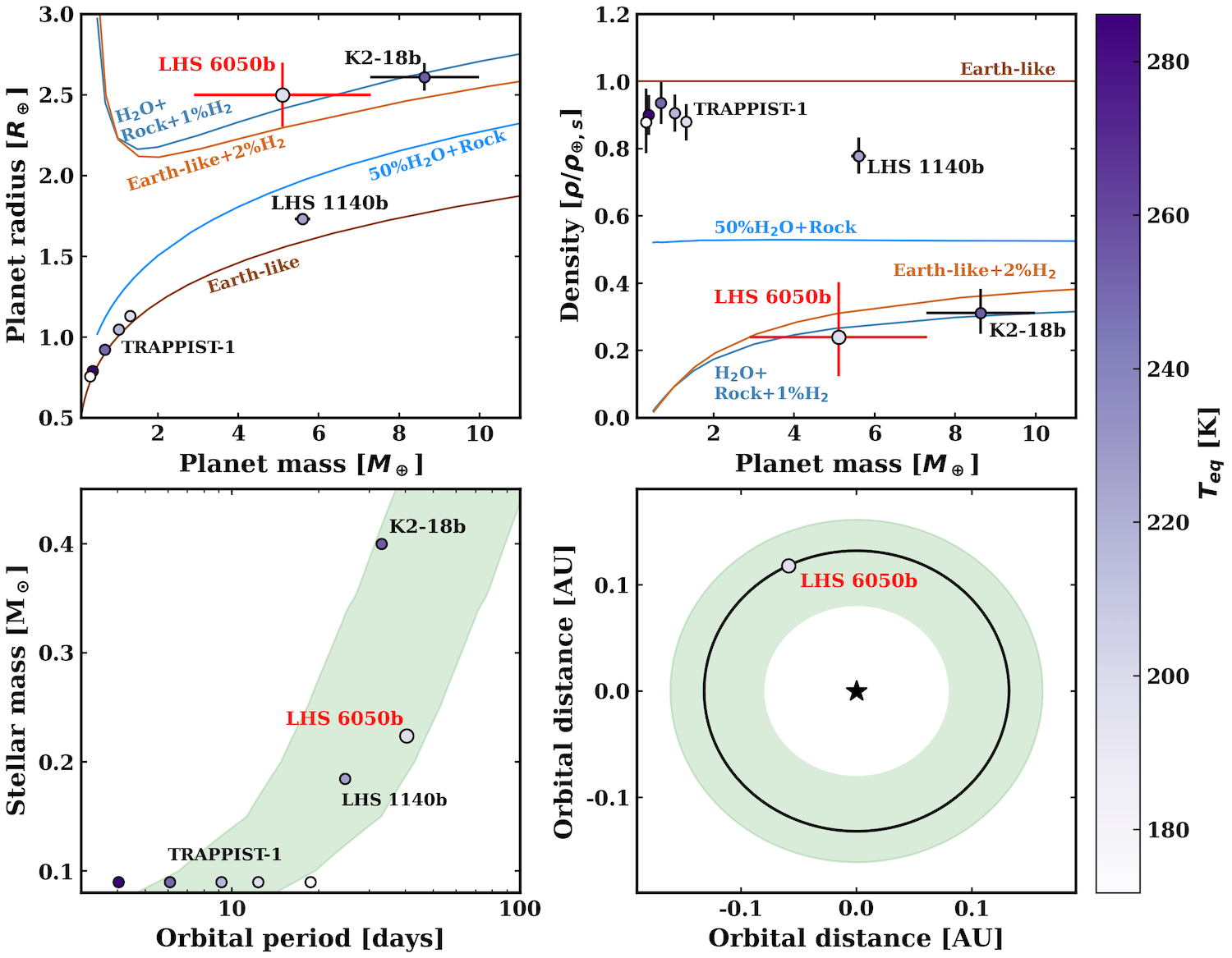
Fig. 1: Upper panels show mass–radius and mass–density diagrams for known low-mass exoplanets with equilibrium temperatures below 300 K. The densities are expressed relative to the Earth-like interior model proposed by Zeng et al. (2019). In the lower left panel, this same set of planets is plotted within the conservative habitable zone as defined by Kopparapu et al. (2014), while the lower right panel presents a top-down view of the LHS 6050 system, illustrating the circular orbit of LHS 6050 b within the habitable zone.
We determine that LHS 6050 b orbits in 40-day around a low-mass M4V star, located only 20 parsecs from the Sun. The planet has a mass 5.1 times that Earth masses and a radius 2.5 times that of Earth, consistent with being a small planet with a bulk density of 1.8 g cm-3. With an equilibrium temperature of about 200 K and an insolation flux of 0.32 times the one received by the Earth, LHS 6050 b places among the coolest known sub-Neptunes orbiting a mid M dwarf within its habitable zone and nearer to the water snow line than any previous confirmed sub-Neptune planet.
In this work, we present the discovery of LHS 6050 b by the Transiting Exoplanet Survey Satellite (TESS). This planet is confirmed via 65 epochs of radial velocity observations, obtained with the ESPRESSO high resolution spectrograph (see Fig. 2, right panel). We verified possible variations in transit depth and refined the transit ephemerides through photometric ground-based follow-up observations from LCO, Minerva-Australis, NGTS, and TRAPPIST-south (see Fig. 2, left panel). In addition, we perform a vetting campaign that incorporates reconnaissance spectroscopy from CHIRON and TRES, high-resolution imaging from Gemini, and archival data, to exclude astrophysical false-positive scenarios and confirm that the transit signals originate from the planet LHS 6050 b.
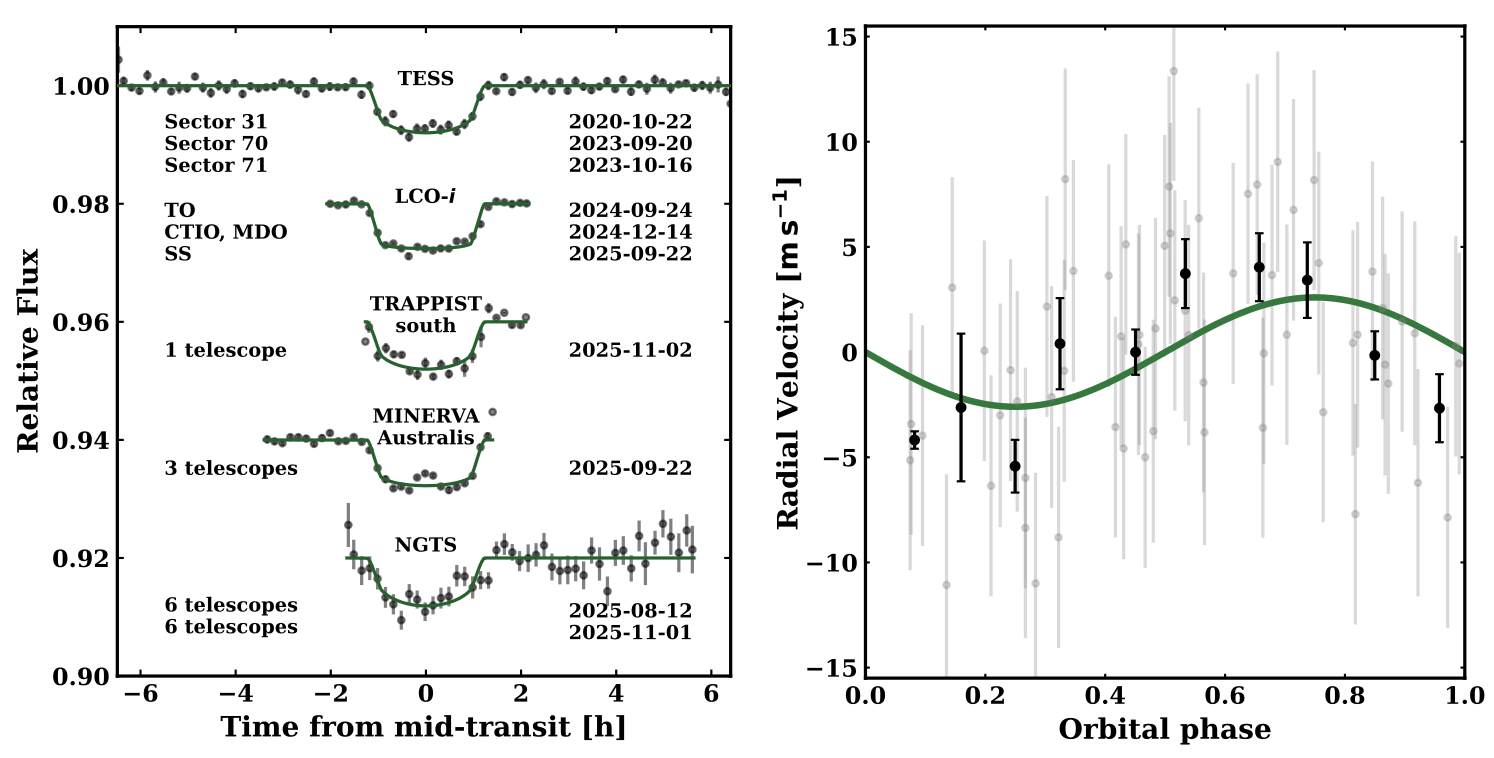
Fig. 2: The left panel presents phase-folded transit observations (with data binned in phase at a 10-minute cadence) from TESS and various ground-based facilities, with our transit model overlaid as a green curve. The right panel displays 65 radial velocity measurements of LHS 6050 obtained with the ESPRESSO spectrograph, together with data binned at uniform phase intervals. Our best-fit model, assuming a circular orbit, is shown as the green curve.
Due to its low density, LHS 6050 b requires the presence of a substantial gaseous envelope. This envelope is not expected to be completely strip away from photoevaporation, despite the high stellar XUV irradiation the planet receives (about 4700 times the Earth X-rays radiation). In this way, LHS 6050 b provides meaningful tests on the role early atmospheric erosion plays in the evolution of small temperate planets. Furthermore, LHS 6050 b is cool enough that it may host a more compact atmospheric envelope than other sub-Neptune planets, to the point where steam-dominated atmospheres might no longer be possible, allowing a clearer comparison with rocky planets and those with gaseous envelopes, in the habitable zones of their host stars. At sufficiently low temperatures, water vapour condenses to liquid and then freezes out of the atmosphere of sub-Neptunes, potentially leaving a thin hydrogen-dominated atmosphere, surrounding a large liquid-water or magma ocean. In low-density cold sub-Neptunes, possible atmosphere–surface interactions can be probed by measuring the abundances of CH4, CO2, NH3, and sulfur-bearing species. LHS 6050 b is the only confirmed sub-Neptune that may host an atmosphere cold enough to break the steam degeneracy, potentially allow a precise identification of a unique interior structure model. This prospect, combined with its TSM of 136, makes LHS 6050 b one of the most promising targets for future JWST observations.
How to cite: Mascolo, Y., Zhou, G., Huang, C., Burt, J., Silva, A., and Zingales, T.: LHS 6050 b: a cool sub-Neptune within the habitable zone of a nearby M-dwarf star, Europlanet Science Congress 2026, The Hague, The Netherlands, 7–11 Sep 2026, EPSC2026-704, https://doi.org/10.5194/epsc2026-704, 2026.


