
 1,2,
1,2,- 1Kyung Hee University, Korea, Republic of (kilho.baek@gmail.com)
- 2Korea Astronomy and Space Science Institute
The wide-angle Polarimetric Camera (PolCam) onboard South Korea’s Danuri spacecraft is a pioneering instrument designed to conduct the first global polarimetric survey of the Moon from lunar orbit. However, its highly oblique viewing geometry (~45° tilt) and shutterless frame-transfer CCD introduced significant topographic distortions and severe charge-smearing artifacts. Due to the lack of comprehensive pre-launch characterization, establishing a rigorous on-orbit calibration pipeline was imperative. This pipeline integrates both geometric and radiometric calibrations (Figure 1). In this presentation, we briefly outline this calibration framework and present the resulting first quasi-global lunar polarimetric map, which notably encompasses observations of the lunar farside.
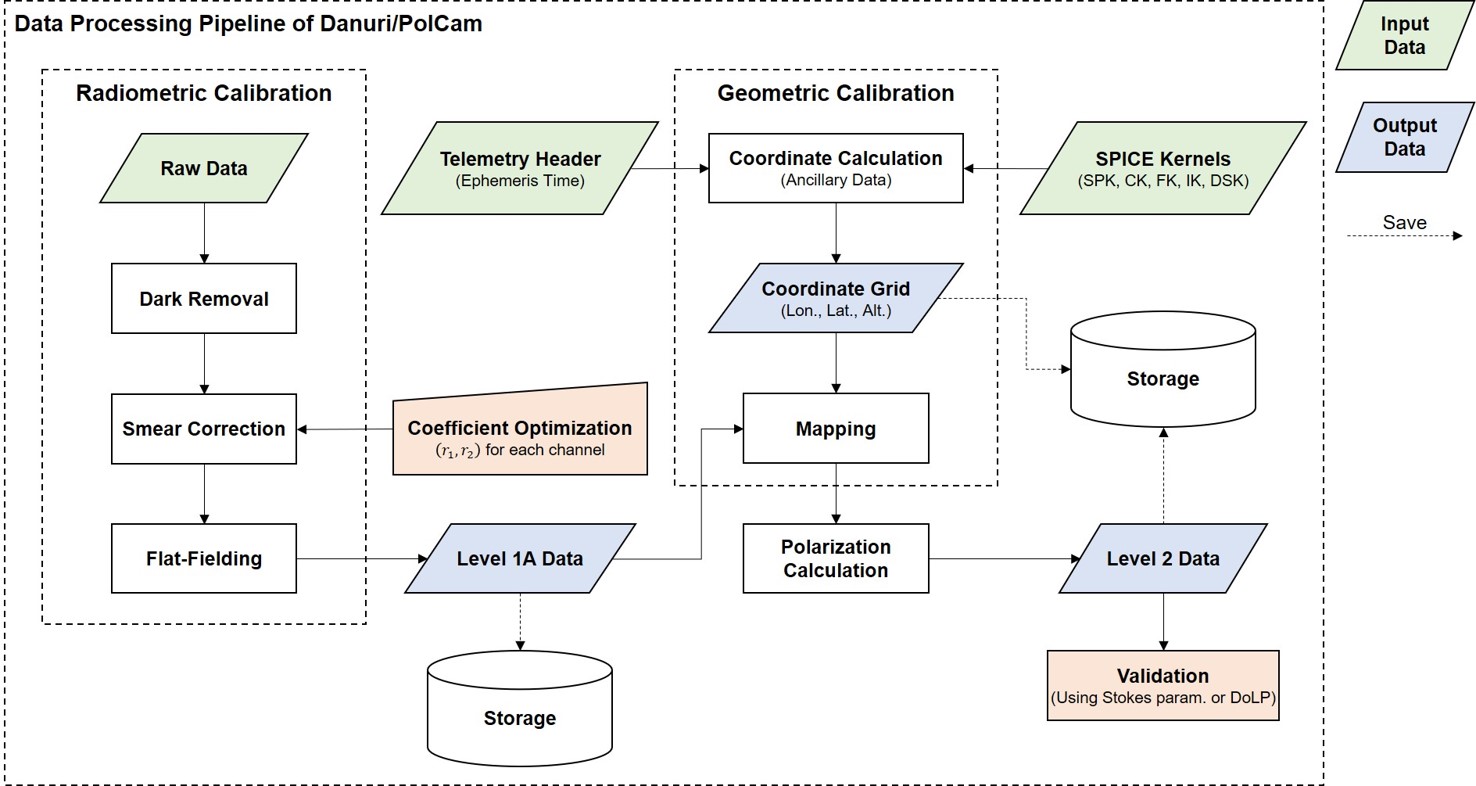
Figure 1. Flowchart for the on-orbit calibration pipeline of PolCam.
The implementation of this pipeline yielded the high-fidelity data required for polarimetric analysis. Geometric parameter refinement minimized reprojection errors, achieving sub-pixel geolocation accuracy with a cross-track root-mean-square error of ~0.87 pixels. This precision enabled the generation of seamless orthorectified mosaics, even across topographically complex terrains such as cratered basins. Radiometrically, the dynamic de-smearing correction effectively mitigated vertical smear artifacts exacerbated by frame-transfer times exceeding exposure times. By optimizing channel-specific de-smearing coefficients for distinct viewing orientations, these artifacts—particularly prominent in high-contrast regions—were successfully suppressed, thereby restoring the radiometric fidelity essential for deriving the Degree of Linear Polarization (DoLP) (Figure 2).
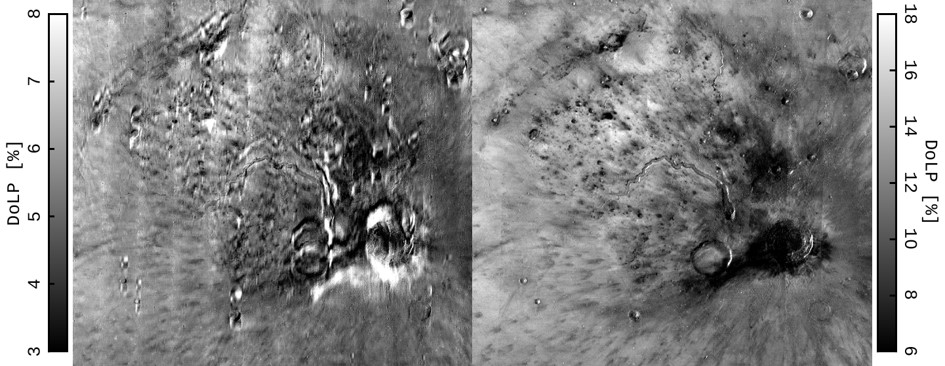
Figure 2. DoLP maps of the Aristarchus Plateau before (left) and after (right) smear correction.
Utilizing this radiometrically corrected and co-registered dataset, we generated the first quasi-global polarimetric map of the lunar surface, spanning all longitudes across a restricted latitudinal range. The map clearly resolves distinct polarimetric features, successfully differentiating the elevated DoLP of the lunar maria (10–15%) from the lower DoLP of the highlands (4–7%). These measurements validate the inverse relationship between reflectance and polarization (Umov's law) across vast spatial scales. Furthermore, these results provide unprecedented insights into regolith maturity, surface roughness, and localized space weathering phenomena. Ultimately, the successful construction of this extensive regional map demonstrates PolCam's robust capability for high-phase-angle polarimetry and establishes the foundational framework for a comprehensive global polarimetric map of the Moon.
How to cite: Baek, K., Kim, S., Jeong, M., and Choi, Y.-J.: First Quasi-Global Lunar Polarimetric Map from Danuri/PolCam Using a Calibration Pipeline with Smear Correction, Europlanet Science Congress 2026, The Hague, The Netherlands, 7–11 Sep 2026, EPSC2026-709, https://doi.org/10.5194/epsc2026-709, 2026.


