
 2,3,4,
- 1Michigan Technological University, Mechanical Engineering-Engineeering Mechanics, United States of America (srbruesh@mtu.edu)
- 2British Astronomical Society, UK (jrogers11@btinternet.com)
- 3Independent Researcher, Stuttgart, Germany (Gerald.Eichstaedt@t-online.de)
- 4Jet Propulsion Laboratory/California Institute of Technology, USA (glenn.s.orton@jpl.nasa.gov)
- 5deceased; formerly of Planetary Science Institute, Tucson, AZ
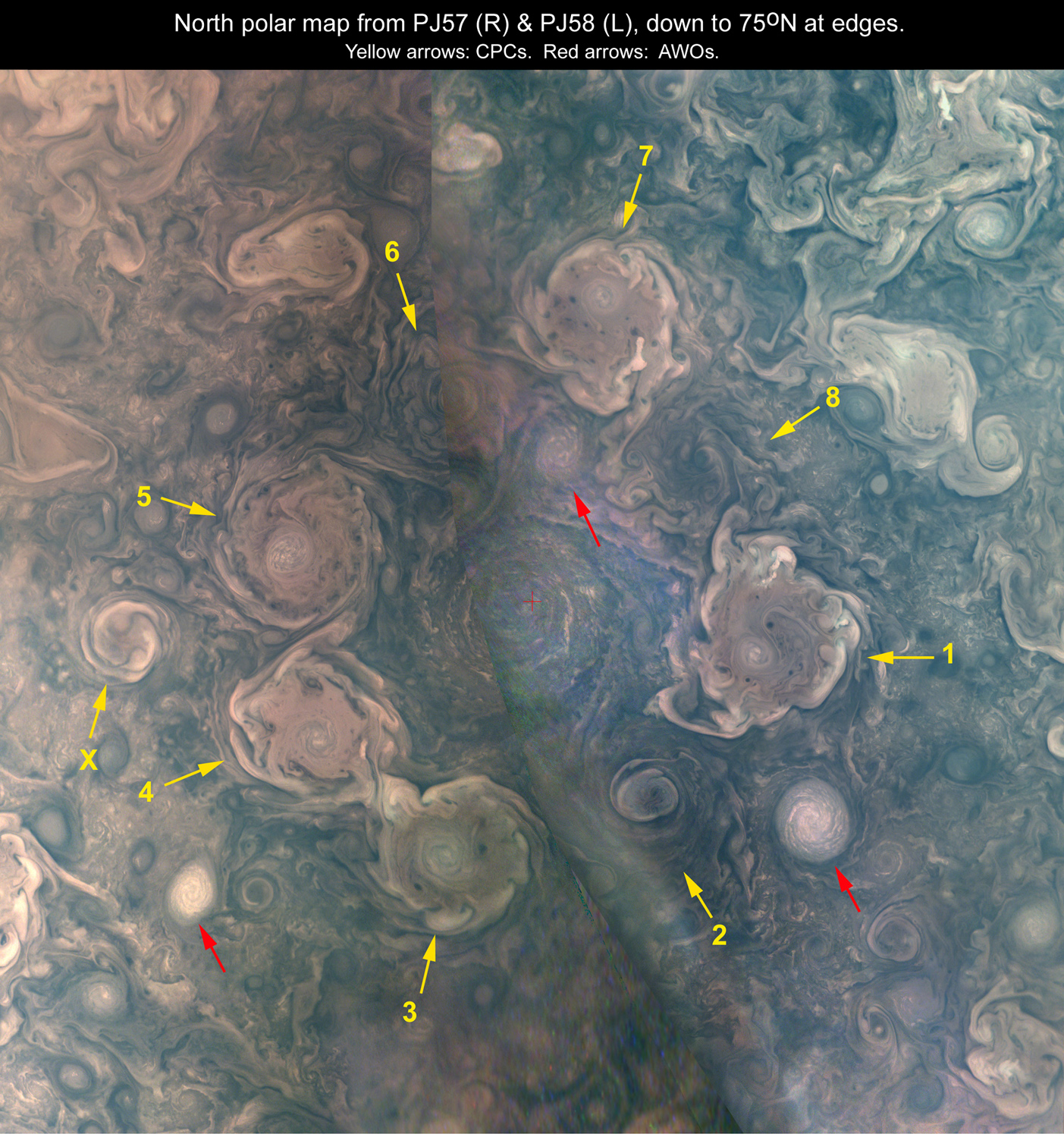
Jupiter’s north pole is attended by eight circumpolar cyclones (CPCs) surrounding a central North Polar Cyclone (NPC) [Fig.1]. They were discovered by the JunoCam and JIRAM instruments on Juno (Ref.1), and have been remarkably stable ever since. Here we use JunoCam maps to track the positions of the CPCs and NPC throughout the Juno mission, as well as the behaviour of several ancillary circulations which have persisted for some time. CPC-7 is always further from the pole than the others, and the NPC is always offset into one quadrant by up to 1.2° from the pole.
Circumpolar cyclones
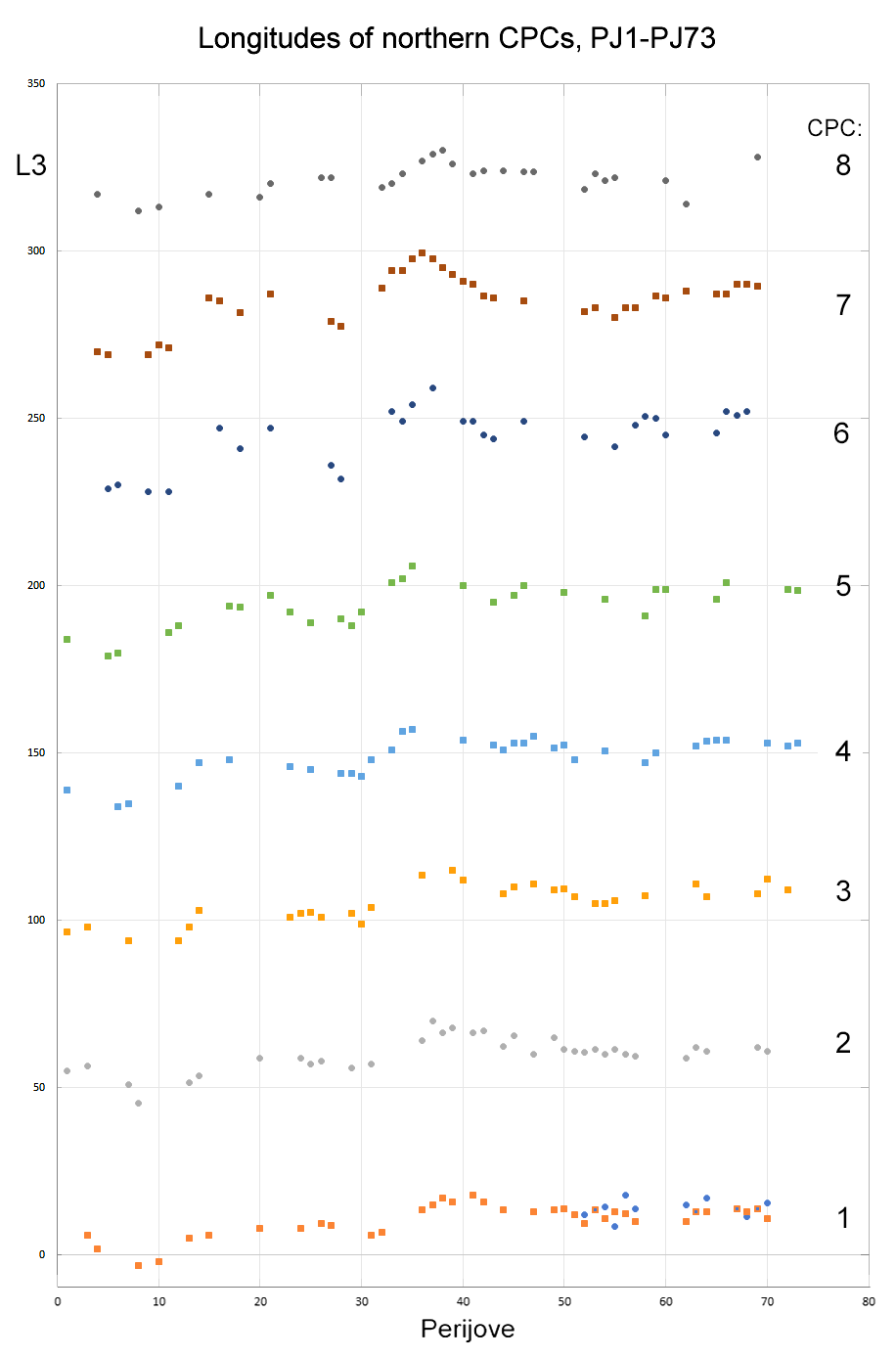
Here we track longitudes of the 8 CPCs up to perijove (“PJ”) 73 [Fig.2], extending the analysis of Ref.2. The CPCs have only shown modest changes on longitude. The results show that the octagon moves largely as a whole, with trends on a timescale of several months to a year.
Most of the CPCs decreased slightly in longitude up to PJ8 then increased between PJ12 and PJ17, as already shown in Ref.2. The CPCs have been generally stationary since then, except between PJ31 and PJ42, when they all increased in longitude substantially then decreased again, though remaining several degrees higher than before. This positive excursion peaked between PJ35 and PJ38, not quite synchronously for all the CPCs, with an increase of 8°-18° relative to their overall mean motion; all other deviations from the mean motion were smaller. Since then, they have all been essentially stationary since then apart from CPC-7 and CPC-6. Overall, the CPCs longitudes have increased by an average of 16 (±5) deg in 9.0 years, but variations are neither progressive nor cyclic.
These results show that the north polar octagon does not copy the systematic rotation and precessional motion of the south polar pentagon (Refs.2, 4, 5), which have been reproduced in a model by Gavriel & Kaspi (Ref.6). However, the lag between longitude changes of CPCs suggests that similar interactions between adjacent cyclones may occur.
We also briefly detail the varying morphologies of each of the CPCs, noting that they tend to fall into either a ‘filled’ category or a more diverse category including spiral and chaotic forms. The ‘filled’ CPCs have mostly grown larger during Juno’s mission, especially CPC-1. Only CPC-5 has not grown. This may suggest a seasonal change, although any reversion to smaller size would have to occur rapidly during the so-far-unobserved portion of the jovian year.
The NPC itself, while appearing as a spiral form, and consistently so, is quite different from the others in radio wavelengths (see other presentations this conference).
Extra circulations
While the 8 CPCs and the NPC are the only features that have persisted throughout Juno’s mission, several other circulations in and around the octagon have been followed for multiple perijoves.
Anticyclonic white ovals (AWOs) inside the octagon: There are always one or two AWOs inside the octagon. One is usually present poleward of CPC-7 (except PJ32 to PJ39) [Fig. 1: PJ57/58 map]; the other (b) was seen from PJ25 to PJ55, poleward of CPCs-3/4/5, though swinging unpredictably in longitude. It seems likely that the two merged just after PJ57, creating an AWO poleward of CPC-1 from PJ62 to PJ70, while a new vortex developed poleward of CPC-7.
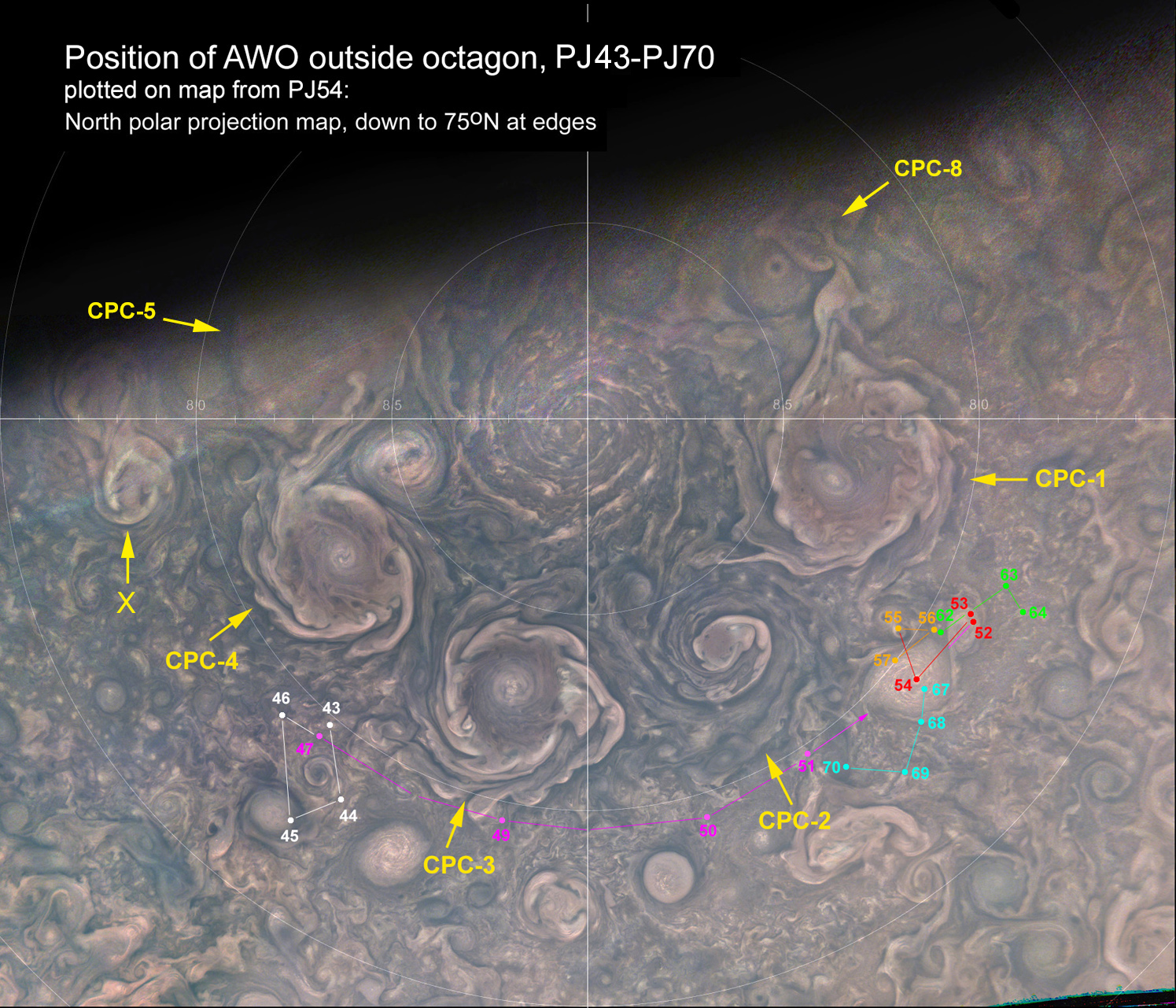
AWO just outside the octagon: A large AWO was tracked from PJ47 to PJ70. [Fig.3. PJ43-PJ70]. After eddying in a small clockwise loop from PJ43 to PJ47, from PJ47 to PJ51 it drifted anticlockwise around the periphery of the octagon at 79.5 (±0.14)°N, consistent with the outer winds of the CPCs. Then at PJ52 it had probably merged with a smaller AWO, and almost stopped moving. From PJ53 to PJ64 it remained just S of CPC-1&2, again oscillating slightly in clockwise loops. At PJ64 it apparently broke loose from this eddy and moved to a lower latitude, then from PJ67 to PJ70 it drifted clockwise (retrograde) around the octagon at 78.0—79.0°N.
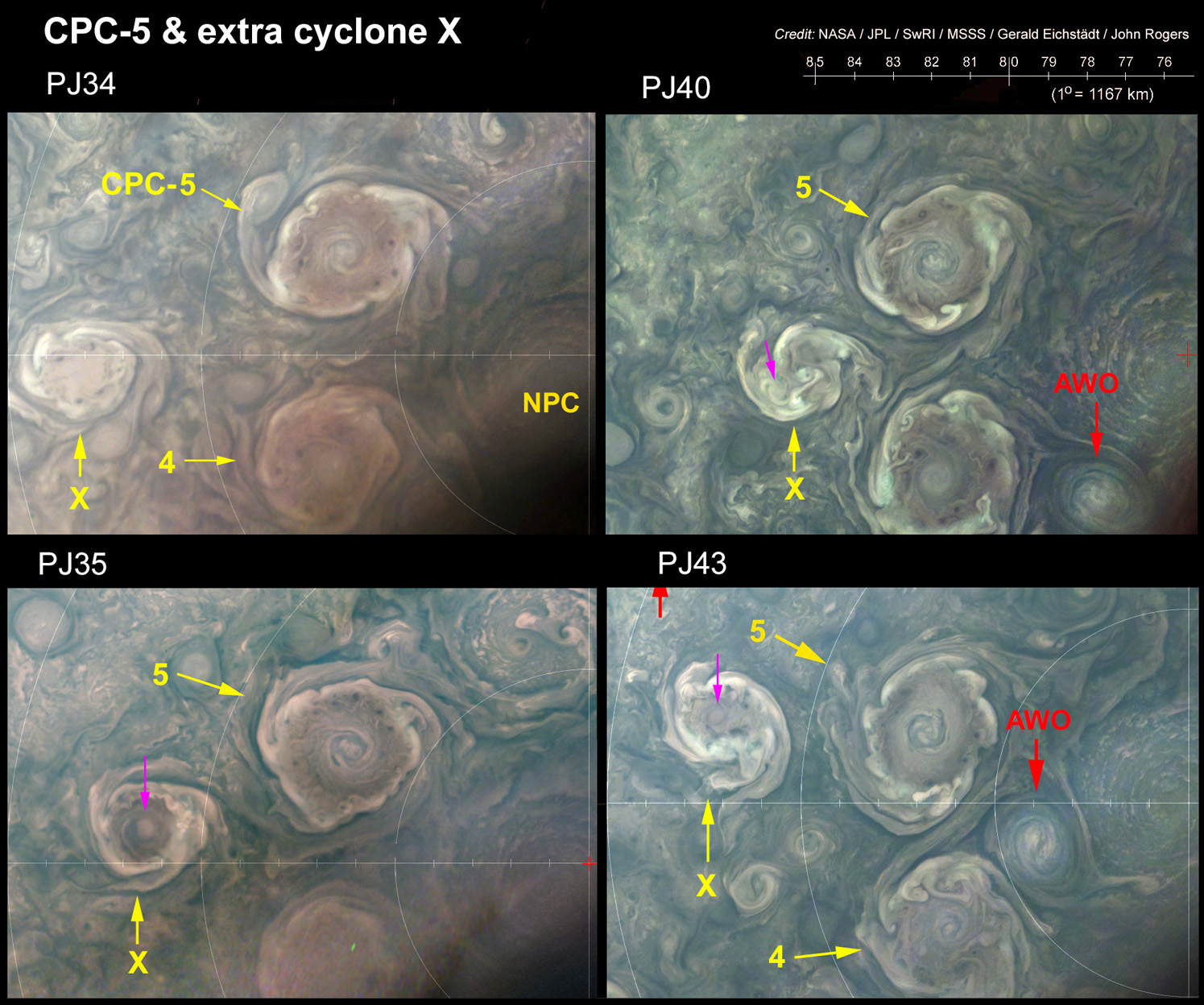
Ancillary cyclones: Sometimes one or two extra cyclones are seen at corners of the octagon, resembling smaller versions of filled CPCs, added to the vortex crystal. Two lasted for some time. One, labelled ‘X’, was recorded from PJ30 to PJ45 [Fig 5]. At PJ50, it was either absent or reduced, but a small cyclone from PJ58 to PJ66 may qualify as a revival of ‘X’. The other ancillary cyclone is labelled ‘IX’ [Fig 4. PJ32-PJ39]. At PJ32 & PJ33 it was a small version of a ‘filled’ CPC. At PJ36 to PJ39, if this was the same object, it had a similar cloud texture but an elongated, distorted outline, and it was drifting clockwise (retrograde) around the octagon at 77.6—78.7°N.
These drifts, for the cyclone and the AWO, did not exceed 2.1 m/s, and were usually < 1 m/s -- much slower than the wind speeds in CPCs or jets. They are consistent with the flow patterns that we found around the south polar polygon: AWOs with variable prograding drift adjacent to the CPCs [Ref.2], and a zone slightly further out in which the average drift was weakly retrograding [Ref.3].
Acknowledgements:
We thank Michael Ravine and Michael Caplinger (Malin Space Science Systems) and Tom Momary (formerly JPL) for enabling the operation of JunoCam. Some of this research was funded by NASA, in part through JPL/CalTech.
References:
1. Adriani A et al. (2018), Nature 555, 216-219.
2. Tabataba-Vakili F et al.(2019/20), Icarus 335, paper 113405. https://doi.org/10.1016/j.icarus.2019.113405
3. Rogers J et al. (2021/22), Icarus 372, paper 114742. https://doi.org/10.1016/j.icarus.2021.114742
4. Rogers J et al. (2021), EPSC Abstracts Vol. 15, EPSC2021-57, 2021. https://doi.org/10.5194/epsc2021-57
5. Mura A et al. (2021), GRL 48, e2021GL094235. https://doi.org/10.1029/2021gl094235
6. Gavriel N & Kaspi Y (2022), GRL 49, e2022GL098708. https://doi.org/10.1029/2022GL098708
How to cite: Brueshaber, S., Rogers, J., Williams, I., Eichstaedt, G., Orton, G., and Hansen, C.: Tracking Jupiter’s North Polar Vortices from JunoCam, Europlanet Science Congress 2026, The Hague, The Netherlands, 7–11 Sep 2026, EPSC2026-710, https://doi.org/10.5194/epsc2026-710, 2026.


