
 1,1,1,2,3
- 1Département de géomatique appliquée, Université de Sherbrooke, 2500 Bd de l'Université, Sherbrooke, Québec, J1K 2R1, Canada
- 2Géodata Paris, 6-8 Av. Blaise Pascal, 77420 Champs-sur-Marne, France
- 3Center for Space and Habitability, University of Bern, Gesellschaftsstrasse 6, 3012 Bern, Switzerland.
Introduction
Impact craters are fundamental geological features on planetary surfaces, serving as primary markers for reconstructing the geological history and surface evolution of Solar System bodies [Hartmann, 1965]. Their morphology, particularly depth-to-diameter (d/D) ratios and degradation states, encode critical information about target surface properties [Melosh, 1999], impactor characteristics [Barlow,2005], and terrain age [Neukum &al.,2001]. However, manual identification and measurement of these features remain subjective, time-consuming, and inconsistent [Stopar & al.,2017]. This abstract presents MorphoPy, a new Python-based tool for the automated calculation of morphometric parameters, including d/D values, and a new “freshness parameter” to estimate crater degradation state [Lemelin et al.,2026].
Data & Methods
MorphoPy uses two elements as input: a Digital Terrain Model (DTM) and a crater identification file that contains the coordinates of the approximate center of each crater as well as their approximate diameter. It outputs a file containing the derived morphological metrics and a shapefile containing the crater locations and geometry. The crater identification file can be derived from a machine learning model, manual crater identification, or “OpenCraterTool” [Heyer & al.,2023]. MorphoPy, first a buffer around each crater and clips the DTM to this buffer. It then identifies the lowest elevation point near the crater center as the crater floor and generates 36 radial profiles (every 10°) through this point (Fig. 1). The highest elevation points on either side of the lowest point for each profile are identified as the crater rim crest. Then, by analysing each crater profile MorphoPy derives morphometric parameters such as the mean depth, mean diameter, median wall slope, circularity, eccentricity, and crater “freshness”. These metrics are stored for craters having a diameter ≥20 DTM pixels and 36 complete radial profiles.
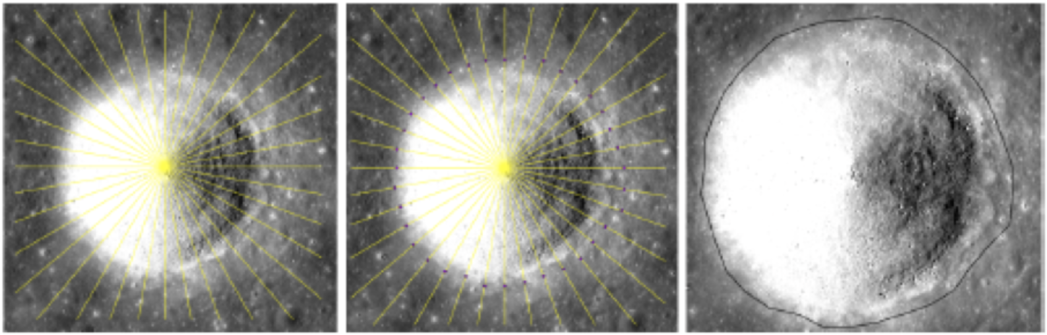
Figure 1. Method used to identify the crater rim. Left) Profiles run through the lowest elevation point are created every 10˚. Middle) The highest elevation points on either side of the lowest elevation point for each profile are identified as belonging to the crater rim crest. Right) The crater rim crest polygon runs through the 36 rim points identified.
Basilevsky (1976) originally proposed to classify craters into five morphological classes (A, AB, B, BC, C). These classes correspond to different degradation states, ranging from fresh (class A) to degraded (class C) [Basilevsky, 1976]. This classification scheme has been adapted through the years to include visual interpretation (e.g., the presence of a visible ejecta) which introduces some subjectivity and manual labor (e.g., Stopar et al., 2017). In this work, we introduce a new “freshness” parameter, with values ranging from 0 to 1 (Figure 2) derived from DTM values, eliminating inter-class effects, subjectivity and manual labor. The freshness parameter aligns with previous classifications schemes [Basilevsky & al.,1976; Stopar & al.,2017], where a value of 0 represents degraded craters (e.g., class C) and a value of 1 fresh craters (e.g., class A). Our Freshness parameter is calculated as follows :

With n the number of half profiles (which is always paired by construction), θmax the maximum angle of repose and si and RHi respectively the slope and the Rim height of the i th profile.
If a crater exhibits a continuous visible rim (i.e., Class A), its freshness parameter value will be ≥0.66. If a crater has no visible rim (i.e., Class C), its freshness parameter value cannot exceed 0.34. If a crater has 50% of its rim visible and a median slope close to θmax, its freshness parameter value will be approximately 0.66 (i.e., Class BC) (Figure 2).
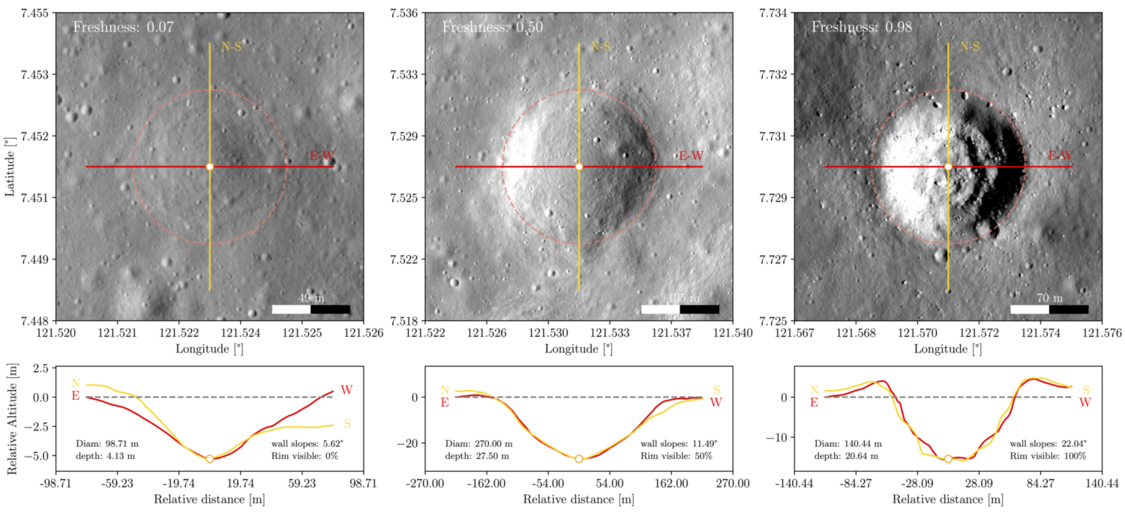
Figure 2. Evolution of the freshness parameter, from degraded craters (freshness <0.10, left) to well-preserved craters (freshness ∼1, right), with an intermediate example (freshness ∼0.5, middle). For each crater, two rim profiles were computed: north--south (top) and east--west (bottom). High freshness parameter values correspond to craters with fully visible rims and wall slopes exceeding 20°. Conversely, low freshness parameter values are associated with craters exhibiting no visible rim and very gentle slopes.
Application example at Reiner Gamma
We used Digital Terrain Models (DTMs) derived from Lunar Reconnaissance Orbiter Camera (LROC NAC) stereo images, with spatial resolutions from 2 to 5 meters, to study crater morphology in the Reiner Gamma and Mare Ingenii regions [Lemelin & al., 2026]. We used a YOLOv5-based model to automatically detect craters in hillshade images derived from the DTMs and ran MorphyPy on the craters detected. The depth-to-diameter (d/D) ratios of small lunar craters (D<400 m) is particularly important for constraining upper regolith properties. In the Reiner Gamma area, we have shown that fresh craters (between 0.8 and 1 freshness parameter) exhibit d/D ratios of ~0.1–0.19, while larger more degraded craters (freshness parameter ≤0.5) display ratios with less than 0.08. In the Mare Ingenii region, we found almost the same results with a d/D ratio 10% lower. Those preliminary results are consistent with what is found in the literature [Stopar & al.,2017, Basilevsky,1976].
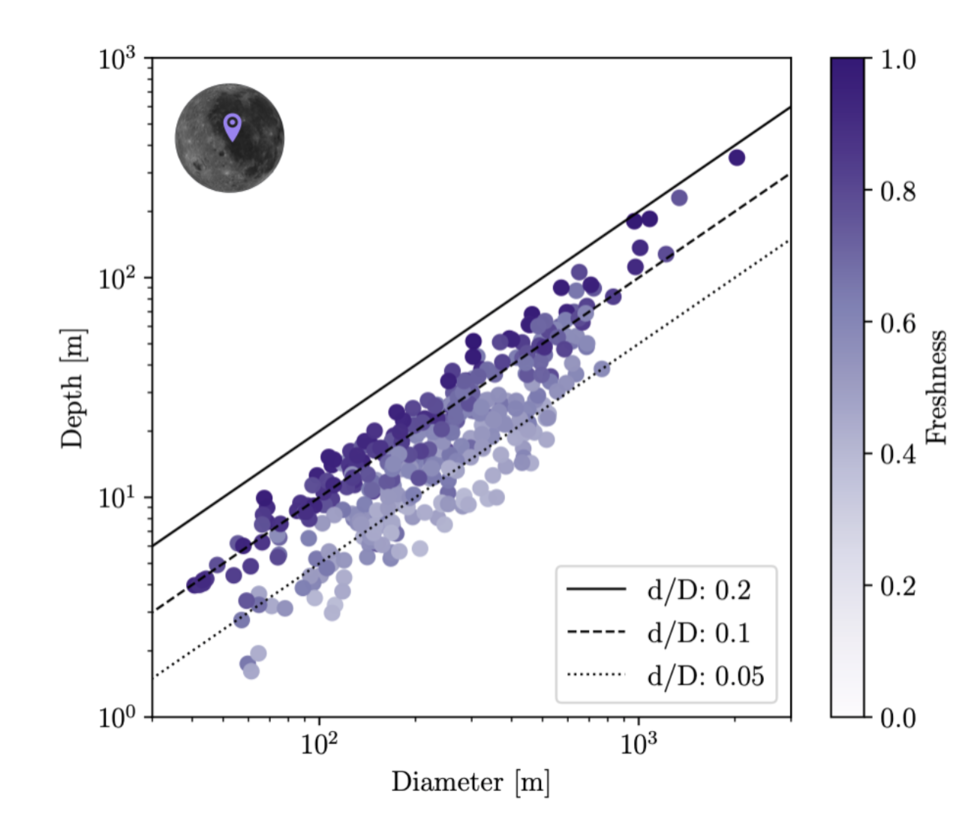
Figure 3. Depth versus diameter for all craters detected by Lemelin et al. (2026) at Reiner Gamma with respect to freshness scale.
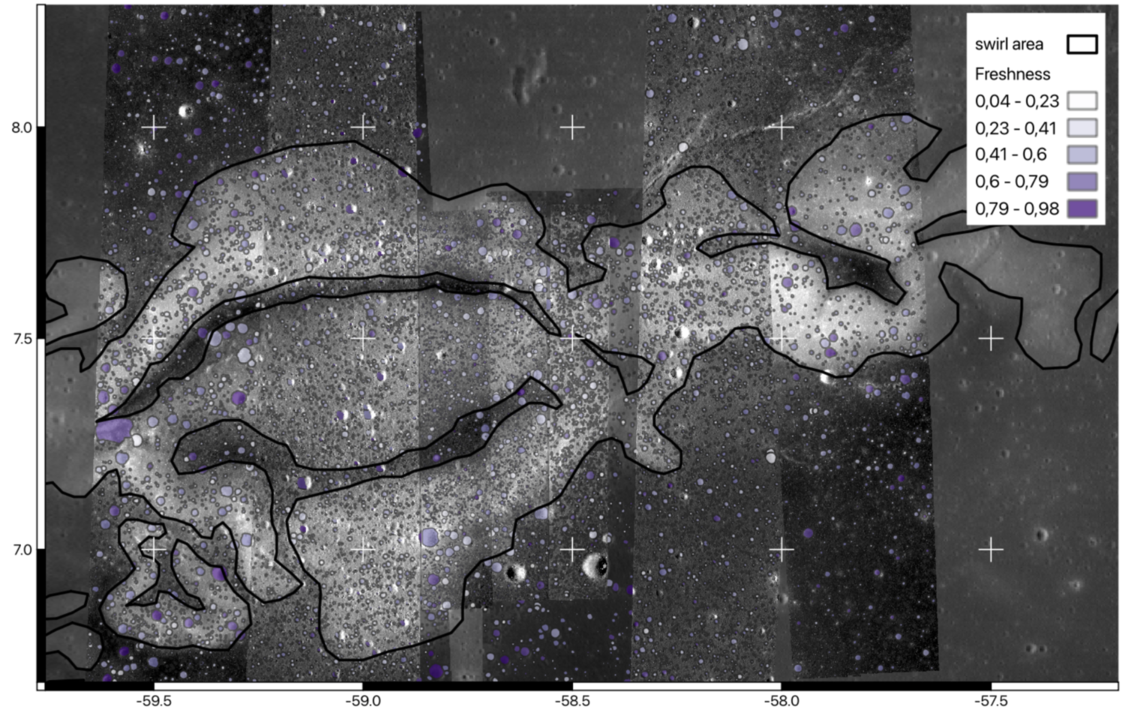
Figure 4. Crater detected by Lemelin et al. (2026) in the Reiner Gamma area with freshness parameter values represented in the purple color gradient.
Conclusion
MorphoPy represents a significant advancement in the standardized, automated analysis of impact crater morphology, including d/D calculations and a new robust freshness parameter. MorphoPy’s standardized depth-to-diameter (d/D) ratio calculations enable the confident use of these ratios in planetary surface analyses. This is particularly valuable when processing large datasets, such as those required for topographic diffusion models, which describe how erosive processes modify crater morphology over time. With the increased availability of high spatial resolution DTMs generated from LROC NAC images, MorphoPy will provide new valuable insights regarding the morphology of small impact craters on the Moon. MorphoPy could also be used to characterize larger craters on the Moon using coarser DTMs, and craters elsewhere in the Solar System such as on Mars or Mercury. Consequently, MorphoPy could be a highly valuable tool to conduct comparative impact cratering research across the Solar System, improving our understanding of planetary surface evolution.
How to cite: Martinez, L., Lemelin, M., Calas, G., Lagneaux, A., Belleau-Magnat, G., and Bickel, V. T.: Morphopy: A new tool for impact crater morphological analyses, Europlanet Science Congress 2026, The Hague, The Netherlands, 7–11 Sep 2026, EPSC2026-726, https://doi.org/10.5194/epsc2026-726, 2026.


