
 1,2,3,2,6,
- 1Instituto de Astrofísica de Andalucía - CSIC - CIF, Granada, Spain (attree@iaa.csic.es)
- 2Department of Earth, Environmental, and Planetary Sciences, Brown University, Providence, RI, USA
- 3Physikalisches Institut, Sidlerstr. 5, University of Bern, CH-3012, Bern, Switzerland
- 4Institut für Geophysik und Extraterrestrische Physik, Technische Universität Braunschweig, Mendelssohnstr. 3, D-38106 Braunschweig, Germany
- 5Max-Planck-Institut für Sonnensystemforschung, Justus-von-Liebig-Weg 3, D-37077 Göttingen, Germany
- 6Aix Marseille Univ, CNRS, CNES, Laboratoire d’Astrophysique de Marseille, Marseille, France
Understanding the activity of comets, including their temporally- and spatially-varying rates of outgassing and dust ejection, as well as how these relate to nucleus surface properties, remains a challenge for our models of cometary structure and material. In particular, thermophysical models (TPMs) with constant properties, such as dust-mantle thicknesses, have been shown to struggle to reproduce observations made by ESA’s Rosetta spacecraft at comet Churyumov/Gerasimenko (67P) [1]. Meanwhile, 67P's nucleus surface morphology shows large differences in dust coverage between the northern and southern hemispheres [2, 3], likely driven by the strong variations in insolation due to its obliquity [4]. Modelling of 67P's outgassing-induced non-gravitational forces and torques also suggests a connection between activity level, surface terrrain, and seasonal effects [5]. Taken together, these correlations suggest that a coupled model may help to explain the data: i.e., one capable of simultaneously simulating the sublimation of ice from beneath a dust mantle, and its momentum transfer, as well as the dynamic changes in said mantle's thickness due to dust ejection and redeposition. We will present the first steps towards building such a model. In particular, we will present recently published work [6] using ballistic trajectory modelling to elucidate the dust-transport pathways that shape the distribution of sediment deposits on 67P. Here, different regimes of local and global dust-redistribution are shown to be dependent on ejection velocity, while observed patterns between and within the different surface regions are reproduced. We will conclude with the current status of efforts to couple these dust-transport maps with a dynamic TPM [7] in an attempt to simultaneously reproduce 67P’s terrain distribution, total outgassing rate, and non-gravitational forces and torques. Such a combined model will have implications for analysing the activity and surface morpholgies of other resolved comets, and for inferring details of unresolved ones.
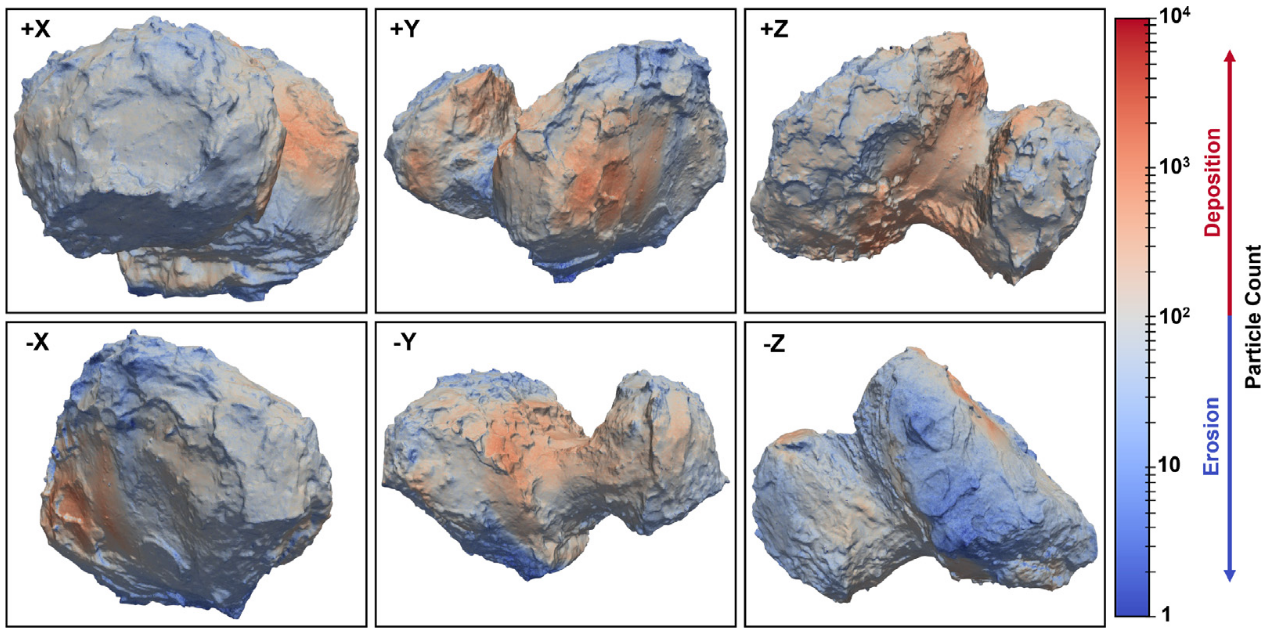
Fig 1. Global sediment redistribution at moderate ejection velocity from [6]. Results of simulations initialized with ∼100 particles per facet, showing the number of particles remaining on each facet of 67P’s shape model after 10 hops at an ejection velocity of 0.5 m s−1. Sediment transport at this velocity involves near-global redistribution driven primarily by the comet’s shape and rotation. Regions that intercept and accumulate material act as ‘‘collectors,’’ while those shielded from incoming trajectories form ‘‘shadow zones’’ with minimal deposition. These interactions establish the global sediment pathways that connect 67P’s distinct geomorphic units.
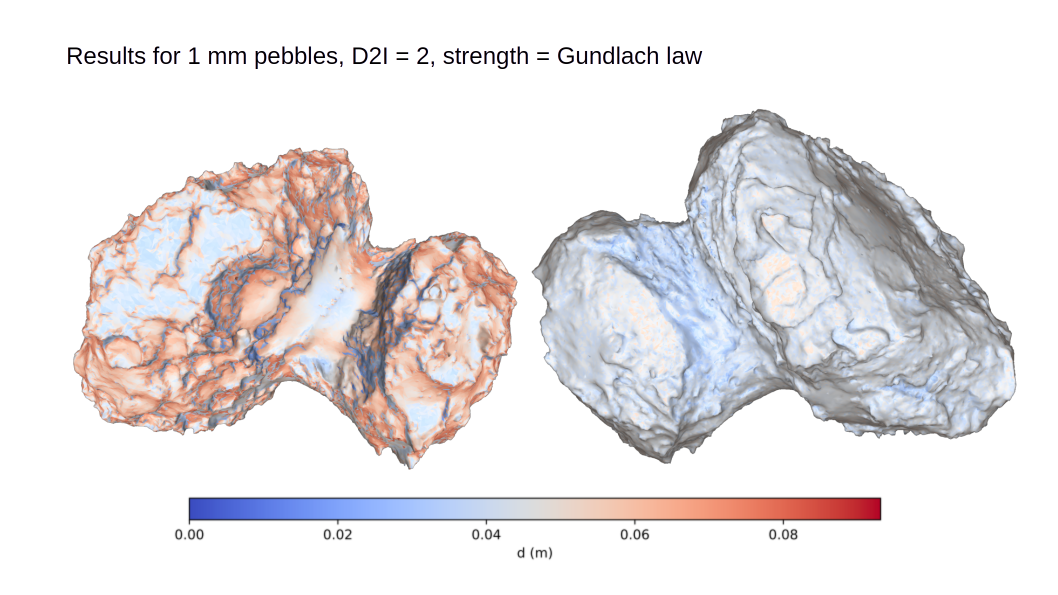
Fig 2. Preliminary results from a TPM with a dynamically varying dust depth driven by dehydration and ejections (currently no fallback). The plots show views of the dust-mantle depth (in metres) across 67P’s northern and southern hemispheres at the end of a simulation run over the Rosetta period.
[1] Skorov et al. MNRAS, 2020, 494, 3, 3310-3316
[2] El-Maarry et al., A&A 583, A26, 2015
[3] Birch et al, MNRAS 469, S50–S67, 2017
[4] Keller et al., A&A 583, A34, 2015
[5] Attree, N., P Gutiérrez, O Groussin,, A&A, 2024a, 690, A82
[6] Jindal et al., Icarus 455, 117099, 2026
[7] Shi et al., ApJL, 961 L16, 2024
How to cite: Attree, N., Jindal, A., Marschall, R., Birch, S., Skorov, Y., Groussin, O., and Gutierrez, P.: Coupling outgassing, dust-transport, and non-gravitational force models for cometary activity, Europlanet Science Congress 2026, The Hague, The Netherlands, 7–11 Sep 2026, EPSC2026-73, https://doi.org/10.5194/epsc2026-73, 2026.


