

- AOPP, Clarendon Laboratory, University of Oxford, UK (henry.eshbaugh@physics.ox.ac.uk)
The discovery of widespread hydration across the lunar surface [1,2,3] is one of the most surprising results of the last twenty years in the field of planetary science. Further considerations have extended to exospheric migration of water on other airless bodies, such as Mercury and Ceres [4]; other works have considered the coupling of multiple volatile species within the lunar volatile inventory [5,6], or have considered the icy moons of the outer Solar System [7], with the seasonal migration of CO2 on the Uranian moon Ariel [8,13] being one such example.
A difficulty in modelling volatile transport is the interplay between various physical and chemical processes, including adsorption kinetics, photochemistry, and transport kinematics. Hence, Monte Carlo modelling has remained the dominant mode of investigation, producing qualitative outputs surveying emergent phenomena. The development of a comprehensive and quantitative forward-modelling approach has remained an outstanding problem.
To produce such a model, we turn to Markov processes [9]. The governing equations of these processes generate, via Kramers-Moyal expansion [10], such familiar results as the Fokker-Planck, continuity, and diffusion equations.
We derive a Markov master equation for a global volatile ensemble from mass-balance. With straightforward probability theory, we model adsorption kinetics at a molecular level, and ballistic transport on a global scale, providing an integrated analytic approach to global volatile dynamics.
Going further, we use tensor products between Markov processes [11,12] to model the interplay between volatile species, allowing for capture of kinetic schemes driven by surficial and photochemical reactions.
We implement a simplified, straightforward model. The global ensemble was taken to be 10^30 water molecules. 4200 timesteps per lunation are calculated for 100,000 timesteps - approximately 607 seconds per timestep. We neglect implantation and loss mechanisms as well as topography. We use an analytic model of lunar surface temperatures [14]. Desorption probabilities are calculated from the Eyring-Polanyi equation [15,16], with an activation energy of 0.7 eV. The Armand distribution [17,18] drives ballistic-hop transport.
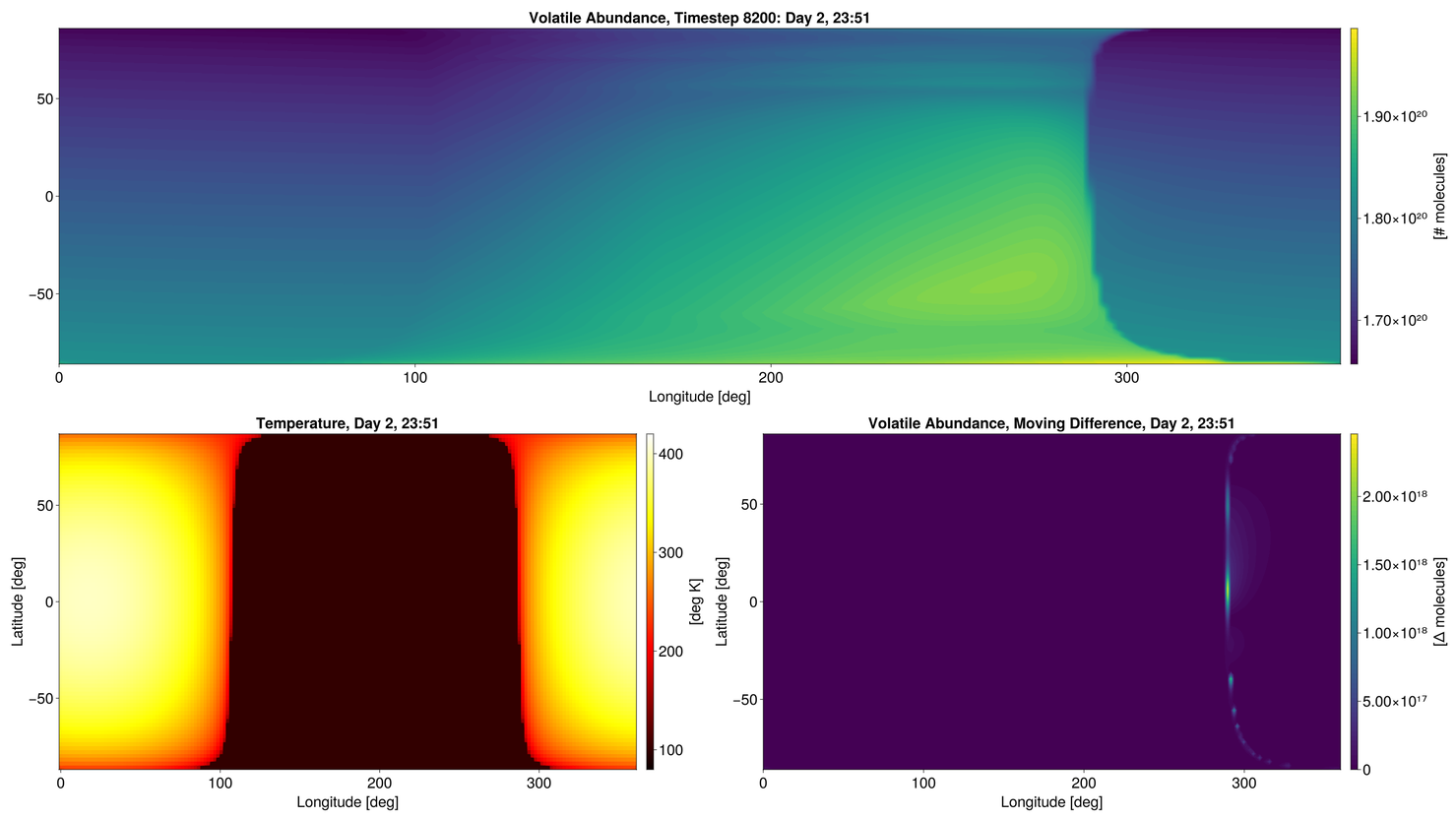
Figure 1: Lunar surficial water abundance; simplified model run, timestep 8200.
Timestep 8200 is shown in Figure 1. Volatile concentration is heightened in the southern winter. The initial volatile distribution was random; onset of equilibrium conditions is rapid. A dusk-dawn asymmetry is present, reproducing the results of Schörghofer [19]. Latitudinal stratification is visible, with the band of minimal concentration dependent on solar declination.
We conclude by presenting paths forward in volatile modelling efforts enabled by this approach.
[1] Pieters, C.M., Goswami, J.N., Clark, R.N., Annadurai, M., Boardman, J., Buratti, B., Combe, J.P., Dyar, M.D., Green, R., Head, J.W. and Hibbitts, C., 2009. Character and spatial distribution of OH/H2O on the surface of the Moon seen by M3 on Chandrayaan-1. science, 326(5952), pp.568-572.
[2] Sunshine, J.M., Farnham, T.L., Feaga, L.M., Groussin, O., Merlin, F., Milliken, R.E. and A’Hearn, M.F., 2009. Temporal and spatial variability of lunar hydration as observed by the Deep Impact spacecraft. Science, 326(5952), pp.565-568.
[3] Clark, R.N., 2009. Detection of adsorbed water and hydroxyl on the Moon. Science, 326(5952), pp.562-564.
[4] Schörghofer, N., Benna, M., Berezhnoy, A.A., Greenhagen, B., Jones, B.M., Li, S., Orlando, T.M., Prem, P., Tucker, O.J. and Wöhler, C., 2021. Water group exospheres and surface interactions on the Moon, Mercury, and Ceres. Space Science Reviews, 217(6), p.74.
[5] Huebner, W.F. and Mukherjee, J., 2015. Photoionization and photodissociation rates in solar and blackbody radiation fields. Planetary and Space Science, 106, pp.11-45.
[6] Smolka, A., Nikolić, D., Gscheidle, C. and Reiss, P., 2023. Coupled H, H2, OH, and H2O lunar exosphere simulation framework and impacts of conversion reactions. Icarus, 397.
[7] Steckloff, J.K., Goldstein, D., Trafton, L., Varghese, P. and Prem, P., 2022. Exosphere-mediated migration of volatile species on airless bodies across the solar system. Icarus, 384, p.115092.
[8] Cartwright, R.J., Nordheim, T.A., DeColibus, R.A., Grundy, W.M., Holler, B.J., Beddingfield, C.B., Sori, M.M., Lucas, M.P., Elder, C.M., Regoli, L.H. and Cruikshank, D.P., 2022. A CO2 Cycle on Ariel? Radiolytic production and migration to low-latitude cold traps. The Planetary Science Journal, 3(1), p.8.
[9] Livi, R. and Politi, P., 2025. Nonequilibrium Statistical Physics: a Modern Perspective. 2nd edition. Cambridge University Press.
[10] Kramers, H.A., 1940. Brownian motion in a field of force and the diffusion model of chemical reactions. physica, 7(4), pp.284-304.
[11] Dayar, T., 2012. Analyzing Markov chains using Kronecker products: theory and applications. Springer Science & Business Media.
[12] Giry, M., 2006, October. A categorical approach to probability theory. In Categorical Aspects of Topology and Analysis: Proceedings of an International Conference Held at Carleton University, Ottawa, August 11–15, 1981 (pp. 68-85). Berlin, Heidelberg: Springer Berlin Heidelberg.
[13] Grundy, W.M., Young, L.A., Spencer, J.R., Johnson, R.E., Young, E.F. and Buie, M.W., 2006. Distributions of H2O and CO2 ices on Ariel, Umbriel, Titania, and Oberon from IRTF/SpeX observations. Icarus, 184(2), pp.543-555.
[14] Crider, D.H. and Vondrak, R.R., 2000. The solar wind as a possible source of lunar polar hydrogen deposits. Journal of Geophysical Research: Planets, 105(E11), pp.26773-26782.
[15] Eyring, H., 1935. The activated complex in chemical reactions. The Journal of chemical physics, 3(2), pp.107-115.
[16] Evans, M.G. and Polanyi, M., 1935. Some applications of the transition state method to the calculation of reaction velocities, especially in solution. Transactions of the Faraday Society, 31, pp.875-894.
[17] Armand, G., 1977. Classical theory of desorption rate velocity distribution of desorbed atoms; possibility of a compensation effect. Surface Science, 66(1), pp.321-345.
[18] Schörghofer, N., 2022. Statistical thermodynamics of surface-bounded exospheres. Earth, Moon, and Planets, 126(2), p.5.
[19] Schorghofer, N., 2014. Migration calculations for water in the exosphere of the Moon: Dusk‐dawn asymmetry, heterogeneous trapping, and D/H fractionation. Geophysical Research Letters, 41(14), pp.4888-4893.
How to cite: Eshbaugh, H. and Bowles, N.: Stochastic Modelling of Volatile Transport in Surface-Bound Exospheres, Europlanet Science Congress 2026, The Hague, The Netherlands, 7–11 Sep 2026, EPSC2026-737, https://doi.org/10.5194/epsc2026-737, 2026.


