
 12
12- 1Sorbonne Université, LATMOS, Paris, France (maxence.lefevre@latmos.ipsl.fr)
- 2Istituto Nazionale di Geofisica e Vulcanologia, Sezione di Pisa, Pisa, Italy
Introduction
On Venus, 85,000 volcanic edifices have been identified (Hahn and Byrne, 2023), and between 40 and 120 per Earth year could be active (Byrne and Krishnamoorthy, 2022; van Zelst, 2022). The question of volcanism is central to determining the long-term and recent evolution of the atmosphere (Gillmann et al., 2022). The climatic impact of volcanic outgassing on Venus is not known, but the sulphuric acid cloud deck, between 47 and 70 km, could be maintained through a supply of SO2 gas (Bullock and Grinspoon, 2001). Volcanic plume destabilising the cloud chemistry is the main hypothesis for the periodical variations of mesospheric SO2 (Esposito, 1984; Marcq et al., 2013). Recent analysis of Magellan images showed geomorphological variations over a few months (Herrick and Hensley, 2023; Sulcanese et al., 2024), and hot spots have been observed by Venus Express, both suggesting possible present volcanic activity (Smrekar et al., 2010; Shalygin et al., 2015). Nevertheless, the characteristics of volcanic plumes on Venus remain unknown (Wilson et al., 2024).
The study of the exotic, hot, sulphur cycle of Venus is a priority of the European, U.S. and international scientific community, with the observations of active volcanism the primary target. The ESA’s EnVision, and two NASA missions, DAVINCI (Garvin et al., 2022) and VERITAS, were all three selected to launch around 2031. It is therefore important to constrain volcanic plume dynamics on Venus.
Lefèvre et al. (2025) adapted a 1D eruption column for Venus, and showed that explosive volcanism would preferably reach 15 km of altitude, and that the super-rotating winds have a substantial impact by plume-bending of reducing the height of plumes. However, discrepancies between 1D and 3D are known for Earth volcanic plumes (Costa et al., 2016), especially for complex features of strong plumes. We propose to adapt a 3D plume model for the Venusian environment to resolve the vertical propagation of strong plume.
Model
The ASHEE solver (Cerminara et al., 2016) is conceived to numerically simulate the dynamics of compressible multiphase flows, focusing on volcanic plumes and dilute pyroclastic density currents, i.e. gas-particle mixtures with multiple gas components and solid particle classes for pyroclasts modelling. The equations solved are the continuity equations for all the phases, the momentum and energy of the mixture, and the equations for the dynamic LES model. The ASHEE was adapted for Venus, and for the first time in 3D, the vertical propagation of volcanic plumes is resolved.
Results
Under extreme vent conditions (mass flow rate, exit temperature and velocity), the 3D plume can reach the clouds (48-70 km), as seen in Fig 1. There are significant discrepancies between the height reached by the plume in 1D versus 3D. The parametrization of entrainment between the plume and ambient air in the 1D is valid for the Earth atmosphere but not valid for the Venus environment. The impact of the wind shear, volatile mass fraction and composition will be assessed. The generation of secondary plumes will be discussed. The volatile flux from the plume into the atmosphere will be presented.
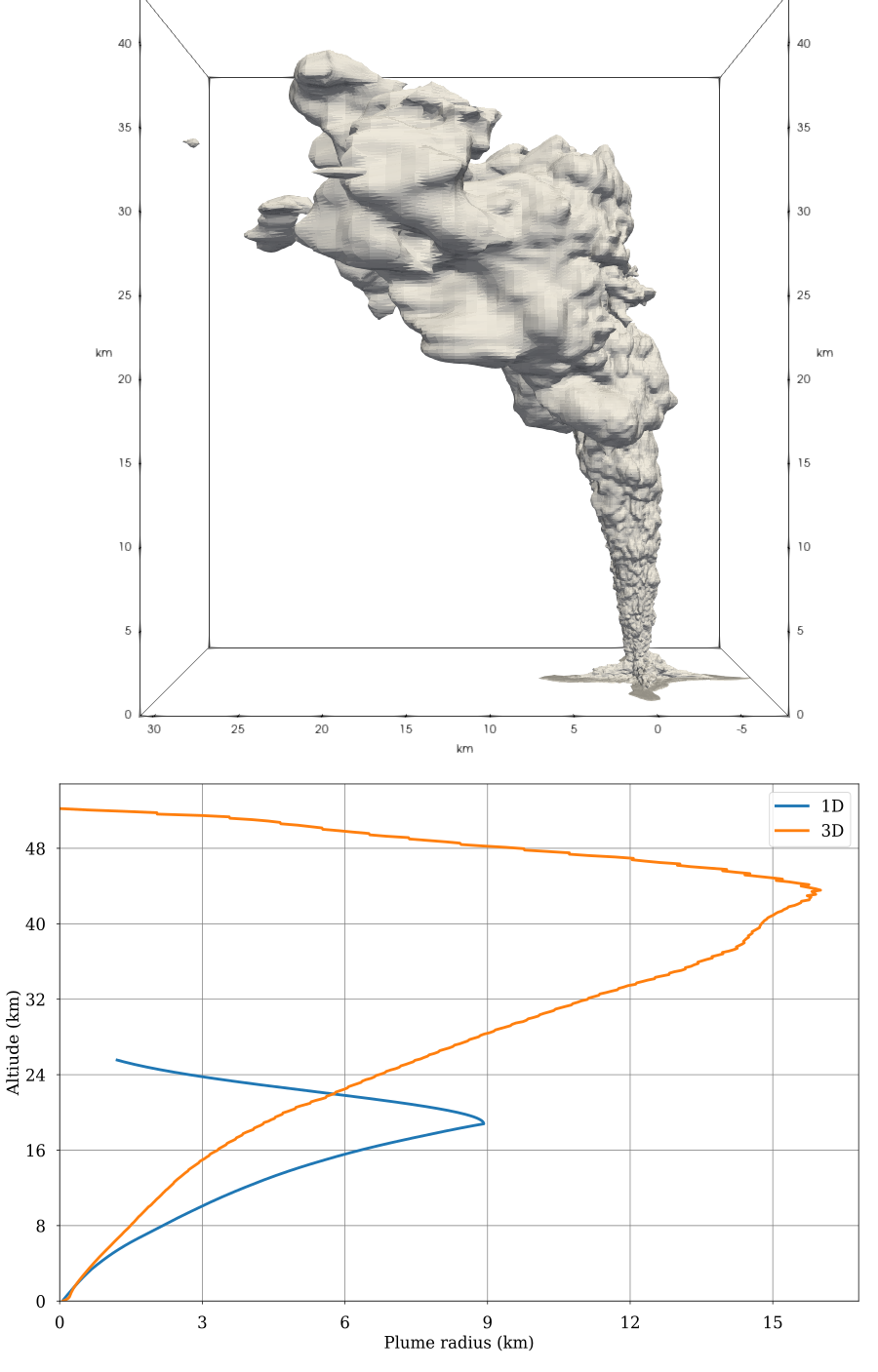
Figure 1: Top: contour for ash. Bottom: Vertical profile of the plume radius. The two panels are for a mass flow rate of 109 kg/s, an exit temperature of 1600 K, an exit velocity of 280 m/s and a 5%wt volatile composed of water with the 1D and 3D model.
Volcanic eruptions generate a spectrum of waves in the atmosphere, from infrasound to gravity waves. The characteristics of those waves were never established for Venus and will be shown. The dispersion of the ash solid particle on the radar reflectivity will be discussed.
References
- Bullock, M. A., & Grinspoon, D. H. (2001). Icarus, 150:19–37.
- Byrne, P. K., & Krishnamoorthy, S. (2022). Journal of Geophysical Research: Planets, 127(1):e2021JE007040.
- Cerminara, M., Esposti Ongaro, T., & Berselli, L. C. (2016). Geoscientific Model Development, 9:697–730.
- Costa, A., Suzuki, Y. J., Cerminara, M., et al. (2016). Journal of Volcanology and Geothermal Research, 326:2–25.
- Esposito, L. W. (1984). Science, 223:1072–1074.
- Garvin, J. B., Getty, S. A., Arney, G. N., et al. (2022). The Planetary Science Journal, 3(5):117.
- Gillmann, C., Way, M. J., Avice, G., et al. (2022). Space Science Reviews, 218(7):56.
- Hahn, R. M., & Byrne, P. K. (2023). Journal of Geophysical Research (Planets), 128:e2023JE007753.
- Herrick, R. R., & Hensley, S. (2023). Science, 379:1205–1208.
- Lefèvre, M., Cerminara, M., & Costa, A. (2025). Journal of Geophysical Research: Planets, 130(10):e2025JE009320.
- Marcq, E., Bertaux, J.-L., Montmessin, F., et al. (2013). Nature Geoscience, 6:25–28.
- Shalygin, E. V., Markiewicz, W. J., Basilevsky, A. T., et al. (2015). Geophysical Research Letters, 42:4762–4769.
- Smrekar, S. E., Stofan, E. R., Mueller, N., et al. (2010). Science, 328:605.
- Sulcanese, D., Mitri, G., & Mastrogiuseppe, M. (2024). Nature Astronomy, 8:973–982.
- van Zelst, I. (2022). Journal of Geophysical Research: Planets, 127(12):e2022JE007448.
- Wilson, C. F., Marcq, E., Gillmann, C., et al. (2024). Space Science Reviews, 220:31
How to cite: Lefevre, M. and Cerminara, M.: 4D modelling volcanic plume on Venus, Europlanet Science Congress 2026, The Hague, The Netherlands, 7–11 Sep 2026, EPSC2026-75, https://doi.org/10.5194/epsc2026-75, 2026.


