
 1,
1,- 1Massachusetts Institute of Technologoy, Earth, Atmospheric & Planetary Sciences, United States of America (gfanson@mit.edu)
- 2Planetary Science Institute
Introduction: Extensive valley networks on Mars record some of the strongest evidence for ancient, sustained water flow on the surface [1]. Encoded in the morphology of these valley networks are quantitative constraints on paleohydrology and, by extension, habitable atmospheric conditions on early Mars [2]. These constraints include key metrics such as the volume of water required to carve them [3-5] and the aridity of the climate in which they formed [6,7]. Estimates of these values made in previous studies [3-5] rely on current valley morphology. However, valley morphologies are likely to have been altered since their formation (>3.5 Ga). In particular, impacts are destructive geomorphic events that can reshape landscapes [8]. Given the ubiquity and destructive nature of impacts, we hypothesize that: (i) the global record of valley networks is incomplete to a non-negligible extent, (ii) larger fluvial features (e.g., flood canyons) are preferentially preserved over smaller features (e.g., higher-order tributaries), and (iii) drainage densities on Mars may be reduced relative to their initial values.
These hypotheses are motivated by several observations. First, impacts can remove portions of valley networks and have the potential to erase extensive global features such as the ancient Martian shoreline [8]. Second, flood canyons represent 24% of the eroded volume on Mars, but only 3% of the valley length [9]. The disparity between spatial extent and total eroded volume suggests that large features could be more resistant to destruction than their shallower counterparts. Third, drainage densities of Martian valley networks resemble those formed in terrestrial arid climates [6]. Impact events may have reduced drainage density, influencing how we interpret the Martian paleoclimate.
We test these hypotheses by modeling the effects of impact events on valleys, reconstructing the pre-impact distribution of valley depths on Mars, and assessing alterations to eroded volume and drainage density. In addition to shedding light on how craters act as geomorphic agents, our results provide an improved understanding of the relative importance of catastrophic fluvial events, and how valley geometries reflect paleo-climate metrics.
Methods: To quantify the preservation of valley networks on Mars, we create a cratering model to simulate 3.5 billion years of impacts at Mars-like impact rates [10]. We begin with un-cratered (pre-impact) terrain that represents the Martian surface at the end of the valley forming era. We use terrain from an analog site on the Kohala Peninsula, in Hawaiʻi, which contains a wide variety of valley depths, ranging from meters up to a kilometer in depth.
For study site, we calculate the size distribution of impact craters expected on Mars since 3.5 Ga and randomly place them on the terrain. Impactors that form small craters compared to the valley they strike do less damage than a comparatively larger impact. For this reason, our model compares the relative size of the impact crater to the valley to determine whether the valley survives impacting.
We quantify how valley depths are modified in the cratering simulation and apply these results to the measured Martian valley depth frequency distribution to reconstruct the pre-impact frequency distribution. This distribution can then be used to reconstruct the total eroded volume at the end of the valley forming era.
Results: Our model placed ~2.5106 craters ranging from ~10 m to ~3,000 m on sample topography representing Mars. By comparing the topography of emplaced impact craters and valley depths, the model removed portions of the valley networks (Figure 1). In total, ~90% of valley pixels were classified as “destroyed” by the model. In particular, shallower portions of valleys were preferentially removed, supporting Hypothesis ii. For example, the presence of valleys in the western portion of the depth map in Figure 1d is reduced compared to the original depth map in Figure 1b, while the large canyons in the east are almost entirely preserved.
After reconstructing the pre-impact frequency distribution of valley depths, we calculate the global eroded volume of the valley networks to be ~19.5% greater than today’s measured eroded volume. While this is an increase in volume, compared to the overall scale of valley formation, it does not substantially alter our understanding of the extent of the valleys, contrary to Hypothesis i.
Finally, we found an overall decrease in drainage density. Tributaries are the primary drivers of drainage density but they are often shallower than the main trunk. If shallower features are indeed more vulnerable to destruction from impacts, it makes physical sense that drainage density would be reduced. This result supports Hypothesis iii.
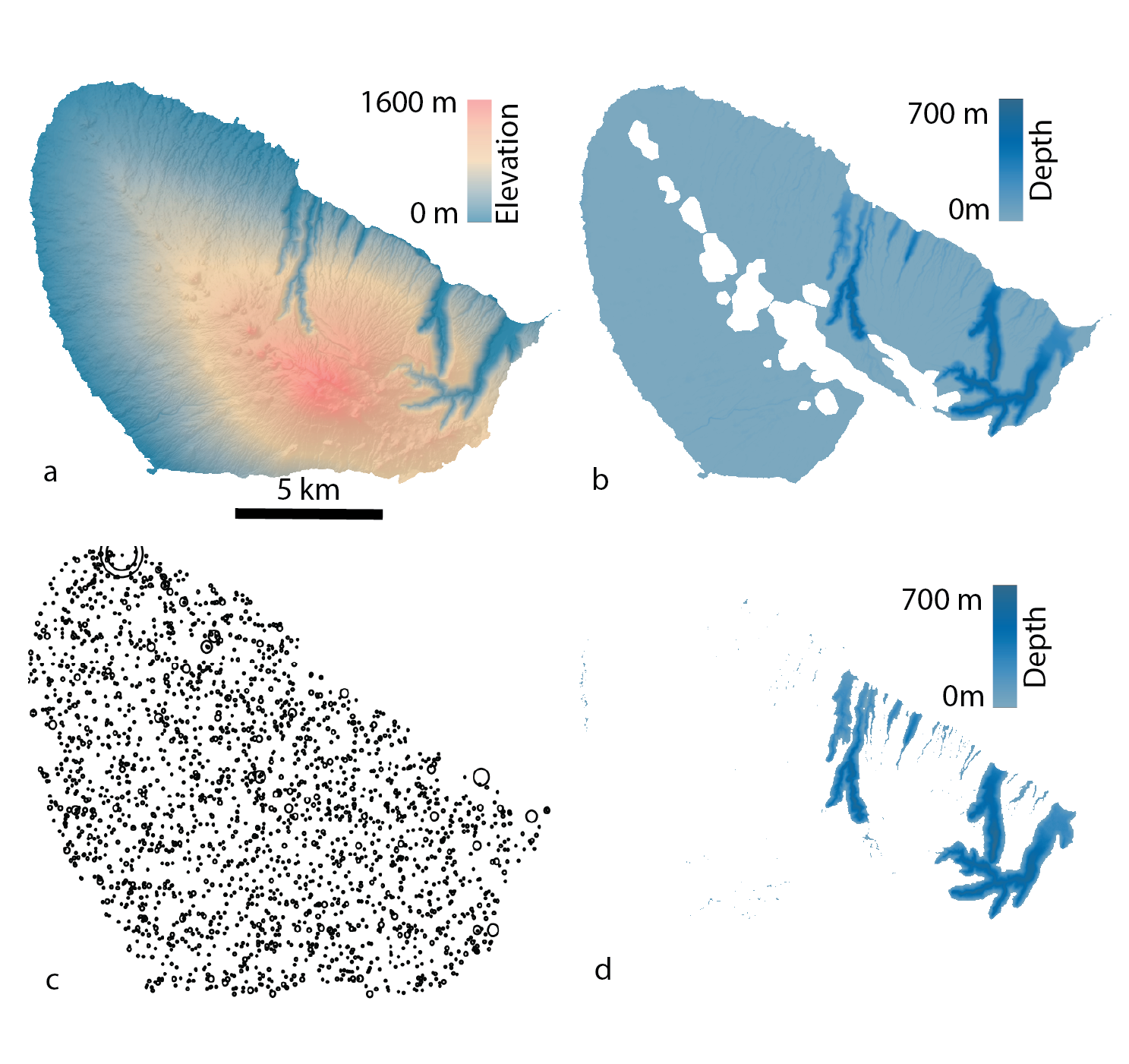
Figure 1: Terrain before and after cratering simulation. (a) Kohala topography hillshade (DEM obtained from USGS); (b) Kohala pre-impact depth map; (c) impact craters (> 0.1 km); (d) Kohala post-impact depth map.
Conclusion: Impact cratering modifies the preservation of Martian valley networks. This result modeled and used to reconstruct their pre-impact eroded volume. Our results show that preservation is depth dependent, with valleys deeper than ~200 m surviving billions of years of impacts, while shallower valleys are preferentially filled in or destroyed.
References:
[1] Hoke, M. R. T. et al. (2011), Earth and Planetary Science Letters, doi:10.1016/j.epsl.2011.09.053.
[2] Kite, E. S., and Conway, S. (2024), Nature Geoscience, doi:10.1038/s41561-023-01349-2.
[3] Rosenberg, E. N. et al. (2019), Icarus, doi:10.1016/j.icarus.2018.07.017.
[4] Rosenberg, E. N., and Head, J. W. (2015), Planetary and Space Science, doi:10.1016/j.pss.2015.08.015.
[5] Luo, W. et al. (2017), Nature Communications, doi:10.1038/ncomms15766.
[6] Carr, M. H., and Chuang, F. C. (1997), Journal of Geophysical Research: Planets, doi:10.1029/97JE00113.
[7] Seybold, H. J. et al. (2018), Science Advances, doi:10.1126/sciadv.aar6692.
[8] Baum, M. et al. (2022), Icarus, doi:10.1016/j.icarus.2022.115178.
[9] Goudge, T. A. et al. (2021), Nature, doi:10.1038/s41586-021-03860-1.
[10] Michael, G. G. (2013), Icarus, doi:10.1016/j.icarus.2013.07.004.
How to cite: Fanson, G., Morgan, A., and Stucky de Quay, G.: Quantifying the Effects of Impact Cratering on the Preservation of Martian Valley Networks, Europlanet Science Congress 2026, The Hague, The Netherlands, 7–11 Sep 2026, EPSC2026-750, https://doi.org/10.5194/epsc2026-750, 2026.


