
 1,2,3,5,1,1,1
- 1São Paulo State University, UNESP, dept. of Mathematics, Guaratinguetá, Brasil (valerio.carruba@unesp.br)
- 2Laboratório Interinstitucional de e-Astronomia, LIneA, RJ 20765-000, Brazil
- 3Universidad de Atacama, UDA, Instituto de Astronomía y Ciencias Planetarias, Copayapu 485, Copiapó, Chile
- 4São Paulo State University, UNESP, Instituto de Geociências e Ciências Exatas, Rio Claro, SP 13506-900, Brasil
- 5São Paulo State University, UNESP, School of Engineering, São João da Boa Vista, SP, 13876-750, Brasil
Mean-motion resonances (MMRs) play a central role in shaping the dynamical evolution of small bodies in the solar system. In Near-Earth Object (NEO) populations, identifying resonant configurations is particularly challenging due to the large number of possible resonances and the chaotic nature of asteroid orbits. Traditional methods rely on computing and inspecting resonant arguments for many candidate resonances, which becomes computationally expensive for large datasets.
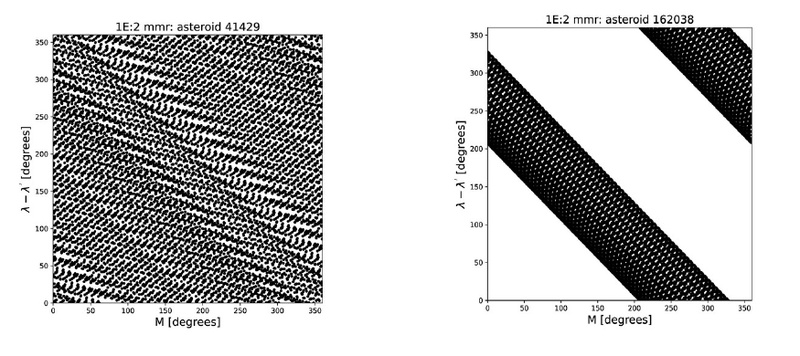
Fig. 1: Examples of orbits in circulating and librating state in the (σ, M) phase space
To address this challenge, we present ML-FAIR, a fully automated machine-learning implementation of the Fast Identification of Mean-Motion Resonances (FAIR) method (Forgács-Dajka et al. 2018). FAIR exploits the geometric structure of resonant motion in the (σ, M) phase space, where σ is either λₚ−λ for inner resonances or λ−λₚ for outer resonances, with p denoting a planet, and M the asteroid mean anomaly. Instead of directly analyzing resonant arguments, it identifies resonance configurations through characteristic stripe patterns in angular plots. The number of stripe intersections with coordinate axes encodes the resonance integers, enabling rapid identification of candidate resonances (see Fig. 1).
ML-FAIR transforms this geometrical method into a scalable pipeline using unsupervised machine learning. Resonance detection is recast as identifying structured patterns in angular distributions. Two variables, σ@(M = 0) and M@(σ = 0), capture the angular intersections that define the FAIR method. A density-based pre-classification separates circulating (non-resonant) orbits from candidate resonant cases using angular coverage metrics, automatically discarding a large fraction of non-resonant objects.
For the remaining objects, ML-FAIR applies unsupervised clustering techniques to detect peaks in angular distributions. We tested DBSCAN, OPTICS, and circular kernel density estimation (KDE). KDE with peak detection performed best overall, especially for complex or switching orbits, while OPTICS complements it in ambiguous cases. An ensemble of both methods provides robust identification of peak structures corresponding to stripe intersections.
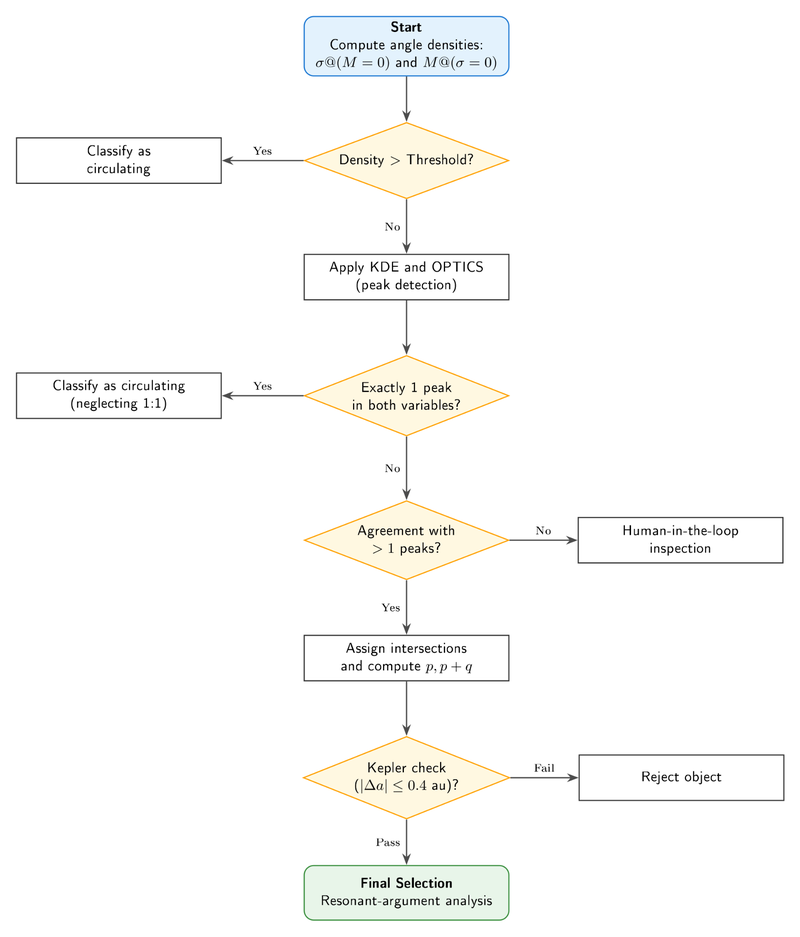
Fig. 2: Flowchart of the machine-learning-enhanced FAIR procedure.
The ML-FAIR pipeline proceeds through the following (see Fig. 2):
(1) density-based classification of circulating orbits;
(2) peak detection via clustering methods;
(3) decision logic combining multiple algorithms;
(4) reconstruction of resonance ratios; and
(5) a physical consistency assessment based on orbital parameters. Objects that pass all steps are then validated through traditional resonant-argument analysis.
We apply ML-FAIR to the Atira and Aten asteroid populations (a < 1 au), which interact with a dense “forest” of resonances with terrestrial planets. Our dataset consists of thousands of numerically integrated orbits, evolved under the influence of all planets and the Moon. Due to the chaotic nature of NEOs, integrations were limited to ~1200 years, already exceeding typical Lyapunov timescales.
The results indicate that ML-FAIR automatically screens more than 85% of cases, drastically reducing the need for manual inspection. For the remaining candidates, the method provides resonance ratio estimates that are subsequently confirmed through resonant-argument analysis.
Comparison with established long-timescale resonance-identification techniques (Smirnov 2023) shows strong qualitative agreement, with both approaches identifying similar populations in the main resonances with terrestrial planets and only minor discrepancies in a few higher-order cases (Fig. 3). This confirms that ML-FAIR preserves the reliability of traditional methods while significantly improving efficiency.
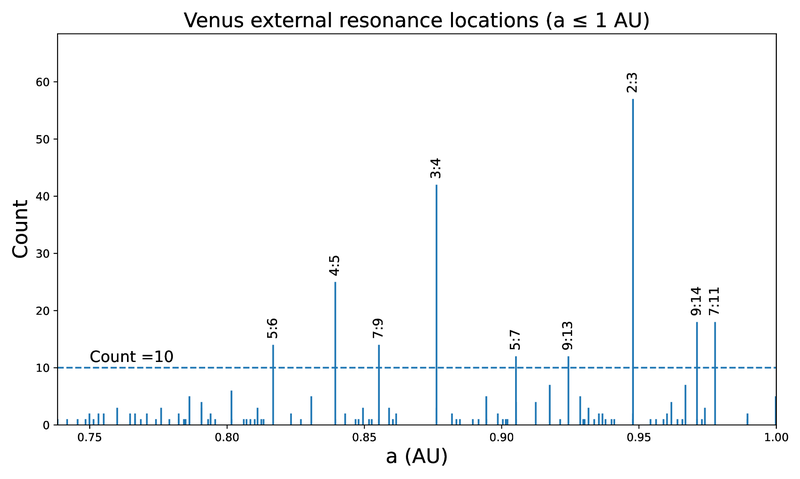
Fig. 3: Location in the (a, count) plane of the external MMR with Venus identified by ML-FAIR. Resonances with 10 or more asteroids are labeled. The horizontal dashed line shows the level at which the count equals 10.
ML-FAIR enables efficient, automated detection of resonances in large NEO datasets, a key capability for upcoming surveys such as the Legacy Survey of Space and Time (LSST), which will dramatically increase the number of known NEOs.
References
-
Carruba V, Aljbaae S, Caritá G, Domingos RC, Bala MM, Pedroso RDZ, and Delfino EMDS (2026) ML-FAIR: an automated machine-learning framework for the fast identification of eccentricity-type mean-motion resonances. CMDA (under review).
-
Forgács-Dajka E, Sándor Z, Érdi B (2018). A fast method to identify mean motion resonances. MNRAS 477, 3383.
-
Smirnov E (2023) A new Python package for identifying celestial bodies trapped in mean-motion resonances. Astronomy and Computing 43, A100707.
How to cite: Carruba, V., Aljbaae, S., Caritá, G., C. Domingos, R., Bala, M., Pedroso, R., and Delfino, E.: ML-FAIR: an Automated Machine-Learning Framework for the Fast Identification of Eccentricity-Type Mean-Motion Resonances, Europlanet Science Congress 2026, The Hague, The Netherlands, 7–11 Sep 2026, EPSC2026-76, https://doi.org/10.5194/epsc2026-76, 2026.


