
 1,
1,- 1Jet Propulsion Laboratory, California Institute of Technology, MS 183-601, Pasadena, California, United States of America (glenn.orton@jpl.nasa.gov)
- 2Arizona State University, Tempe, Arizona, USA
- 3California Institute of Technology, Pasadena, California, USA
- 4Independent Scholar, Stuttgart, Germany
- 5Michigan Technological University, Houghton, Michigan, USA
Abstract. The JunoCam instrument on the Juno mission has been used to detect and measure properties of detached haze layers in Jupiter’s atmosphere using observations of the planet’s limb. Although results are preliminary, a surprising concentration of detached haze layers was found in a discrete planetocentric latitude range of 30°-35°N, well separated from prominent hazes associated with the north polar region.
Introduction. The JunoCam instrument on the Juno spacecraft has sufficient spatial resolution to characterize haze properties using observations that resolve vertical distribution of haze particles at the limb. Some of these observations reveal the presence of detached hazes. These hazes may influence Jupiter’s atmospheric dynamics, radiative balance and photochemistry, and we have studied their presence or absence at each latitude in an effort to constrain meridional variability in atmospheric processes. This effort required sorting through considerable complexities such as the changing observational geometry, to derive the frequency and distribution of these hazes. Observational circumstances such as resolution, exposure, solar incidence angle and phase angle differ substantially and those difference affect the visibility of these faint atmospheric hazes, contributing to observational biases and non-detections.
The Juno spacecraft repeatedly observed Jupiter in limb-viewing geometry with JunoCam providing higher-resolution images across many close approaches, known as perijoves. These close-up images contain valuable information about vertical atmospheric structure and interpreting these observations consistently required the systematic handling of cases where the limb boundary is not sharply defined. A programmatic pipeline was developed to process JunoCam images and sort them into three categories: detection, non-detection, or ambiguous.
Methods. By analyzing the changing peaks in image brightness (Figure 1), this framework allows for the systematic classification of individual image sets, enabling the consistent comparison of detached haze detection across latitudes. Strict geometric and detectability filters were applied so that retained detections represent only cases where detached haze is clearly resolvable above instrumental and viewing limitations. As a result, the occurrence statistics we derived should be interpreted as robust but likely incomplete, emphasizing reliability over sensitivity. Figure 2 illustrates the accumulated counts from all images in PJ14.
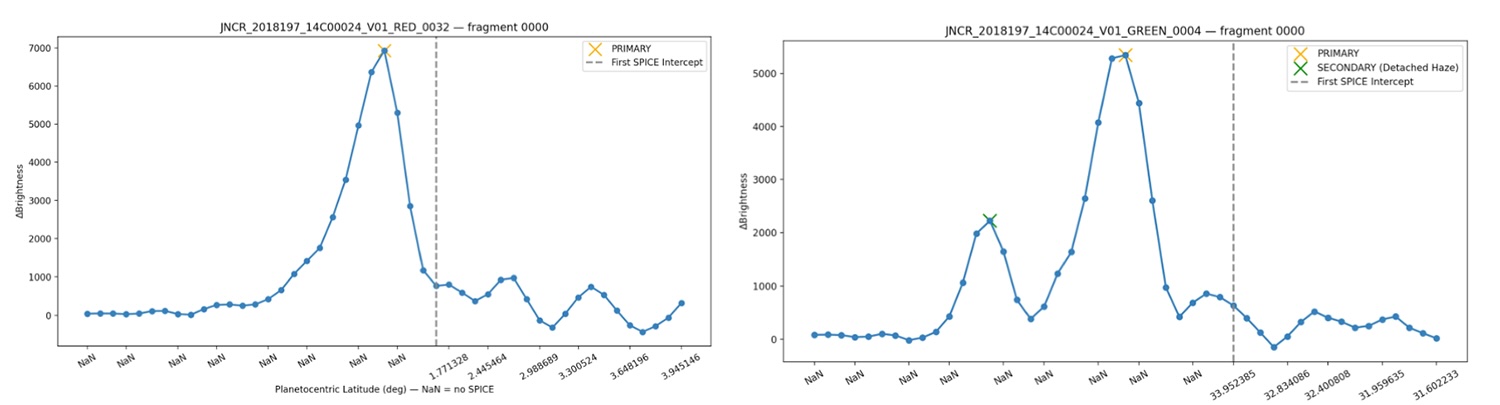
Figure 1. Brightness profiles illustrating primary and secondary peaks used in deteched-haze classifications. The image on the left panel illustrates a non-detection of a detached haze, and the right panel illustrates the detection of a detached haze.
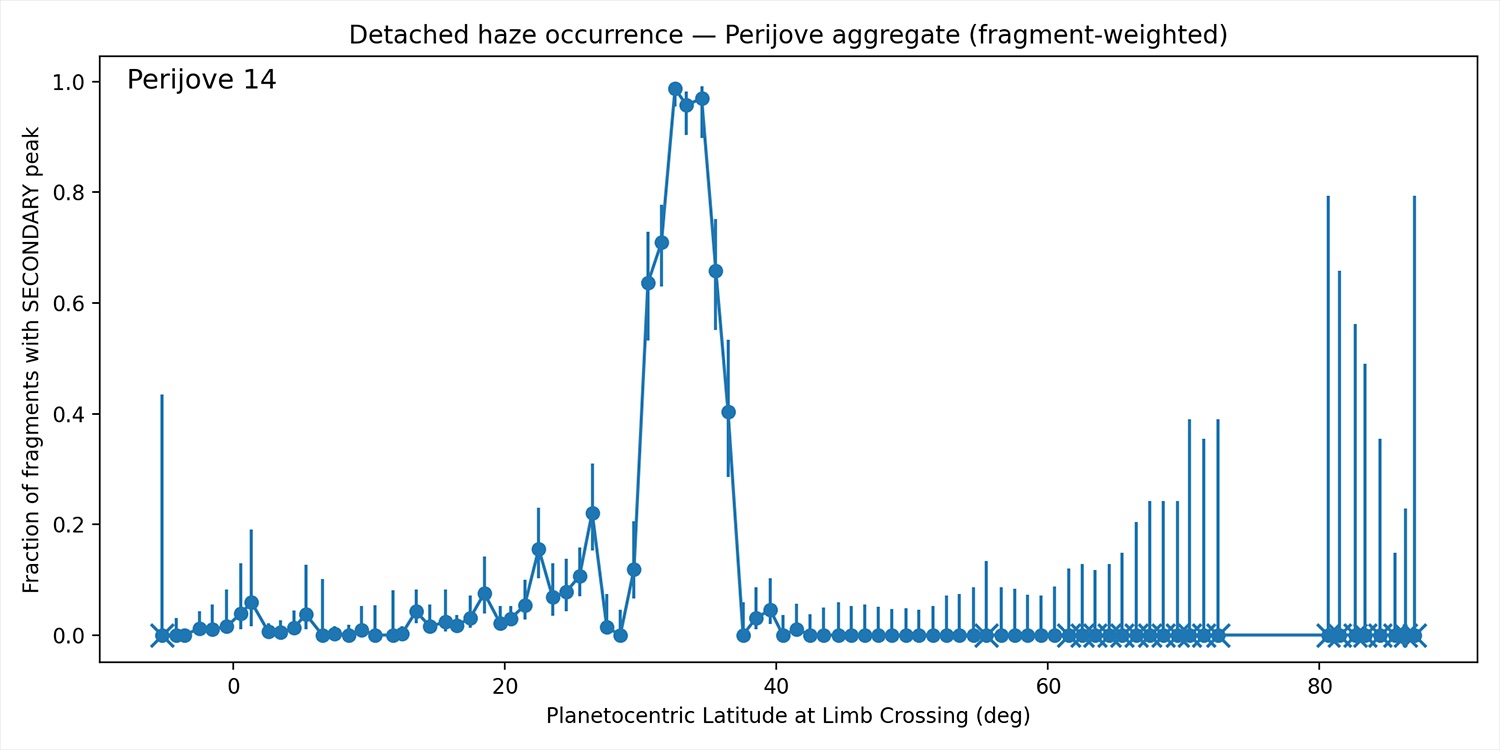
Figure 2. Detached haze detection frequency at various latitudes derived from limb classifications using the validated pipeline. The peak at planetocentric 30°-35°N is a robust feature that appears in several images. The “picket-fence” appearance at high latitudes is the result of sparse coverage, where only a few geometry-valid limb fragments contribute, so individual detections produce isolated spikes.
Results. The present results are preliminary and are based primarily on PJ14, with additional methodological refinements and analysis of earlier southern perijoves still in progress and to be discussed in this presentation.
Figure 3 expands the results of Figure 2, showing the detached-haze signal on an image-by-image basis for all images in PJ14, highlighting its confinement to a narrow mid-latitude band (~30–35°) over several longitudes, and makes clear that the analysis is intentionally conservative through the detectability masking. In favorable observations, the separation between the two maxima in the radial brightness gradient corresponds to an apparent detached haze altitude of approximately 70–80 km above the main cloud deck, roughly three atmospheric scale heights. This may actually be an under-estimate of the distance to the main cloud top, since, in general, there might exist an additional haze layer above the main cloud top that is only obvious in the limb perspective, and hence reduces the apparent altitude of the detached haze layer above the main cloud deck.
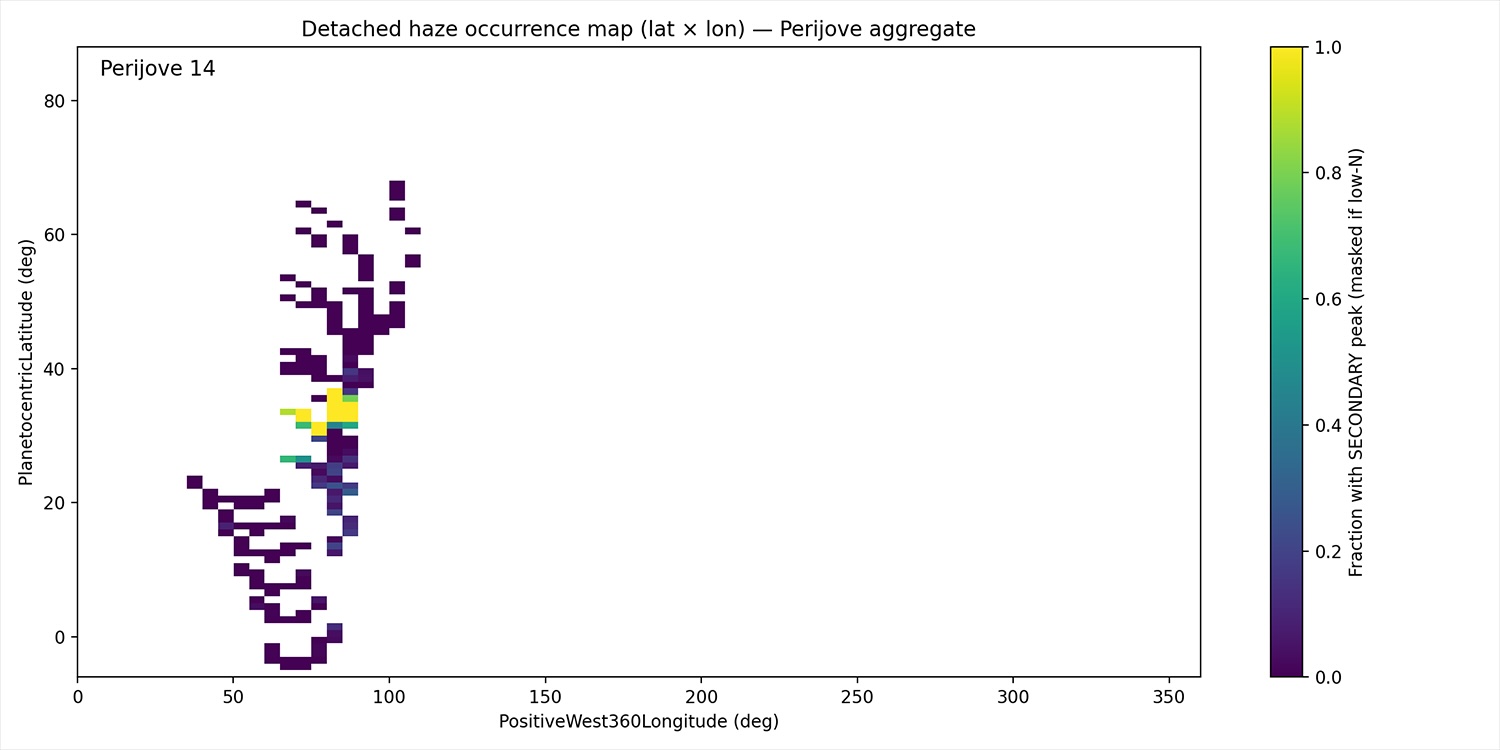
Figure 3. Figure 3. Longitude–latitude occurrence map for detached haze during Perijove 14. Colors indicate the fraction of detectably valid fragments exhibiting secondary peaks within each longitude–latitude cell; cells below the minimum fragment threshold are masked. The mid-latitude enhancement is retained in map space but remains coverage-limited in longitude under the limited range of JunoCam’s viewing geometry in PJ14.
This result is surprising, prompting us to double-check it by examining the raw images, which verified its presence. This is well south of the upper-atmospheric hazes apparent in the northern polar hood. It may provide a clue about the formation of those hazes. It could simply be a diluted extension of the north polar hood that drifted southward. Alternatively, it is a radiation-induced haze that is produced at a slower rate than the polar hazes caused by energetic radiation interacting with the upper atmosphere. Additional clarity will ensue from our extension of this study to greater latitude ranges, including not only the north but also a hemispherical cross-comparison with several measurements made early in the mission at southern latitudes. Comparisons will be made with other Juno measurements, as well as historical observations (Rages et al 1998).
Acknowledgements. Some of this research was carried out at the Jet Propulsion Laboratory, California Institute of Technology, under a contract with the National Aeronautics and Space Administration (80NM0018D0004). KK was an intern at JPL in the Student Independent Research Internship (SIRI) program during part of this work. KD was a Caltech Summer Undergraduate Research Fellow (SURF) at JPL during this work.
All analyses were performed using an open-source, fully reproducible pipeline.
Dedication. We dedicate this work to the memory of Dr. Candice Hansen, who was the Juno instrument lead for JunoCam through most of the mission. She provided operational insight and guidance for both the public access to Juno observations envisioned for this instrument and for the strong quantitative scientific results it brought to the mission.
Reference:
K. Rages, R. Beebe, D. Senske. 1998. Jovian stratospheric hazes: The high phase angle view from Galileo. Icarus 139, 211-226;
How to cite: Orton, G., Kelly, K., Donolo, K., Eichstaedt, G., and Brueshaber, S.: Preliminary Assessment of Detached and Other Hazes in Jupiter’s Atmosphere from JunoCam Observations, Europlanet Science Congress 2026, The Hague, The Netherlands, 7–11 Sep 2026, EPSC2026-769, https://doi.org/10.5194/epsc2026-769, 2026.


