
 1,1,2,1,3
- 1Université Paris-Saclay, CNRS UMR8148, GEOPS, Orsay, France
- 2Institut Universitaire de France, IUF, Paris, France
- 3Université de Versailles St Quentin en Yvelines, LATMOS/IPSL, Guyancourt, France
Introduction
We introduce a novel statistical approach for propagating multifractal 2D fields to finer scales (upscaling a field at higher resolution than actually observed) and inpainting missing data points. The strategy ensures that the new artificially generated data follows the multifractal statistics and thus produces a more realistic field than usual interpolation methods. The method is called MUFFIN (MUltifractal Fast Fourier INterpolation).
Multifractal frameworks are used to describe systems that exhibit variability across many scales. Several formalisms and models exist to describe it [1, 2, 3], each with different assumptions, tools and applications. The most common one used in the geophysics is the Universal Multifractal (UM) model [4-9]. Moreover, since geophysical processes are generally non-stationary, an additional fractional integration to the UM is provided. This model is referred as the Fractionally Integrated Flux (FIF) and was used to perform the upscaling.
A FIF field has an analytical moment scaling function defined by the knowledge of only three parameters α, C1 and H. The intermittency of a field is controlled by the multifractality exponent α and the sparsity degree C1. The smoothness and non-conservation of the field are described by the Hurst exponent H.
Methods
For the upscaling algorithm, we used the UM continuous method from (chap. 5)[10] to generate a 2D synthetic field with the same multifractal properties (α, C1) as the input field. The input field is converted to a UM field and its size is increased by a factor U. The finer scales of the
synthetic field are then grafted to the input field, propagating its cascade to smaller scales. The final product is obtained by reapplying the fractional integration flux to get back a FIF field. The upscaling algorithm relies on the Fast Fourier Transform (FFT) and is therefore computationally efficient. It has no constraints on the field size or upscaling factor, making it robust and easy to use.
For the inpainting algorithm, we use a linear combination of 2D synthetic fields (candidates) with the same multifractal properties as the input field. The optimal linear combination of candidates recreate the exact same input field with observed data. Since the candidates do not have missing points, the unobserved points are simply filled with the one from the combined candidates. Both methods are detailed in [11].
Results
Comparison were made upon both synthetic and realistic examples. We present here the results applied on a real dataset. The upscaling and inpainting were performed on the North quadrangle of Mercury (887m/pixel), respectively on the full dataset and on the same dataset with missing points (corresponding to N orbits laser altimeter measurements). In order to validate our method, the ground truth, upscaled and inpainted fields are analyzed and compared with the Mean Haar Fluctuations (MHF) and the Power Spectral Density (PSD).The upscaling and inpainting approaches ensure an interpolated field with relatively small errors [11].
For the upscaling, the MHF Relative Root Mean Square (RRMS) and PSD RRMS are always >1% and <4%, while for a Bicubic upscaled field the MHF RRMS and PSD RRMS are always >17% and <73%.
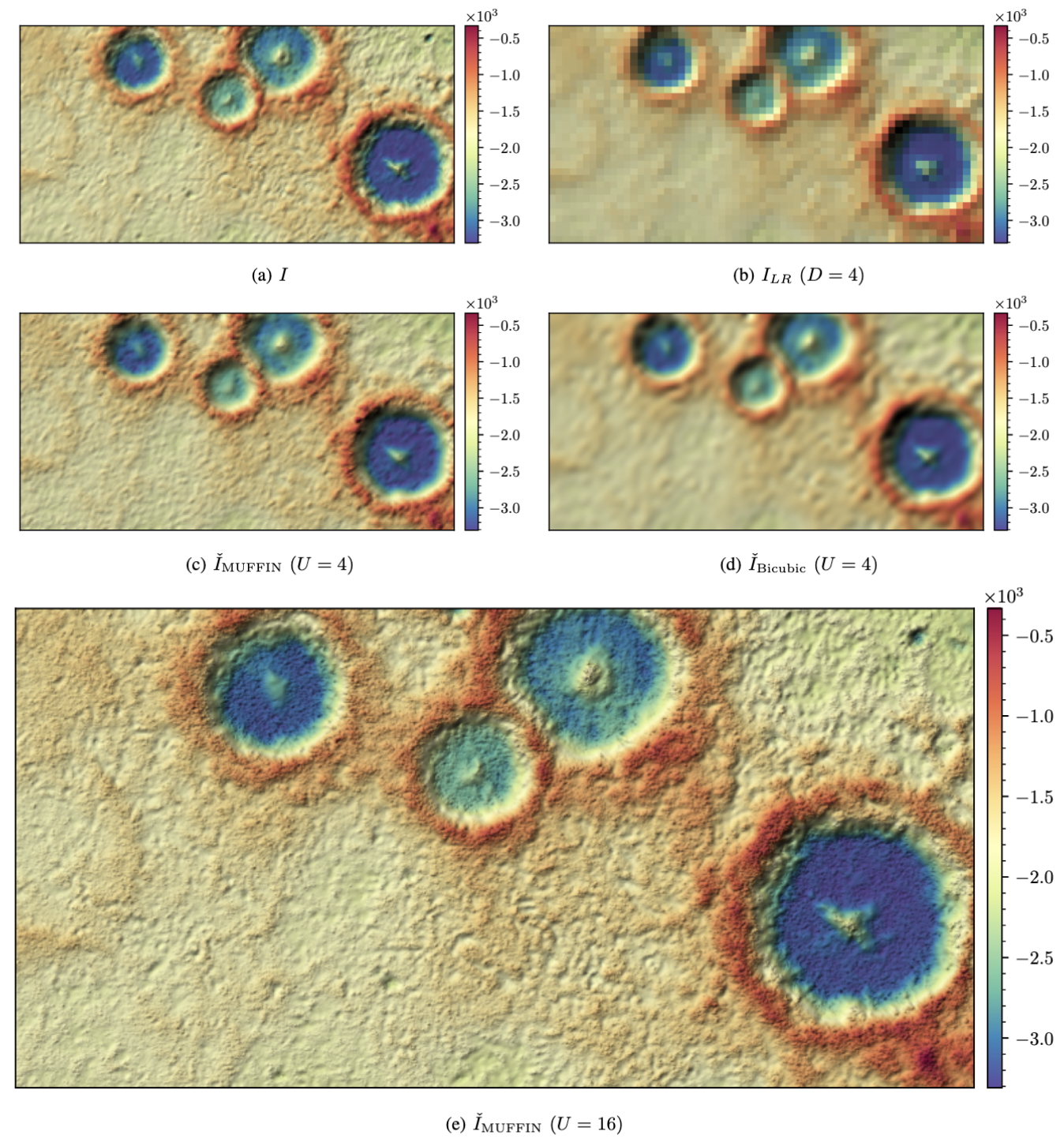
Figure 1. (a) I: the ground truth field, (b) ILR: the input field (downscaled by a factor D=U), (c) IvMUFFIN: our method output field (upscaled by a factor U=4), (d) IvBICUBIC: the Bicubic upscaled field (upscaled by a factor U=4) and (e) IvMUFFIN : our method output field (upscaled by a factor U=16) from I as the input field. (a),(c) and (d) have a size of 512x256, (b) has a size 128x64 and (e) has a size 8192x4096. For the inpainting, the MHF Relative Root Mean Square (RRMS) and PSD RRMS are always >5% and <34%, while for a Biharmonic inpainted field the MHF RRMS and PSD RRMS are always >7% and <77%.
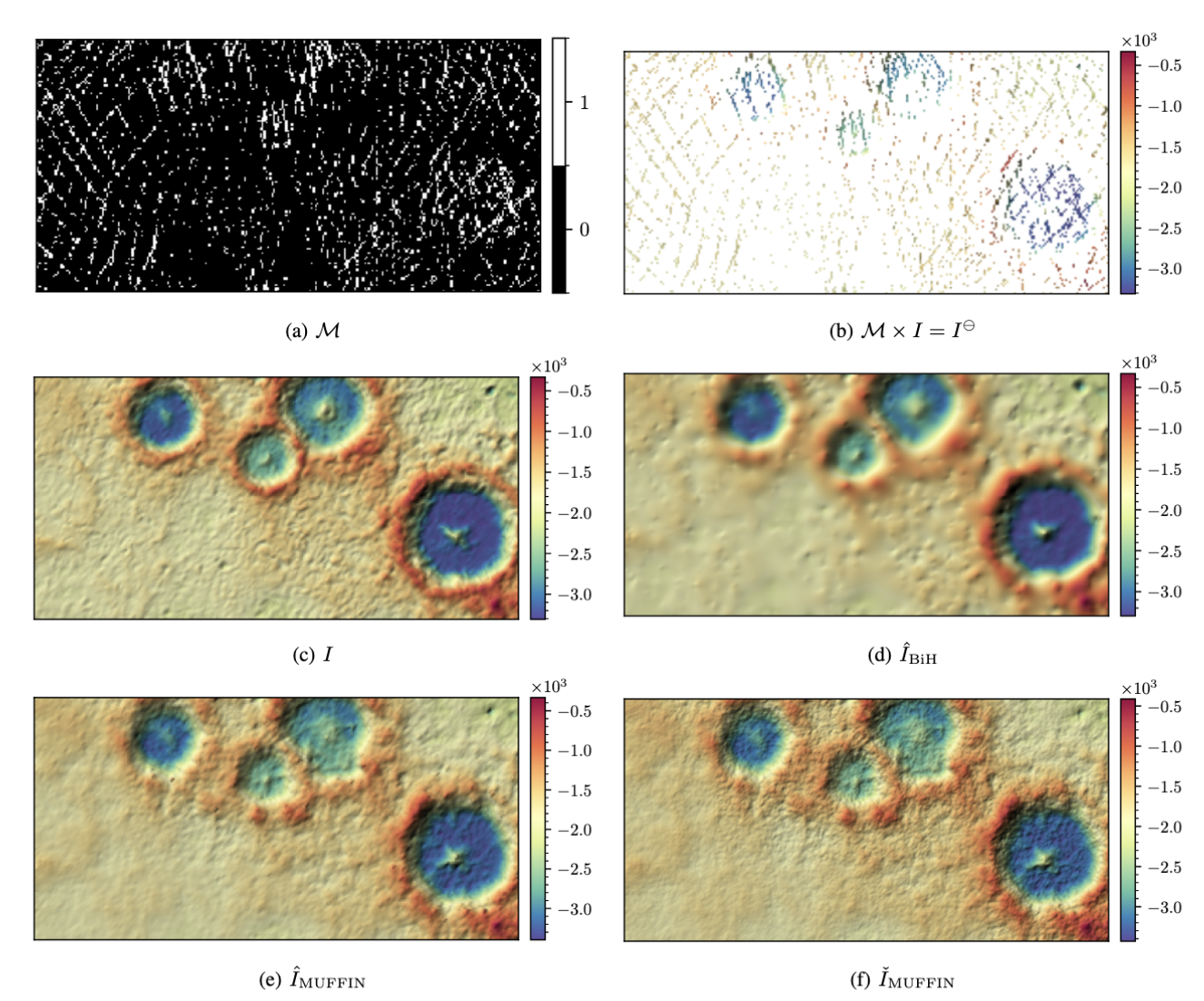
Fig 2. (a) I: the ground truth field, (b) ILR: the input field (with missing points), (c) IvMUFFIN: our method output field, (d) IvBICUBIC: the Biharmonic inpainted field and (f) IvMUFFIN:an upscaled version of IvMUFFIN by a factor U=2. (c) to (e) have a size of 512x256 and (f) has a size of 1024x512.
Our approaches can thus be used for users who aim at generating an interpolated dataset with realistic roughness, including the intermittent case, with statistical properties (maximum, average, other statistical moment) that are realistically assessed.
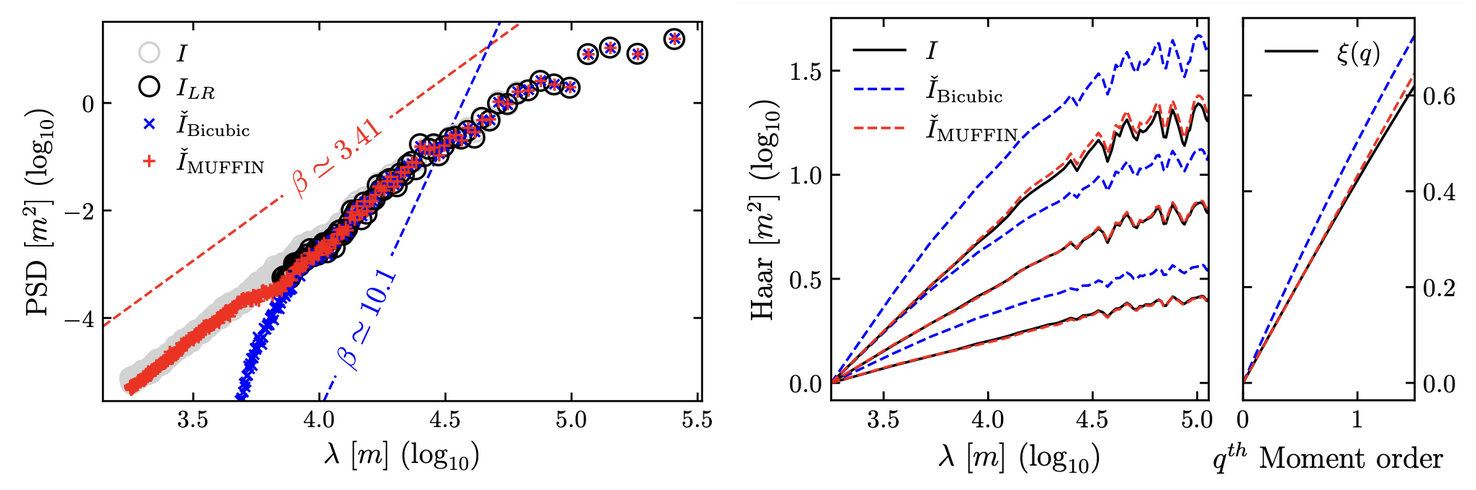
Fig 3. Multifractal analysis of Fig 1. fields, the PSD on the left and the MHF analysis normalized for order moment q=1, 1.5 and 2 on the right. The results are excellent for the MUFFIN method with a near perfect respect of the ground truth field statiscal nature (power-laws).
Conclusion
We propose MUFFIN [11], new fast and robust methods to interpolate data while keeping its statistical properties. The approach ensures an interpolated field with plausible new smaller scales and a natural look. The methods are easy to use, made with Python and necessitate a simple line of command with parameters to run.
References
[1] Schertzer et al., Physical modeling and analysis of rain and clouds by anisotropic scaling multiplicative processes, Journal of Geophysical Research: Atmospheres, 1987.
[2] Halsey et al., Fractal measures and their singularities: The characterization of strange sets, Nuclear and Particle Physics Proceedings, 1987.
[3] Muzy et al., Multifractal formalism for fractal signals: The structure-function approach versus the wavelet-transform modulus-maxima method, Physical Review E, 1993.
[4] Lovejoy et al., The l1/2 law and multifractal topography: theory and analysis, Nonlinear Processes in Geophysics, 1995.
[5] Gagnon et al., Multifractal earth topography, Nonlinear Processes in Geophysics, 2006.
[6] Lovejoy et al., Scaling and multifractal fields in the solid earth and topography, Nonlinear Processes in Geophysics, 2007.
[7] Lovejoy et al., The Weather and Climate: Emergent Laws and Multifractal Cascades, Cambridge University Press, 2013.
[8] Landais et al., Universal multifractal Martian topography, Nonlinear Processes in Geophysics, 2015.
[9] Landais et al., Topography of (exo)planets, Monthly Notices of the Royal Astronomical Society, 2019.
[10] Lovejoy et al., The Weather and Climate: Emergent Laws and Multifractal Cascades, Cambridge University Press, 2013.
[11] Lancery et al., MUltiFractal Fast Fourier INterpolation (MUFFIN): Inpainting and upscaling multifractal images, IEEE Image Processing, 2026 (submitted).
How to cite: Lancery, H., Schmidt, F., Andrieu, F., and Vannier, E.: Multifractal upscaling and inpainting of topographies using MUFFIN, Europlanet Science Congress 2026, The Hague, The Netherlands, 7–11 Sep 2026, EPSC2026-77, https://doi.org/10.5194/epsc2026-77, 2026.


