
 1,3,
1,3,- 1Jet Propulsion Laboratory, Pasadena, United States of America (alexander.akins@jpl.nasa.gov)
- 2Division of Geological and Planetary Sciences, California Institute of Technology, Pasadena, United States of America
- 3Astronomy Department, University of California, Berkeley, United States of America
- 4National Radio Astronomy Observatory, Albuquerque, United States of America
Ground- and spacecraft-based microwave radiometry investigations of the satellites of Jupiter and Saturn have provided interesting constraints on the properties of their icy regoliths, including degree of ice purity, porosity and, at the longest wavelengths, conductive ice shell thickness. These properties in turn have applications towards understanding the evolutionary history of the moons; as a recent example, Phua and Stevenson (2026) find that the ice purity of Ganymede inferred from Juno MWR observations corresponds to an impactor flux which is less by an order of magnitude than that posited by Barr and Canup (2010) to explain differences in the differentiation outcomes of Ganymede and Callisto during their evolutions.
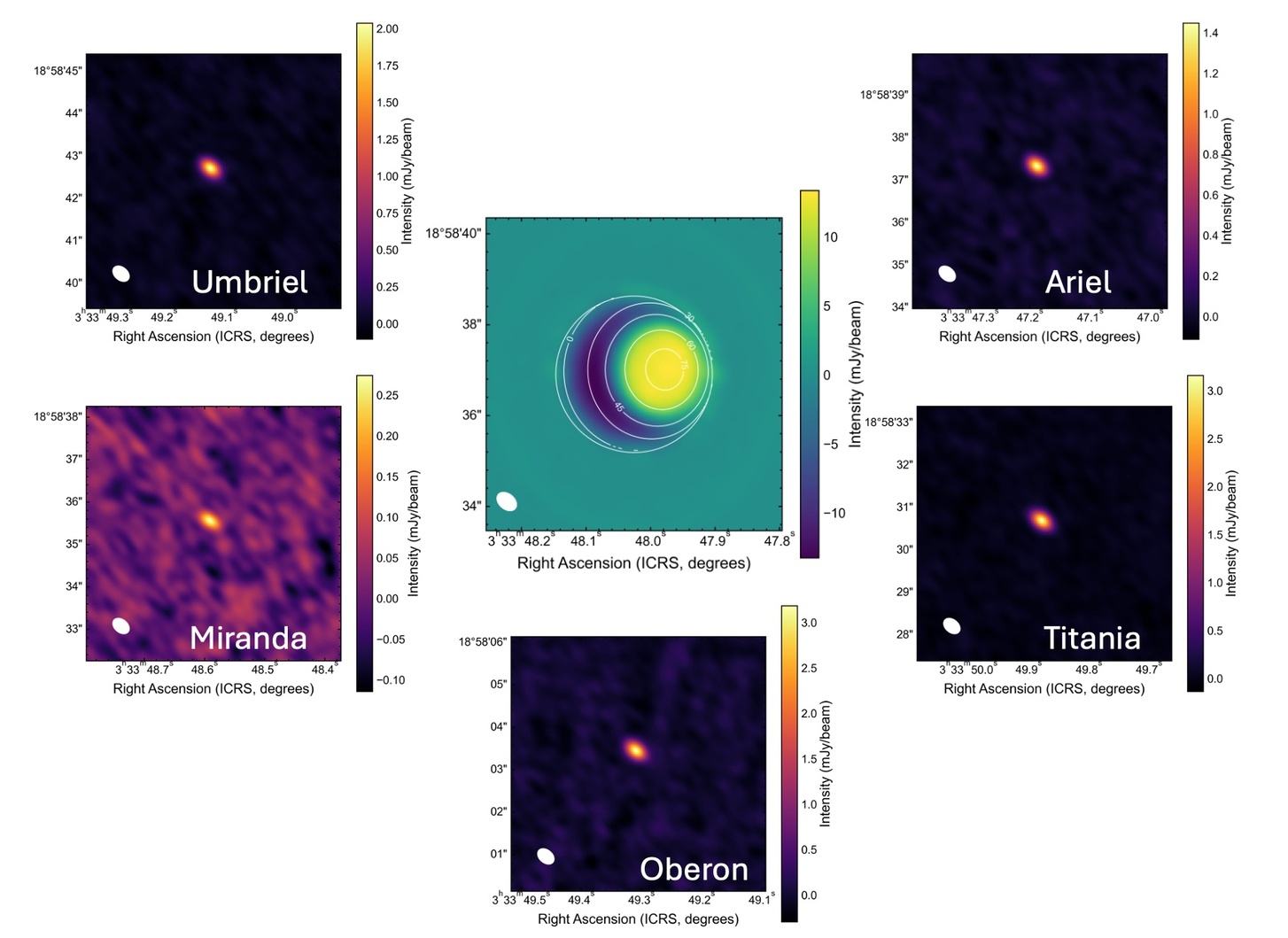
While several microwave thermal emission measurements have been obtained for the primaries of Jupiter and Saturn, no such measurements have yet been reported for the Uranian system. We re-reduced VLA and ALMA observations of Uranus between 2015-2025 and have compiled disk-integrated spectra for Miranda, Ariel, Umbriel, Titania, and Oberon from 0.85-30 mm; the previous longest wavelength of detection is 160 micron, by Detre et al. (2020). Over this time, the sub-observer point on the satellites moves closer to their northern poles, resulting in insolation-induced changes in their disk-integrated brightness temperatures The fact that these satellites are co-observed with Uranus enables an improvement in the calibration accuracy over the observatory standard procedures.
The spectra for Titania and Oberon are generally consistent with Europa, Ganymede, and Callisto: Brighter at millimeter-wavelengths, then decreasing substantially as (presumably) scattering in the low-loss sub-surface regolith begins to become a substantial process. The spectra for Ariel and Umbriel in comparison are remarkably flat (although Umbriel is as expected much brighter than Ariel overall). Our presentation will discuss thermal and radiative transport modeling of these observations which consistently treats the porosity and grain size of the regolith material.
How to cite: Akins, A., de Kleer, K., Camarca, M., Thelen, A., de Pater, I., and Butler, B.: VLA/ALMA Microwave Spectra of Uranus’ Primary Satellites and their Implications for Regolith Structure, Europlanet Science Congress 2026, The Hague, The Netherlands, 7–11 Sep 2026, EPSC2026-773, https://doi.org/10.5194/epsc2026-773, 2026.


