
 ,
,- Politecnico di Milano, DART lab, Department of Aerospace Science and Technology at the Politecnico di Milano, Milan, Italy (iosto.fodde@polimi.it)
Saturn’s small inner moons present some of the most unusual shapes observed in the Solar System. Among these, Pan stands out for its distinctive equatorial ridge, which gives the moon its characteristic appearance as seen in Figure 1. The ridge displays a polygonal longitudinal profile defined by five lobes [7]. Understanding the origin of these structures offers a small-scale analogue to broader astrophysical processes such as pebble accretion onto planetesimals in protoplanetary disks [1].
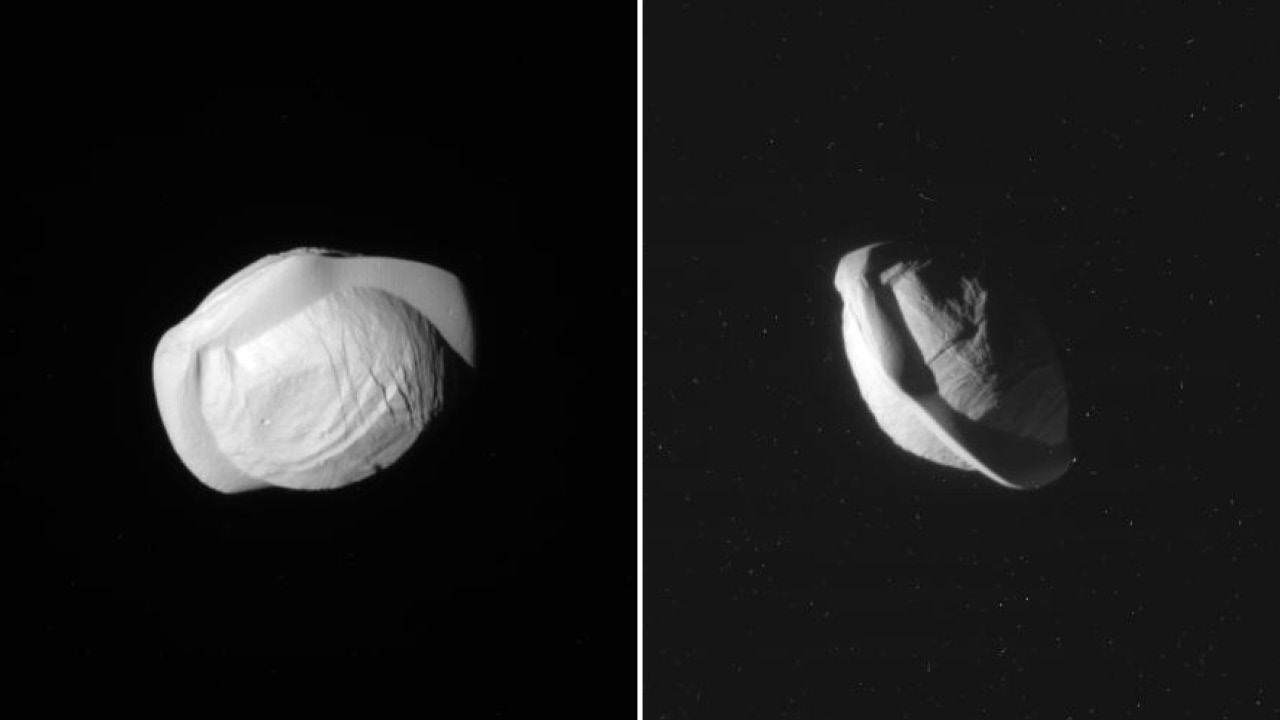
Figure 1: Cassini image of Pan. Credits: NASA/JPL-Caltech/Space Science Institute
Three main formation hypotheses have been proposed. The first invokes gravitational forcing from the rings driving granular surface flow toward the equator [6], but predicts uniform ridge structures. The second interprets the ridges as remnants of low-velocity merging events between comparable-sized moonlets [4], but requires highly constrained impact parameters and leaves the polygonal shape unexplained. The third scenario proposes accretion of ring particles onto a pre-existing core [1], determined from the ridge’s equatorial location, smoother texture, and lower crater density. However, previous implementations of this framework could only reproduce simplified single-lobed morphologies and could not account for the multi-lobed structure or latitudinal extent without ad hoc assumptions [5].

Figure 2: Lagrange points L1, L2 and zero-velocity curves for the Pan, including (perturbed)
and excluding (unperturbed) shape effects.
This study investigates the low-energy dynamics of ring particles in the vicinity of Pan using a Circular Restricted Three-Body Problem (CR3BP) framework augmented with spherical harmonic perturbations from both Saturn and Pan. In the low-energy regime, ring particles can only reach Pan’s surface by transiting through the necks of the zero-velocity surface near the L1 and L2 Lagrange points, located within approximately 18–19 km of Pan’s centre, see Figure 2. This constraint is exploited to perform systematic grid-search simulations of particle trajectories initiating at the L1 and L2 sections, reducing the search space and analysing mainly physically feasible pathways to accretion. Both planar and three-dimensional configurations are explored, and backward propagations from Pan’s surface are performed to characterize the original orbits of impacting particles. The 2D grid search reveals a strong dynamical symmetry between trajectories transiting through the two necks, a consequence of the small mass ratio. This symmetry implies that symmetric accretion conditions cannot reproduce the observed asymmetric ridge profile. The best agreement with the observed ridge altitude distribution is obtained when inner-ring particles are located closer to Pan than their outer-ring counterparts, and when impacts from the L1 neck slightly exceed those from L2. Under these conditions, the simulated impact longitude distribution reproduces the correct number of peaks and troughs and correlates strongly with the ridge altitude profile, particularly on the Saturn-facing hemisphere. The 3D grid search demonstrates that reproducing the observed latitudinal spread requires strictly limiting the out-of-plane position and velocity components of accreting particles at the neck sections. This strongly indicates that the ridge could only have formed through accretion from a very thin particle disk, consistent with Saturn’s ring geometry [3]. This result removes the need to invoke Pan’s orbital inclination as the primary driver of the ridge’s latitudinal extent, a hypothesis that had yielded inconsistent results in prior studies [1, 5]. The simulated three-dimensional shape of Pan shown in Figure 3 shows good visual agreement with the observed morphology, particularly on the Saturn-facing and trailing sides. Analysis of impact transverse velocities yields a mean value of approximately 0.33- 0.36 m/s, roughly one order of magnitude smaller than previously assumed [5], revising the minimum accretion timescale from ∼105 down to ∼104 years. Backward propagation of impacting trajectories confirms that virtually all low-energy impacting particles originate from nearly circular orbits within the Encke Gap, with effective eccentricities never exceeding 10−3, consistent with accretion from local ring material.
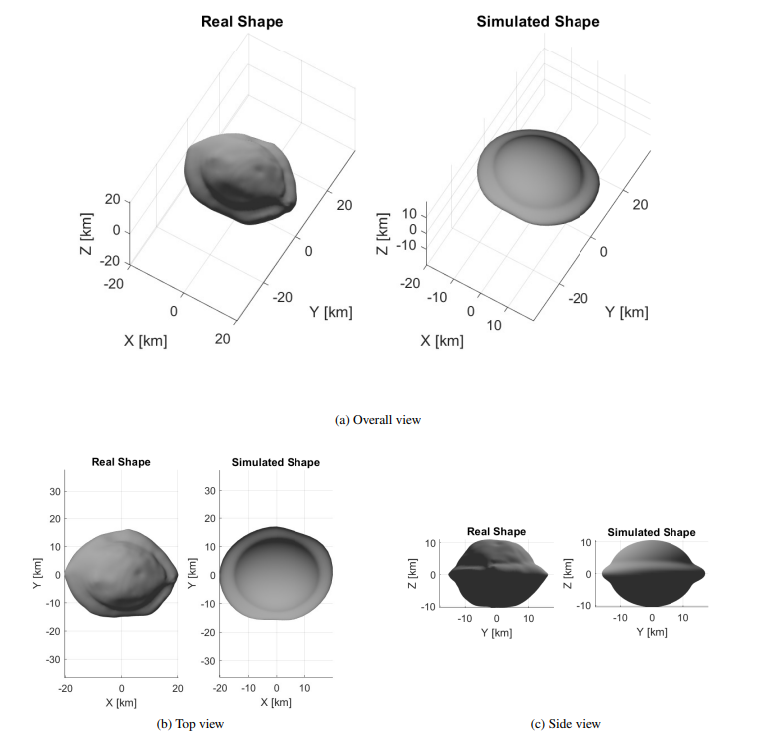
Figure 3: Different views of the simulated shape of Pan resulting from the 3D grid search,
alongside the observed shape of Pan for comparison.
These results provide dynamically and morphologically consistent explanation for Pan’s equatorial ridge, demonstrating that its polygonal shape, latitudinal extent, and asymmetric altitude distribution are natural consequences of low-energy ring particle accretion. The methodology is directly transferable to Atlas and Daphnis, and broadly applicable to other low-energy deposition and impact processes in the Solar System.
Acknowledgments
Funded/co-funded by the European Union (ERC, TRACES, 101077758). Views and opinions expressed are however those of the authors only and do not necessarily reflect those of the European Union, the European Research Executive Agency, or the European Research Council. Neither the European Union nor the granting authority can be held responsible for them. This work was also partly carried out within the Space It Up! project funded by the Italian Space Agency (ASI) and the Italian Ministry of University and Research (MUR) under contract No. 2024-5-E.0, CUP No. I53D24000060005.
References
[1] S. Charnoz, A. Brahic, P. C. Thomas, C. C. Porco, Charnoz, S´ebastien, Brahic, Andr´e,
Thomas, P. C., Porco, and C. C. The Equatorial Ridges of Pan and Atlas: Terminal
Accretionary Ornaments? Science, 318(5856):1622, 12 2007.
[2] M. Ciarniello, G. Filacchione, P. D. Nicholson, M. M. Hedman, S. Charnoz, J. N. Cuzzi,
M. El Moutamid, A. R. Hendrix, N. Rambaux, K. E. Miller, O. Mousis, K. Bailli´e, P. R.
Estrada, and J. H. Waite. The Origin and Composition of Saturn’s Ring Moons. Space
Science Reviews 2024 220:7, 220(7):72–, 9 2024.
[3] L. W. Esposito. Composition, structure, dynamics, and evolution of saturn’s rings.
Annual Review of Earth and Planetary Sciences, 38(Volume 38, 2010):383–410, 5 2010.
[4] A. Leleu, M. Jutzi, and M. Rubin. The peculiar shapes of Saturn’s small inner moons as
evidence of mergers of similar-sized moonlets. Nature Astronomy 2018 2:7, 2(7):555–561,
5 2018.
[5] A. C. Quillen, F. Zaidouni, M. Nakajima, and E. Wright. Accretion of ornamental
equatorial ridges on Pan, Atlas and Daphnis. Icarus, 357:114260, 3 2021.
[6] T. Shinbrot. Gravitational influence of Saturn’s rings on its moons: a case for free
granular flow. Frontiers in Astronomy and Space Sciences, 10:1146705, 5 2023.
[7] P. Thomas and P. Helfenstein. The small inner satellites of Saturn: Shapes, structures
and some implications. Icarus, 344:113355, 7 2020.
How to cite: Baj, M., Fodde, I., Civati, L. F., and Ferrari, F.: The Shape of Small Embedded Ring Moonlets: Low-Energy Dynamics and the Origin of Pan's Polygonal Ridge, Europlanet Science Congress 2026, The Hague, The Netherlands, 7–11 Sep 2026, EPSC2026-778, https://doi.org/10.5194/epsc2026-778, 2026.


