
 2
2- 1Delft University of Technology, Faculty of Aerospace Engineering, Delft, Netherlands (e.s.steenstra@tudelft.nl)
- 2Laboratory for Laser Energetics, University of Rochester, Rochester
Introduction: The geochemical behavior of C and S has strongly influenced Venus’ evolution. Their degassing from the interior shaped the present greenhouse atmosphere and clouds [1,2], while they may also contribute to the low-viscosity melts responsible for surface features such as canali channels [e.g. 3,4] and the formation of surface coatings [5]. C and S further affect core properties and the potential for thermochemical convection within Venus’ interior. However, Venus’ interior and core composition remain poorly constrained. Ref. [6] examined permissible core mass fractions and O and Si contents based on geochemical modeling and moment of inertia, but did not consider C and assumed very high S contents (<22 wt.%), whose compatibility with current bulk Venus composition estimates remains uncertain.
Methods: Constraints on the C and S fluxes during accretion of Venus requires constraints on the chemical composition of bulk Venus. There is a significant degree of chemical similarity between bulk Venus and bulk Earth [7]. Venera and VEGA chemical data indicate that the K/Th and K/U ratios of Venusian basalts, which are considered representative of the bulk planet given the incompatibility and lithophile behavior of K [8], could point to similar abundance of volatile elements in both planets. However, estimates of 1–3.1 wt.% S have been inferred for bulk Venus, based on equilibrium condensation models [9]. This is up to 5 times higher than bulk Earth [10]. Instead, Venus likely has a similar volatile element budget compared to Earth, for example reflected by N and C estimates [11,12]. Mass balance considerations and dynamical models both point to volatile element homogenization of the Earth and Venus region [13]. For bulk Venus, bulk Earth values for C and S are thus assumed (2650±2220 µg/g C, 6100±1465 µg/g S [10]). This estimate also takes a potential depletion of S in bulk Venus relative to bulk Earth into account (Fig. 1). The available geophysical and geochemical models indicate a relative core mass of 22 to 38 mass % [6] which is the range that will be explored here.
To quantify the C and S budget of the core and co-existing silicate magma ocean, partition coefficients (D's) are required. The D's and solubilities of C and S were calculated along the estimated liquidus temperature of terrestrial pyrolite [16,17] using existing high-pressure models [18–20] that are calibrated up to pressures largely relevant for Venus’ mantle. Crystallization of an outer magma ocean on Venus likely occurs bottom upwards [7], with a maximum (average) core equilibration pressure of 80 GPa [21,22]. A basal magma ocean could have existed on Venus [22], which would have evolved largely isolated from the outer magma ocean, thereby not affecting the subsequent evolution of C and S in the outer magma ocean. Accretion models of Venus indicate a peak temperature of metal equilibration of 3750 K and 71 GPa [e.g. 21]. Using the assumed bulk S and C content, the degree to which both C and S partitioned into the core and mantle was calculated assuming (1) a simplified single-stage and full equilibration model [6,18] assuming an ‘’average’’ core formation pressure or (2) by implementing the results of multi-stage accretion models [18,21] for Venus.

Fig. 1: Bulk planet S abundances [10,14,15] versus heliocentric distance
Results: In this abstract, we only report results on the single-stage accretion model. For the considered CMF range, the mantle FeO content was re-calculated to ensure internal consistency (Fig. 2). For example, for a bulk Venus composition with 31.2 wt. % Fe [10], comprising a 90 wt.% Fe core, a CMF of ~0.22 corresponds with a FeO mantle content of 20 wt.%. For the latter composition, the maximum CMF is ~0.35.
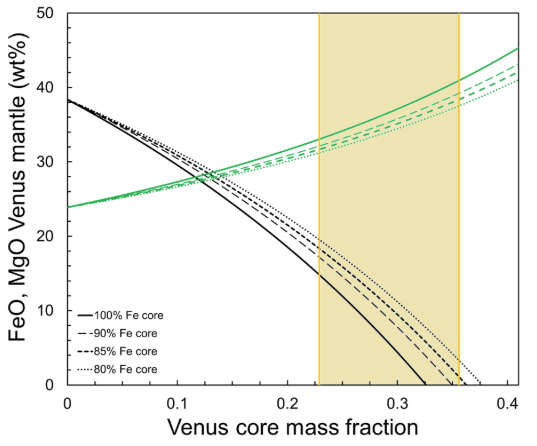
Fig. 2 Venus’ CMF versus mantle FeO, MgO for a bulk Earth composition. Vertical shaded bar represents the considered core mass fractions in this study [e.g. 6].
The resulting core and mantle composition for element i was then calculated using a simple mass balance approach [23]. The calculations suggest a bulk Venus core composition of 0.1–2.2 wt.% C and 1.2–3.4 wt.% S. Despite the many uncertainties related to Venus, several commonly assumed core compositions can be ruled out based on plausible geochemical constraints. The S content inferred for the core is generally lower than considered in previous studies: the calculations exclude intermediate or S-rich core compositions as proposed in previous work [6]. Unless bulk Venus was significantly enriched in S, which does not agree with existing geochemical or dynamical models of the inner solar system, the Venusian core is relatively S-poor, regardless of the accretion scenario considered. More modeling results will be reported at the meeting.
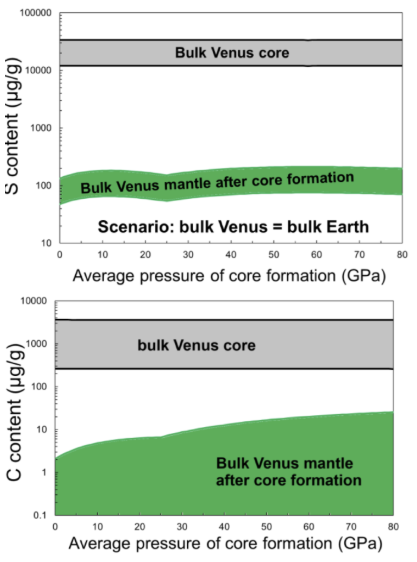
Fig. 3 Calculated bulk core and mantle C and S content assuming single-stage core formation. Given the overall iron-loving behavior of S and C across a wide range of P-T conditions, the core compositions are (near)-constant across the full P-T range applicable to Venus.
Acknowledgments: ESS acknowledges funding of ERC StG VenusVolAtmos.
References: [1] Gillmann et al. (2022) Space Sci Rev [2] Jorritsma et al. (this meeting) [3] Aerts et al. (this meeting) [4] Jorritsma et al. (2026) LPSC [5] Dyar et al. (2021) Icarus [6] Shah et al. (2022) Astrophys. J. [7] Lammer et al. (2020) Icarus [8] Treiman (2009) Venus Geochemistry: Progress, Prospects, and New Missions [9] Kaula et al. (1981) In: Basaltic volcanism on the terrestrial planets [10] Wang et al. (2018) Icarus [11] Halliday (2013) GCA [12] Lécuyer et al. (2000) EPSL [13] Wetherill (1986) In: Origin of the Moon [14] Lodders & Fegley (1997) Icarus [15] Steenstra et al. (2019) Icarus [16] Fiquet et al. (2010) Science [17] Andrault et al. (2011) EPSL [18] Suer et al. (2017) EPSL [19] Blanchard et al. (2022) ESPL [20] Steenstra et al. (2022) GPL [21] Rubie et al. (2015) Icarus [22] Trønnes et al. (2019) Tectonophys [23] Steenstra and van Westrenen (2020) Icarus
How to cite: Steenstra, E. and Suer, T.-A.: The Carbon and Sulfur Cycles during Accretion of Venus and Implications for its Enigmatic Evolution , Europlanet Science Congress 2026, The Hague, The Netherlands, 7–11 Sep 2026, EPSC2026-784, https://doi.org/10.5194/epsc2026-784, 2026.


