
 1,2
1,2- 1Charles University, Faculty of Mathematics and Physics, Department of Geophysics, Prague 2, Czechia (vojtech.patocka@matfyz.cuni.cz)
- 2Institute of Space Research, German Aerospace Center (DLR), Berlin, Germany
With 1 Venusian day lasting 243 Earth days, Venus is the slowest-spinning planet in the Solar System and its rotational bulge is anomalously small. A rotational bulge (flattening) is the excess mass around the equator that stabilizes the orientation of planets. Having only a tiny stabilizer, the rotational pole of Venus is expected to easily separate from the figure pole (main inertia axis of the planet, MIA), which has been used to explain why both poles are observed to be 0.5° apart (Konopliv et al., 1999), several orders of magnitude more than on other terrestrial bodies.
One possible explanation for the 0.5° spin-figure axes (ω-MIA) offset is mantle convection (Spada et al., 1996). Here, we couple 3D mantle-convection simulations and polar motion dynamics to explore how mantle flow, and in particular surface mobilization, drives Venus’s polar motion. We provide a predictive framework for polar motion on slow rotators and show that the spin-figure pole separation (or offset) follows a simple law: it scales with the figure-axis drift rate times the planet’s Chandler period (Fig. 1b). However, in models matching Venus’s geoid, the figure-axis drift rate reaches only up to a few degrees per Myr (Fig. 1c), which is too slow compared to ca. 60°/Myr that is needed to excite the observed 0.5° offset (Patočka et al., 2025).
Another possibility is that it is the torque exerted on the solid Venus by its atmosphere that drives the ω-MIA offset. The atmosphere of Venus is extremely dense, with pressures reaching 93 bar at the surface, and its 4-day superrotation remains enigmatic. Several studies suggest that significant torques could result from the friction accommodating the interaction between atmospheric circulation and the topography of Venus (Navarro et al., 2018; Navarro and Schubert, 2024). Length of day variations suggest that the relative angular momentum of Venus’s atmosphere varies over time with diurnal and semidiurnal frequencies (Margot et al., 2021). To understand the role of torques exerted by the atmosphere on solid Venus, we solve the polar motion dynamics equations for arbitrarily prescribed surface forcing and investigate how the spin and figure axes separate during the excited polar motion. Both time-constant and time-varying torques are applied, mimicking different possible mechanisms of angular momentum transfer between the atmosphere and solid Venus. The results help in understanding the link between the atmospheric and polar motion dynamics of Venus and can be used to constrain the transfer of angular momentum between the atmosphere and the solid surface.
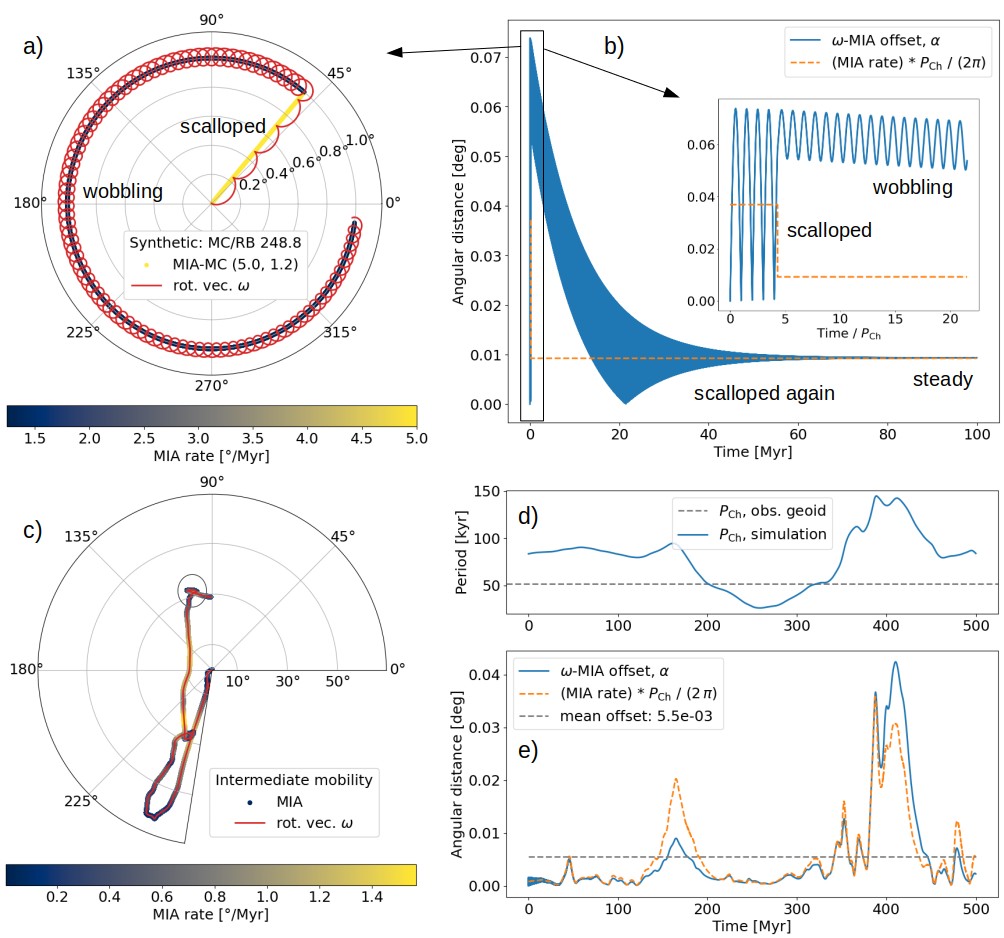
Figure 1: Polar motion response of Venus. a,b) Synthetic tests in which the loading is artificially prescribed: inertia axis of the load is first moving at the rate of 5°/Myr (polar motion is scalloped) and then abruptly slowing down to 1.2°/Myr (the change induces wobbling). The imposed difference between the main and the minor moments of inertia (C−A) is 2 orders of magnitude larger than C−A of the rotational bulge, similarly to values obtained from the observed geoid. In
steady state, the angular offset between the spin and figure axes α follows our scaling law, shown by the orange dashed line and described in the legend. c-d) Mantle convection simulation with moderate surface mobility. Paths of the rotational and figure poles on the globe (c), the evolution of Chandler period, as computed from the mantle flow-induced geoid (d), and the time evolution of the spin-figure axes offset, compared with our scaling law (panel e, blue vs. orange lines). The average angular separation of the figure and rotation axes is two orders of magnitude below the observed value (gray
dashed line). Adopted from (Patočka et al., 2025).
References
Konopliv, A., Banerdt, W., Sjogren, W., 1999. Venus gravity: 180th degree and order model. Icarus 139, 3–18.
doi:10.1006/icar.1999.6086.
Margot, J.L., Campbell, D.B., Giorgini, J.D., Jao, J.S., Snedeker, L.G., Ghigo, F.D., Bonsall, A., 2021. Spin state and
moment of inertia of venus. Nat. Astro. 5, 676–683. doi:10.1038/s41550-021-01339-7.
Navarro, T., Schubert, G., 2024. Mountain waves in the upper atmosphere of venus. Geophys. Res. Lett. 51,
e2023GL104922. doi:10.1029/2023GL104922
Navarro, T., Schubert, G., Lebonnois, S., 2018. Atmospheric mountain wave generation on venus and its influence on the
solid planet’s rotation rate. Nat. Geo. 11, 487+. doi:10.1038/s41561-018-0157-x.
Patočka, V., Maia, J., Plesa, A.C., 2025. Polar motion dynamics on slow-rotating venus: Signatures of mantle flow. AGU
Advances 6, e2025AV001976. doi:10.1029/2025AV001976.
Spada, G., Sabadini, R., Boschi, E., 1996. Long-term rotation and mantle dynamics of the Earth, Mars, and Venus.
J. Geophys. Res. Planets 101, 2253–2266. doi:10.1029/95JE03222.
How to cite: Patočka, V., Maia, J., and Plesa, A.-C.: Mantle and atmospheric drivers of the 0.5° offset between the spin and figure axes of Venus, Europlanet Science Congress 2026, The Hague, The Netherlands, 7–11 Sep 2026, EPSC2026-786, https://doi.org/10.5194/epsc2026-786, 2026.


