
 11,2
11,2- 1CNRS, GEOPS, Orsay, France (francois.andrieu@universite-paris-saclay.fr)
- 2Institut Universitaire de France (IUF), France
Introduction
Radiative transfer describes the interactions between light and matter. In the planetary surfaces field, most data comes from remote sensing instruments such as spectrometers or imaging spectrometers. Modeling the interactions at the surface is thus mandatory to better understand them. Particularly, when studying the spectro-photometric behavior of planetary surfaces, the most used model is the B. Hake model [1], because of its simple analytical form and its ability to correctly reproduce the behavior of most surfaces. One major limitation of this model is that it assumes a semi infinite homogeneous surface. In this work, we address this issue, by providing a new simpla analytical expression for the reflectance of a planetary surface that is constituted of two layers separated by interfaces. It can be applied to a translucent slab overlaying any other kind of surface as seen on Mars for example, or to a layer of fine grained ice (space weathered) overlaying a coarser more protected layer, such asexpected on icy moons. This model is an improvement from a previous formulation [2], that could only represent a slab over a granular medium.
Model
The model is described in the Figure 1. The surface is illuminated both by collimated and diffuse radiation. The collimated radiation can be from the Sun or an active instrument such as a laser altimeter, and diffuse radiation can come from the atmosphere (clouds, aerosols). We consider the two-stream approximation inside the surface.
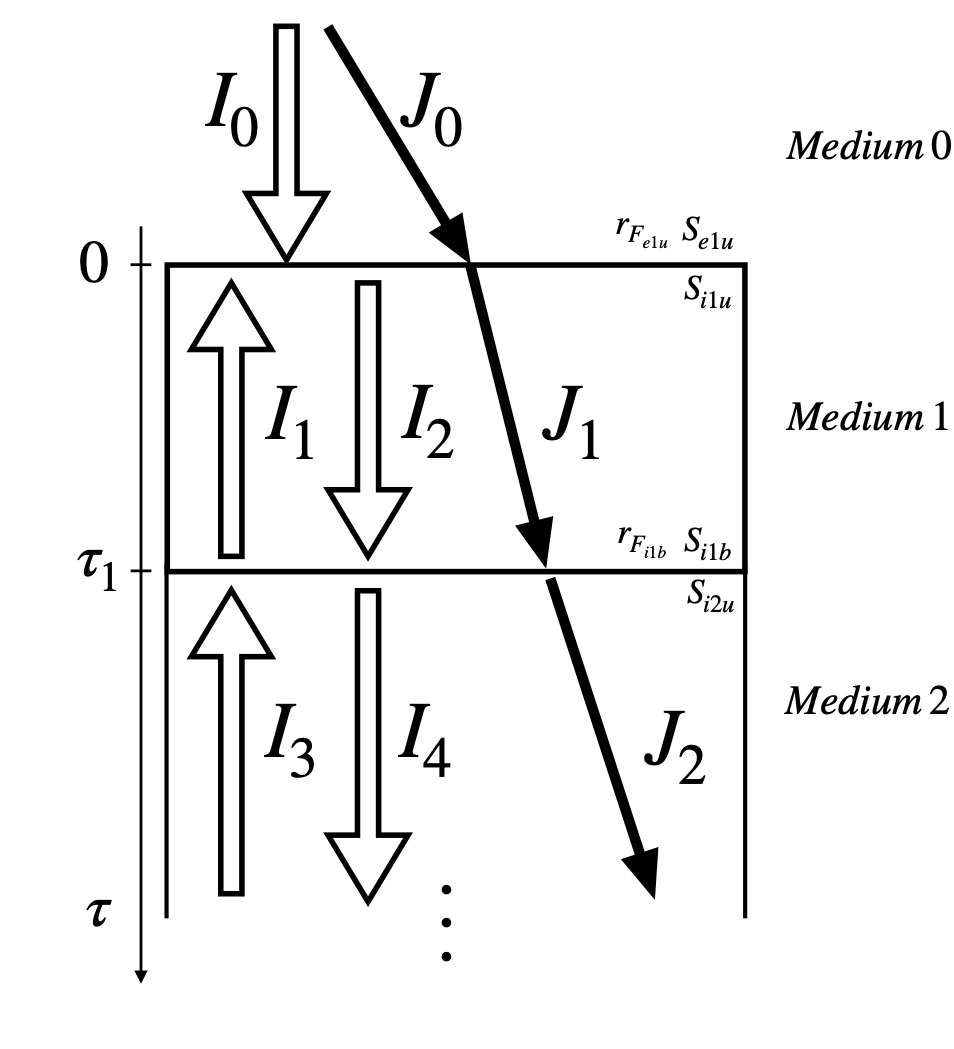
Figure 1. Description of the various fluxes and quantities involved inside the different media. Our model supposes a bilayered material illuminated from the top by collimated source J0 and diffuse isotropic illumination I0. The incidence angle of the collimated source J0 in medium 0 is noted μ0 (respectively μ1 and μ2 for medium 1 and 2). Through the propagation in the media, the collimated source is noted J1 in medium 1 and J2 in medium 2. For granular material, all reflection coefficients rFx, Sx are 0. For slab compact media with interfaces, those coefficients can be computed using the Fresnel law. Our model solve the two-stream approximation of the diffuse intensities I, and in particular the outward flux at the top to estimate the reflectance of this complex bilayered material.
This formulation of the problem allow us to couple the medium 1 and 2 with internal and external reflections, that was not possible with our previous model [2], making it suitable for any kind of 2 layer surface.
Solution
The resolution of the radiative transfer under the two-stream approximation is conducted with the same methodology as Hapke [1] , and similarity relations are used to take the anisotropy of scatterers into account. Inside medium 1 or 2 (see Fig. 1), the radiative transfer equation can be integrated over the upward and downward solid angles, giving two differential equations:

where ω is the single-scattering albedo, I↑ is the upward flux, I↓ the downward flux and F(𝜏) is the source function at optical thickness 𝜏. The solution of these differential equations has a known general form, with 4 unknown integration constants, that are determined using the following boundary conditions:
- When 𝜏 → ∞, I3 and I4 must remain finite
- At 𝜏 = 𝜏1 , we apply the continuity rules for upward and downward streams and consider that all that is left of the collimated radiation inside the medium 1 is either transmitted to medium 2 or reflected back according to Fresnel's reflection coefficient. We also approximate that what is reflected upward can be accounted as diffuse upward radiation and thus be included in I1.
- At 𝜏 = 0, we apply the continuity rules for I0 and I1 and I2.
These boundary conditions are extended from [1,3]. In our case, reflections at the interfaces are considered.
The first boundary condition imposes one out of the 4 unknown integration constants to be 0, and the other two gives three equations, yielding a linear system of three equations with three unknowns that can be readily solved.
Discussion
Singularities:
The resulting expression for the reflectance contains several “0/0” singularities. These singularities have no physical basis and must have a finite limit. They already existed in the granular monolayer version of the two-stream resolution [1] and the granular over granular resolution [3]. Despite great efforts, we could not reformulate the expression into one that did not contain such singularities. We chose to find the analytical limits around them using Mathematica, and expectedly found a finite limit for the twelve identified singularities.
Comparison with ray-tracing and photometric behavior:
We compared this new analytical formulation with a recently developed monte-carlo radiative transfer model [4], in the case of a thick slab of water ice at wavelenght 1 µm. Fig. 2 shows the photometric behavior of TARTATIN compared to WARPE [4]. The various reflection coefficients are computed considering the optical indexes of water at 1 µm (real part n=1.30, imaginary part κ=1.27.10-6 from [5]). A good agreement between both models is found, within a few percent, which is expected. Indeed, the two-stream approximation is known to produce errors up to 5% [1]. The observed behavior, with maximum radiance factor around emergence 60°, is mainly due to the refraction of rays going from medium 1 (ice) to medium 0 (air). Interestingly, this photometric effect increases significantly with ω1.

Figure 2: Angular dependency of the radiance factor (I/F), for TARTATIN (line) and monte carlo ray tracing algorithms WARPE [4] (crosses).
Conclusion
We present TARTATiN, a simple analytical formulation of the reflectance of a two-layer plnetary surface. Only a few parameters are needed to describe the reflectance, using parametrizations to convert compositions and grain-sizes inside the media into optical quantities, such as developed in [2]. The method’s precision is estimated at a few percent, which is inherent to the energy conservation of the two-stream approximation and numerical constraints. A key advantage of this model is its fully analytical nature, enabling extremely fast numerical implementation.
Raferences:
[1] Hapke, Cambridge University Press, 2012
[2] Andrieu et al., Applied Optics, 2015
[3] Johnson et al., Icarus, 2004
[4] Barron et al., JQSRT, 2025
[5] Schmitt, et al., 1998
How to cite: Andrieu, F. and Schmidt, F.: TARTATIN: an analytical radiative transfer model for layered planetary surfaces with interfaces, Europlanet Science Congress 2026, The Hague, The Netherlands, 7–11 Sep 2026, EPSC2026-79, https://doi.org/10.5194/epsc2026-79, 2026.


