
 1,1,1,1,1,1,2,2,2,2,3,3,4,1,1,1,
- 1Italian National Institute for Astrophysics (INAF), Institute for Space Astrophysics and Planetology (IAPS), Rome, Italy (beatrice.baschetti@inaf.it)
- 2Italian National Institute for Astrophysics (INAF) - Astronomical Observatory of Padova (OAPD), Padova, Italy
- 3Centre of Studies and Activities for Space (CISAS) “G.Colombo”, Padova, Italy
- 4Department of Geosciences, University of Padova, Padova, Italy
Introduction: Understanding the surface composition of Mercury remains one of the most challenging aspects related to the study of this planetary body. As of today, observations from the NASA MESSENGER mission show that most of Mercury’s surface does not exhibit distinctive absorption features in the visible and near-infrared range [1]. A notable exception is the presence of a 630 nm band, possibly coupled with a ~900-1000 nm inflection, associated with the enigmatic features known as hollows. Additionally, a feature at 830 nm was discovered in the relatively fresh material within the Praxiteles basin, including hollows in the early stage of their formation [2].
Hollows are a surface morphological expression unique to Mercury, consisting of bright and irregular flat-floored depressions and thought to form by loss of volatiles from the surface [3]. Indeed, their feature at 630 nm has been attributed to the presence of volatile sulfide and chloride species [4-6]. However, it has also been pointed out that low-iron mafic silicate minerals enriched in Cr, Ti and Ni could be partly responsible for the hollows’ spectral behavior [7]. The 830 nm feature is also suggested to be related to low-iron minerals [2]. Hence, hollows potentially represent a unique window on the planet’s extremely reducing crust. Given these premises, expanding on the range of investigated hollows is essential to study the extent of variability of their spectral features, providing constraints on their formation mechanism and on the nature of the bedrock on which they form.
In this work we investigated the spectral variability of hollows in the Michelangelo quadrangle (H12, Figure 1) using unsupervised machine learning. Considering the current challenges of identifying spectral signatures on Mercury, such advanced methods can be particularly useful to identify patterns and subtle spectral changes. The selected region encompasses several areas where hollow fields are present. The Michelangelo quadrangle (lat. 22.5°S–65.0°S and lon. 180°E–270°E) has diverse terrains, offering a range of potential bedrock sources for hollow formation: morphologically, the area is dominated by intermediate plains, while intercrater plains are the second most widespread unit [8]; spectrally, the region is characterized by both dark-blue terrains and by bright reddish-yellow terrains (Figure 1).
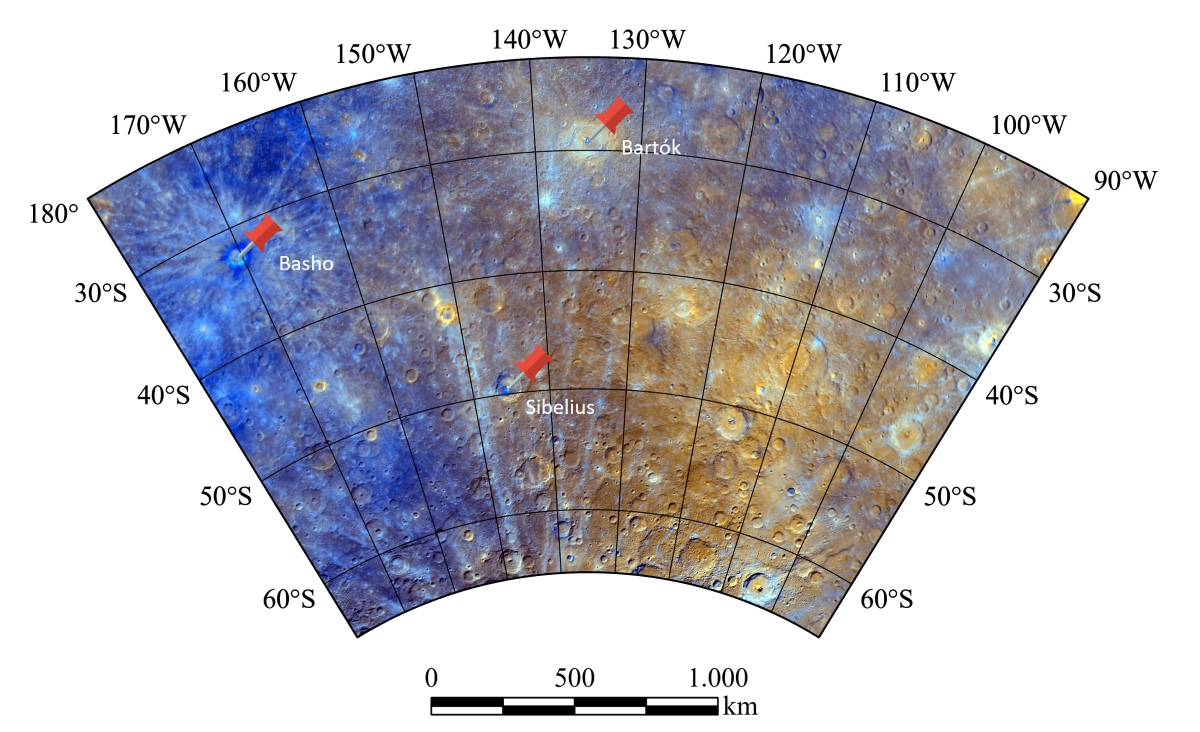
Figure 1. MDIS enhanced mosaic of Michelangelo quadrangle. Selected areas for spectral analysis of hollows are pinpointed on the map.
Data and methods: Hollow fields were selected based on the global catalogs by [9, 10] and from the map of the Michelangelo quadrangle by [8]. This information was combined with the map by [11], which highlights the broad, shallow band near 600 nm that is observed in low reflectance materials (LRM) but often also found in hollow materials. Based on this, we identified large hollow fields with a strong 600 nm feature in Basho, Bartók, and Sibelius craters (Figure 1).
For spectral analysis, we employed multispectral data (400-1000 nm) from the MESSENGER Mercury Dual Imaging System (MDIS) - WAC. EDR (Experiment Data Records) images were radiometrically and photometrically corrected following [12] and stacked to data cubes through the Integrated Software for Imagers and Spectrometers (ISIS). High-resolution MDIS-NAC images (panchromatic, 750 nm), radiometrically and photometrically corrected, are used for contextual and morphological analysis. MDIS-WAC data are clustered via unsupervised learning using a full covariance gaussian mixture model (GMM), a method which well suits spectral data analysis, being fast and capable of dealing with complex large datasets.
Results: We show results from Basho crater (Figure 2). The cluster analysis was performed on a portion of an 8 filter WAC image at 840 m/px resolution. Considering the color variability from the enhanced map (Figure 2a), 10 clusters were given as input to the algorithm (Figure 2b). Of these, 4 clusters correlate to areas with hollow fields and nearby terrains (clusters number 2, 5, 8, 9; Figure 2b and 2c). The average (median) spectral signatures of these clusters are shown in Figure 2d.
Clusters 2 and 8 show a broad ~ 550-800 nm range absorption feature related to hollows with different average reflectance levels. Additionally, cluster 8 displays a deeper band in the 550-800 nm range, as well as an inflection towards 1000 nm. Clusters 5 and 9 do not show the 550-800 nm band, but highlight the presence of a shallow 900 nm band. Results from Bartòk, and Sibelius reveal a similar variability.
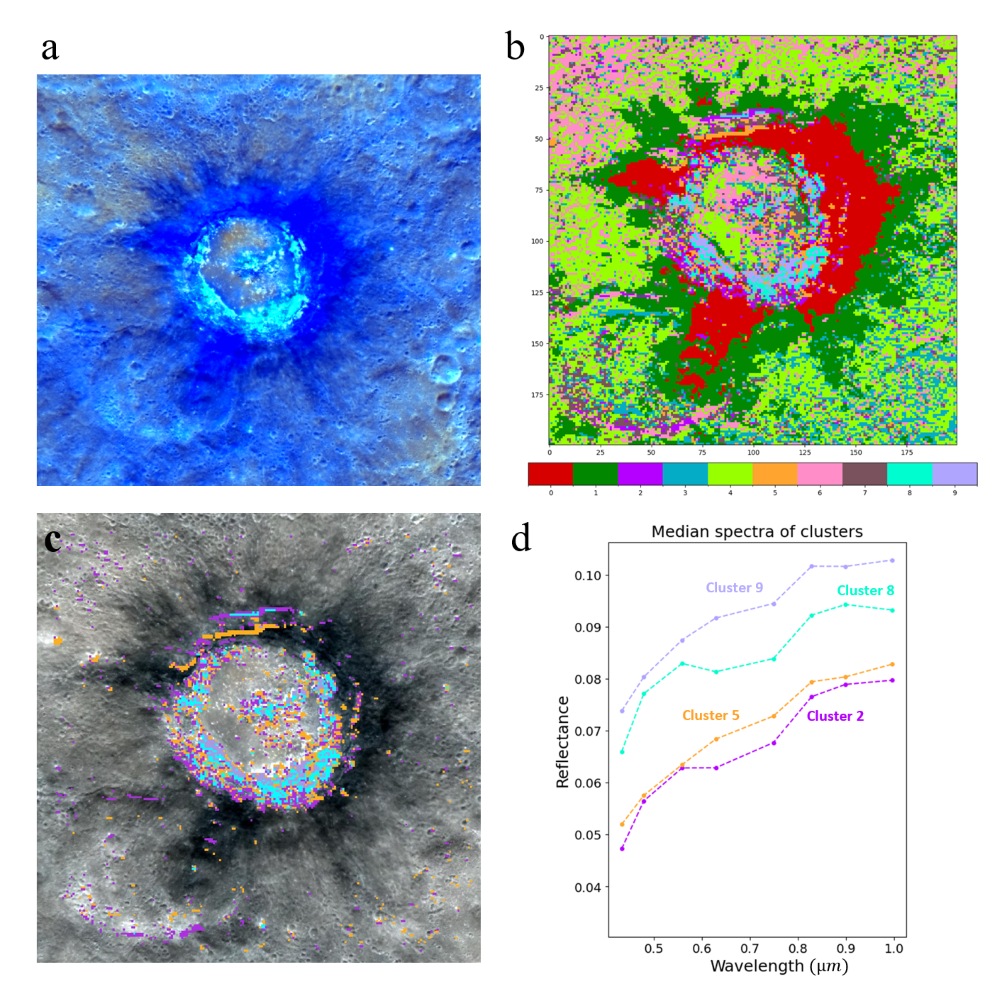
Figure 2. (a) MDIS enhanced view of Basho crater. Hollows and surrounding materials appear in bright cyan colors; (b) spectral clusters obtained with a full covariance GMM; (c) clusters in (b) spatially correlating with hollows and surrounding materials; (d) median spectra of clusters from panel (c).
Summary and future perspectives: By means of unsupervised machine learning we provided evidence of high spectral variability among hollow-associated materials in the area of the Michelangelo quadrangle. Future characterization will include complementary analysis with spectral indices and correlation with morphology to better assess the origin and possible interpretation of the observed signatures. The results will represent an important pre-characterization of hollow materials in preparation for the observations by the SIMBIO-SYS/Visible Infrared Hyperspectral Imager Channel (VIHI) instrument onboard the ESA/JAXA BepiColombo mission. In particular, the Michelangelo quadrangle is scheduled to be imaged within the first six months of the primary mission phase, offering one of the earliest opportunities to directly compare new orbital hyperspectral observations with the spectral trends identified in this study.
References: [1] Izenberg et al., 2014, Icarus, 228 (2014); [2] Galiano et al., 2026, Planet. Sci. J. 7, 27. [3] Blewett et al., 2011, Science, 333, 1856-1859; [4] Vilas et al., 2016, Geophys. Res. Lett., 43, 1450-1456. [5] Lucchetti et al., 2021, Icarus, 370, 114694; [6] Barraud et al., 2023, Science, 9(12), eadd6452; [7] Lucchetti et al., 2018, JGR: Planets, 123, 2365-2379; [8] Buoninfante et al., 2015, J. Maps, 21 (1); [9] De Toffoli et al., 2024, ESS, 11, 12; [10] Bickel et al., 2025, JGR: MLC, 2, e2024JH000431. [11] Klima et al., 2018, GRL, 45, 7. [12] Domingue et al., 2016, Icarus, 268, 172-203.
Acknowledgments: this study is supported by the ASI agreement n. 2024-18-HH.0
How to cite: Baschetti, B., Filacchione, G., Buoninfante, S., Carli, C., Galiano, A., Zambon, F., Munaretto, G., Tullo, A., Vergara Sassarini, N. A., Re, C., Tognon, G., Massironi, M., Giacomini, L., Galluzzi, V., Capaccioni, F., and Cremonese, G.: Spectral variability of hollows in the Michelangelo quadrangle of Mercury as revealed through unsupervised clustering methods., Europlanet Science Congress 2026, The Hague, The Netherlands, 7–11 Sep 2026, EPSC2026-790, https://doi.org/10.5194/epsc2026-790, 2026.


