
 2,2
2,2- 1Department of Earth and Planetary Science, School of Science, The University of Tokyo, Tokyo, Japan (horie-yuna937@g.ecc.u-tokyo.ac.jp)
- 2Institut Supérieur de l'Aéronautique et de l'Espace (ISAE SUPAERO), University of Toulouse, Toulouse, France
Abstract
This study investigates the influence of grain-scale characteristics, including size, angularity, and bulk density, on the avalanching behavior of two-dimensional granular column collapses on three distinct materials: sand, glass grit, and glass beads. Our results demonstrate that the morphological evolution of the final deposit is fundamentally governed by the initial aspect ratio, a. A critical regime change of the final deposit was observed at a ~ 0.7 for glass beads and a ~ 1 for angular particles. Scaling laws for the normalized deposit height (Hf/Li) and normalized runout distance ((Lf-Li)/Li) qualitatively follow known power-law behavior. However, our derived exponents indicate a higher sensitivity to the initial aspect ratio compared to previously reported values. These findings suggest that while aspect ratio remains the primary governor of collapse dynamics, grain-scale angularity plays a significant role in determining the timing of regime transitions and the slope angle.
Introduction
Understanding granular flow is essential for interpreting in-situ and remote observations of planetary surfaces, ranging from cm-scale wheel-regolith interactions to km-scale landslides. This study is motivated by the significant diversity in regolith morphology observed across the solar system, where highly angular lunar grains contrast with the rounded particles found on Mars. Although established scaling laws describe post-avalanche deposits based on the initial aspect ratio (a) [1, 2, 3], grain-scale characteristics fundamentally alter mass wasting, and flow behavior remains insufficiently quantified. To address this gap, we expand upon previous works by investigating a diverse range of materials including sand, glass grit, and glass beads, to provide a more comprehensive characterization of the scaling laws governing granular avalanches.
Experiment Setup
To investigate the role of grain-scale characteristics in avalanching behavior, we conducted a series of controlled column collapse experiments using a polycarbonate rectangular container measuring 100 mm in height by 300 mm in length by 30 mm in width (Fig. 1). The channel width was selected to avoid wall effects on the flow dynamics, while the base features a rough surface to simulate natural boundary conditions. The experimental configuration promotes unidirectional spreading, with the particulate column initially accommodated at one end of the channel. Flow was initiated by the rapid retraction of a frontal gate using a pulley system. Sand, glass grit, and glass beads, with various sizes, grain morphology, and bulk density, were tested. Avalanching processes were recorded using a high-speed camera, providing high-resolution data to characterize runout behavior and the morphological features of the deposits.
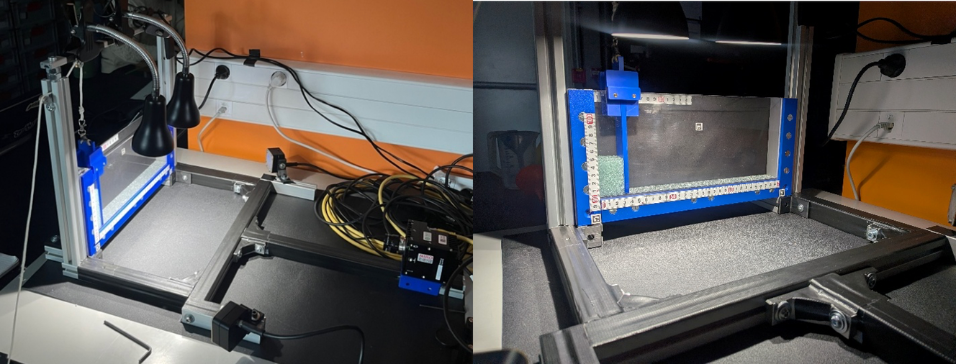
Figure 1: Setup for two-dimensional granular column collapse experiments.
Results
Our experiments confirm that the morphology of a post-avalanche deposit is fundamentally governed by the initial aspect ratio a of a column (Fig. 2). For low aspect ratios (a <= 0.7 for glass beads and a <= 1.0 for angular particles), the deposit retains a motionless plateau with a constant final slope angle, measuring approximately 20 degrees for beads and 25 degrees for angular materials (Fig. 3). The difference in angle of repose is due to grain angularity. As a exceeds these critical values, the column transitions to a vertical collapse mode where initial potential energy is converted into horizontal spreading, resulting in gentler final slopes that exhibit a consistent trend across all tested materials. This morphological transition is reflected in the scaling laws for normalized maximum deposit height (Hf / Li), where a regime change corresponds to the disappearance of the plateau of final deposit (Fig. 4). For angular particles, the power-law exponent shifts from 0.96 +/- 0.03 to 0.43 +/- 0.02 at a = 1, while beads exhibited a similar shift at a = 0.7 from 0.96 +/- 0.03 to 0.43 +/- 0.01. These observations qualitatively align with Lube et al. (2005), who identified a transition for coarse sand at a = 1.15 with an exponent shift from 1 to 0.4, and Lajeunesse et al. (2005), who observed a transition for beads at a = 0.7 to an exponent of 0.33. While our derived exponents are slightly higher, the overall power-law behavior and the timing of the regime transitions show good agreement. Furthermore, the normalized runout distance ((Lf - Li) / Li) displayed a regime change at a ~ 2.5, with power-law transitioning from 1.0 +/- 0.03 to 0.80 +/- 0.12 (Fig. 5). Although previous studies [1, 2] reported a transition at a ~3 to a 0.67 power law, our results indicate a higher sensitivity to the initial aspect ratio in the large-a regime. These results demonstrate that grain morphology is one critical factor governing regime transitions in granular collapses, providing further constraints for interpreting the surfaces of celestial bodies with varying regolith characteristics. Future work will investigate the effects of material friction and surface gravity, which will be integrated into scaling laws to enable more precise estimations of regolith properties from asteroid imagery.
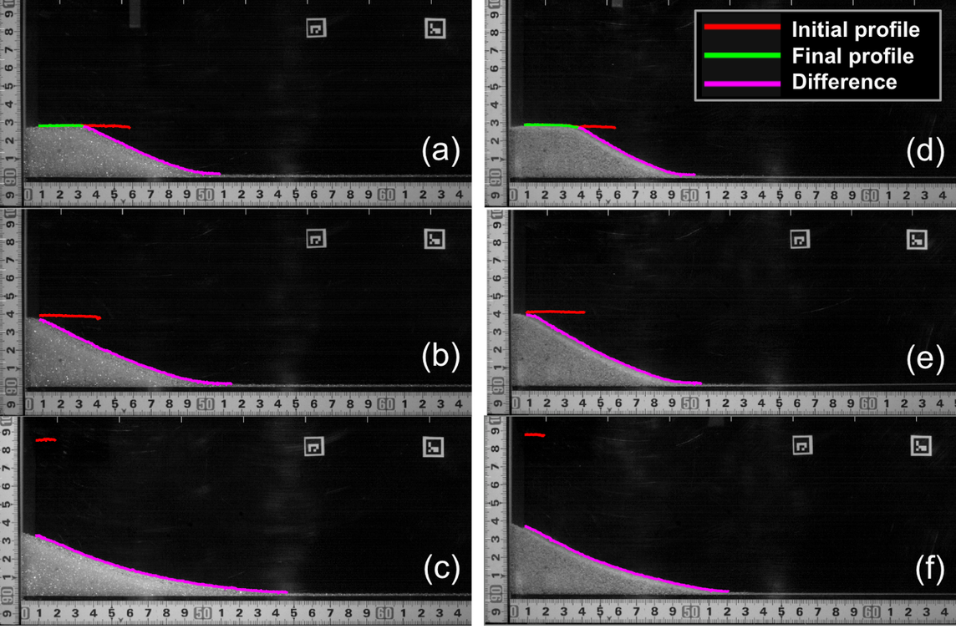
Figure 2: Panels (a–c) show the final deposits of glass beads (diameter = 0.855 mm) for a = 4.5 (a), 0.95 (b), and 0.50 (c). Snapshots (d–f) show sand (diameter = 0.5 mm) at a = 4.6 (d), 1.0 (e), and 0.49 (f). For both materials, a static plateau remains at low aspect ratios (a ~ 1.0), while higher aspect ratios lead to a complete vertical collapse.
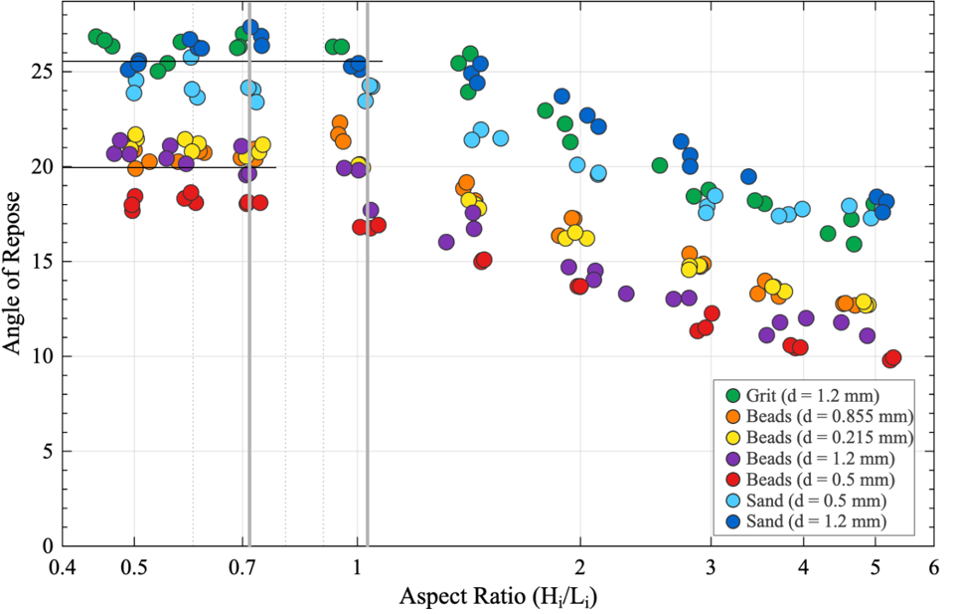
Figure 3: Angle of repose vs initial aspect ratio, with the vertical lines showing the first flow transition for glass beads (a = 0.7) and angular particles (a = 1).
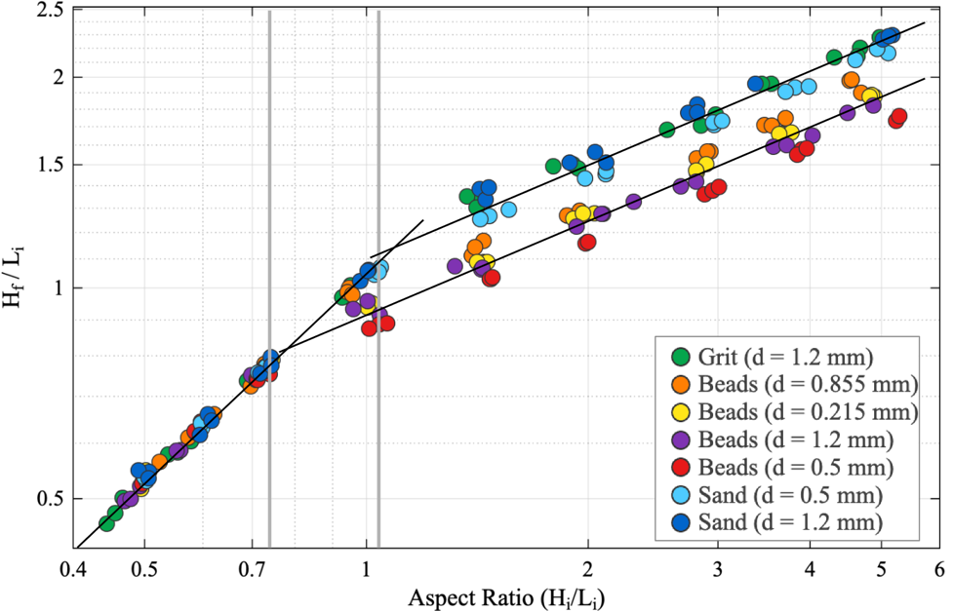
Figure 4: Normalized final deposit height vs initial aspect ratio, with the vertical lines showing the first flow transition for glass beads (a = 0.7) and angular particles (a = 1).
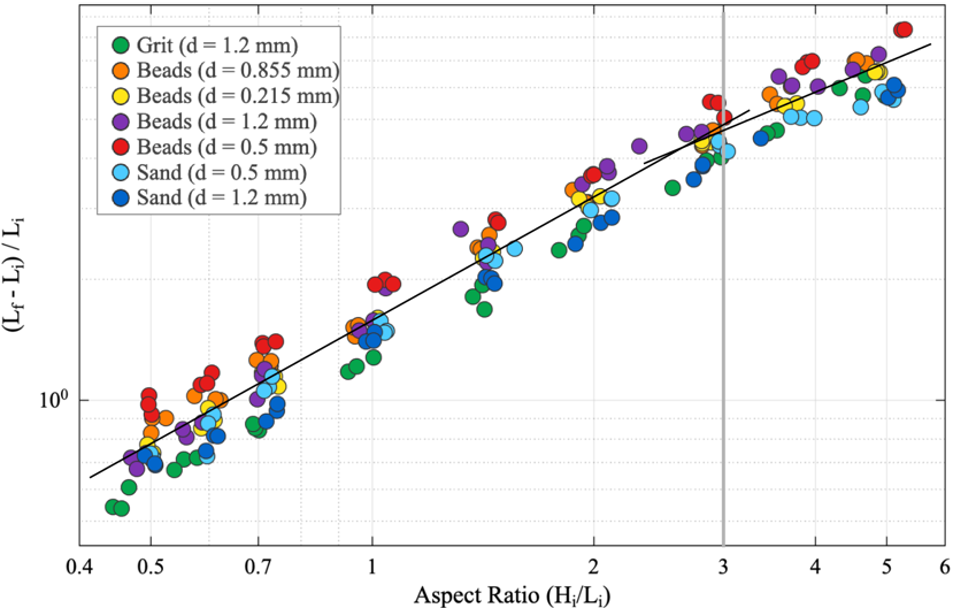
Figure 5: Normalized runout distance vs initial aspect ratio, where the vertical line shows the second regime transition for all materials (a = 3).
Acknowledgement
This work is supported by the European Research Council GRAVITE project (grant N°1087060).
References
1. Lube, G., et al. PRE 72.4 (2005).
2. Lajeunesse, E., et al. GRL 4 (2006).
3.Roche, O., et al. EPS Letters 311 (2011).
How to cite: Horie, Y., Sunday, C., Sugita, S., and Murdoch, N.: Grain-Scale Morphology and Initial Aspect Ratio Effect on Granular Avalanches, Europlanet Science Congress 2026, The Hague, The Netherlands, 7–11 Sep 2026, EPSC2026-796, https://doi.org/10.5194/epsc2026-796, 2026.


