
 1,1,2,1,1,3,3,4,5,
- 1Paris Sciences et Lettres - Observatoire de Paris, Laboratoire Temps Espace - LTE, Paris, France (raphael.lallemand@obspm.fr)
- 2Institut Polytechnique des Sciences Avancées IPSA, Ivry-Sur-Seine, France
- 3Laboratoire Lagrange, Université Côte d’Azur, OCA, CNRS, Nice, France
- 4Aristotle University of Thessaloniki (AUTh), University Campus, 54124 Thessaloniki, Greece
- 5Instituto de Astrofísica de Andalucía (CSIC), Glorieta de la Astronomía s/n, 18008 Granada, Spain
- *A full list of authors appears at the end of the abstract
Multiple systems are now recognised as a common outcome of small-body-evolution in the Solar System. As of today, we estimate the fraction of binaries at ~15% of Near-Earth objects and Transneptunian objects population [1, 2]. A similar fraction hase been estimated among small Main-Belt objects (D <10 km) [3]. These binary systems provide key access to fundamental parameters of Solar System remnants and planetary formations such as the bulk densities, mass and internal structure [4]. However, the current knowledge of these populations remains strongly biased by observational limitations. In particular, main-belt binary systems are still poorly characterised, since current techniques preferentially detect either widely separated binaries through direct imaging or close and bright systems via photometry and radar [5,6]. In this context, the high-precision astrometry of the Gaia mission has revealed a new population of candidate binaries exhibiting dynamical signatures consistent with unresolved companions [8,9]. The present work is part of the GaiaMoons program and aims to characterise a sample of 622 potential binary asteroid targets and to confirm or refute their binary nature. The properties of these candidates were derived from the high-precision photometric and astrometric observations provided by the Gaia satellite.
Stellar occultations emerge as one of the most effective methods to confirm their binary nature and to improve the current census of intermediate-size systems. Stellar occultations occur when three bodies align : an observer, an occulting Solar System object, and a background star. The occulting object passes in front of the star, creating a shadow detectable by the observer. As the object moves, the shadow also moves along way, creating an occultation path on the surface of the Earth. This method allows to have access to its physical parameter such as its volume with a sub-kilometric precision [9,10]. Between October 2023 and March 2026, 176 observations were successfully carried out for more than a hundred targets. These events were subsequently analysed in the context of the available literature and previously reported observations [11].
Out of 176 observations, 79 led at least to one positive observation. Among them, 24 objects have undergone unprecedented occultation observation campaigns. A detailed presentation will be made for objects showing strong indications of binary or contact binary features namely (35420) 1998 AG6, (206) Hersilia and (36882) 2000 SW155 (see Figure 1). These key stellar occultation campaigns illustrate the efficiency of mixing highly precise Gaia data with stellar occultation to characterise new binary or contact binary systems.
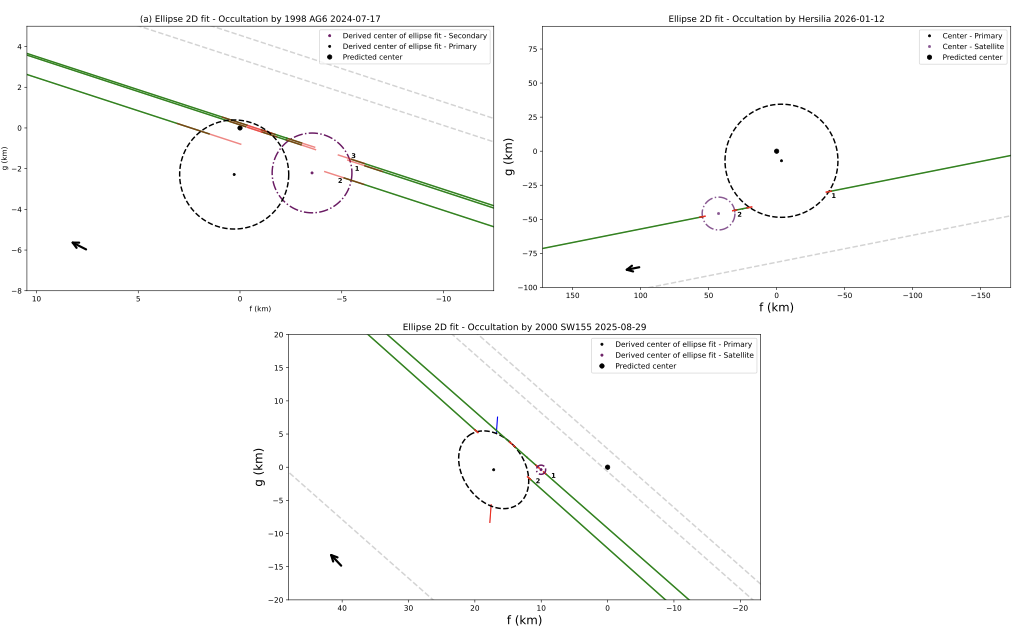
Figure 1: Sky-plane projection of the stellar occultation events of (35420) 1998 AG6 on 2024/07/17 (top left), (206) Hersilia on 2026/01/12 (top right) and (36882) 2000 SW155 on 2025/08/29 (center down). The green lines stand for positive observations while grey dottd-lines stand for negative ones. Red segments represent timing uncertainties for immersion and emersion. Primary and satellites fits are displayed by black and purple dotted-line ellipses. Numbers are displayed to distinguish drops. The arrow shows the direction of the object in the sky plane.
In the end, resulting dataset provides, for the vast majority of these objects, unique physical and astrometric constraints, as they had never been observed through stellar occultations before. GaiaMoons illustrates how stellar occultation campaigns, associated to Gaia observations, generate a self-improving cycle to find new binary systems : probe size and shape to constrain future observations. By standardising this approach, we deliver critical data in unexplored parameter spaces, resolving long-standing observational ambiguities.
Acknowledgement
This work was supported by the project GaiaMoons of the Agence Nationale de Recherche (France), grant ANR-22-CE490002. The GaiaMoons team gratefully acknowledges the amateur communities of IOTA, IOTA/ES, IOTA/EA, TTOA, and Planoccult for their essential support, dedication, and significant contributions to this work. The properties of Solar System Object are from the service SsODNet.ssoCard of the Space Service (SE-OP) of Laboratoire Temps Espace at Paris Observatory through its Solar System Portal (https://ssp.imcce.fr) with the python library rocks (https://github.com/maxmahlke/rocks). This work has made use of data from the European Space Agency (ESA) mission Gaia (https://www.cosmos.esa.int/Gaia), processed by the Gaia Data Processing and Analysis Consortium (DPAC, https://www. cosmos.esa.int/web/Gaia/dpac/consortium). The authors would like to thank the Action Pluriannuelle Incitative (API) Pro-Am initiated and supported by Paris Observatory in the ROADIES program context. Z. Liu and D. Hestroffer thank the Academie Spatial program for their support. Part of observations were funded by the Scientific Research Projects Coordination Unit of Istanbul University with project numbers: BAP-3685 and FBG-2017-23943. Felipe Braga-Ribas acknowledges CNPq grant 316604/2023-2 and the financial support of the NAPI “Fenômenos Extremos do Universo” of Fundação de Apoio à Ciência, Tecnologia e Inovação do Paraná. M.A. thanks grants CNPq 427700/2018-3, 310683/2017-3, and 473002/2013-2, and FAPERJ E-26/210.705/2024. Y. Kilic, J.L. Ortiz, N. Morales and P. Santos-Sanz acknowledge financial support from the Severo Ochoa grant CEX2021-001131-S funded by MICIU/AEI/10.13039/501100011033. P. Santos-Sanz and Y. Kilic acknowledge financial support from the Spanish I+D+i project PID2022-139555NB-I00 (TNO-JWST) funded by MCIN/AEI/10.13039/501100011033. TUG100 Telescope at the Antalya TUG Site of the Türkiye National Observatories has been utilized, and we express our gratitude for the support provided by the Türkiye National Observatories and all its staff.
[1] Pravec et al., 2007, Icarus, Photometric survey of binary near-Earth asteroids.
[2] Noll et al., 2008, The Solar System Beyond Neptune, Binaries in the Kuiper Belt.
[3] Ćuk et al., 2010, Icarus, Orbital evolution of small binary asteroids.
[4] Fuentes-Muñoz, 2025, The Astrophysical Journal, Asteroid Mass Estimation by Mutual Perturbations During Close Encounters After Gaia Focused Product Release.
[5] Ostro S. J., 2002, Asteroids III, Asteroid Radar Astronomy.
[6] Grundy et al., 2019, Icarus, Mutual orbit orientations of transneptunian binaries.
[7] Liberato et al., 2024, Astronomy & Astrophysics, Binary asteroid candidates in Gaia DR3 astrometry.
[8] Liberato et al., 2026, Astronomy & Astrophysics, submitted.
[9] Desmars et al., 2019, Astronomy & Astrophysics, Pluto's ephemeris from ground-based stellar occultations.
[10] Rommel et al., 2020, Astronomy & Astrophysics, Stellar occultations enable milliarcsecond astrometry for Trans-Neptunian objects and Centaurs.
[11] Lallemand et al. 2026, Astronomy & Astrophysics, submitted.
A. Leroy, M. Assafin, L. Abe, D. Mary, R. Leiva, F. Casarramona, D. Smith, D. Antuszewicz, J.-L. Dauvergne, G. Langin, P. Henarejos, P.-L. Phan, F. Braga-Ribas, A. Castro, A. Pal, \'A. S\'odor, A. Cano Ruiz, A. Ossola, A. Pratt, A. Noschese, A. Manna, A. Eberle, A. Schweizer, A. Wendelborn, A. Marciniak, A. Catapano, B. Zi\'o{\l}kowski, B. Begi\c{c}arslan, B. Kattentidt, B. Lade, B. Whitehurst, C. T. Tezcan, C. Weber, C. Schnabel, C. A. Domingues, C. Ziolek, C. Sartini, C. M. Schäfer, C. McPartlin, Cs. Kiss, D. Blazewicz, D. Deneuchatel, D. Herald, D. W. Dunham, D. Sailing, E. Fonseca Morato, E. Goni, E. Fernandez-Garcia, E. Namur Neto, E. Smith, E. Gradovski, E. Donate Lucas, E. Garc\'ia Navarro, E. Kaan \"Ulgen, F. Garcia, F. Genc, G. Margoti, G. Arraras, G. Schmidt, G. Privett, G. Krannich, G. Lyzenga, H. de Groot, I. P\'erez-Garcia, I. Z. Kelkitli, J. M\'anek, J. Flores-Martín, J. Prat, J. Bardecker, J. Delincak, J. Siegert, J. Dunham, J. Moore, J. Talbot, J. A. Berlanga, J. A. Reyes, J. L. Maestre, J. L. Ortiz, J. Collada Barcena, J. Per{\l}a, J. Spagnotto, K. Getrost, K.-L. Bath, K. Harrison, K. Okasaki, K. Bender, M. OConnell, M. Skrutskie, M. Jennings, M. Gutekunst, M. Margoti, M. I\c{c}en, M. Acar, M. Fid\^encio Neto, M. Altan, M. Rottenborn, M. Turchenko, M. A. Alava Amat, M. Kretlow, M. Tekkesinoglu, N. Tak\'acs, N. Karaman, N. Castro-Morales, N. Morales, N. Wakefield, O. Erece, O. Canales Moreno, P. Santos Sanz, P. Fini, P. D. Maley, P. Teckenburg, P. Walker, P. Martorell, P. Gilge, P. Zeleny, P. Stuart, A. Ashimbekova, P. Denyer, R. Sfair, R. Nolthenius, R. Piety, R. Liu, R. Jones, R. Szak\'ats, R. Gon\c{c}alves, S. Pastor, S. Chairetas, S. Kalkan, S. \"Ozel, S. \"Otken, S. Ali{\c s}, S. Tsavdaridis, S. Meister, S. Sposetti, S. Conard, S. Tirak, S. Fisek, T. Swift, T. Haymes, T. Jan\'ik, V. Nikitin, V. Cucchiaro, W. Hanna, R. Dahoumane, W. Ogloza, W. Stewart, W. Beisker, Y. Liu, Y. Avcioglu, S. Quinet, J.-F. Counilh, M. Irzyk, C. Marlot, A. Keijzer, Y. Pinard, X. Dupont, T. Salomon, T. Mollier, T. Legault, S. Valat, S. Kindt, S. Kidd, J. Souchu, S. Vasseur, R. Dequinze, P. Couvée, P. Lemoine, P. Barroy, P. Le Cam, P.-J. Mercier, P. Andr\'e, P. Le Guen, O. Schreurs, M. Boutet, M. Giraud, M. Lecossois, M. Serrau, M. Conjat, L. Herrier, L. Rousselot, J. Delpau, J. Bourgeois, J.-C. Dalouzy, J.-F. Gout, J.-F. Pittet, J.-F. Coliac, J.-L. Dumont, J.-N. Ferrier, J.-P. Nombret, J.-P. Masini, J.-P. Arnould, J.-B. Marquette, G. Arlic, G. Vanwalleghem, F. Denjean, F. Cavaill\'e, E. Barbotin, E. Vauthrin, D. Bourdens, D. Walliang, I. Auvray, C. Latg\'e, C. Lavault, A. Stachowicz, E. Jacquet, C. Rizand, J. Raffard, M. Saillenfest, K. Hussein, M. Montargès, N. Robichon, S. Renner, V. Lapeyr\'ere, W. Thuillot, F. Vachier, D. Hestroffer, A. Vienne, J. Vaubaillon, F. Thill, B. Lott, C. Bourdens, R. Boninsegna, M.-C. Lin , Y.-L. Chen, S. H. Tsai, C.-E. Lee, Y.-N. Lee, Z.-Y. Lin, H.-C. Lin, C.-H. Wang, A. T.L. Shen, T.-H. Chuang , C.-C. Chang, Ha. Watanabe, M. Ida, H. Togashi, A. Asai, T. Nemoto, K. Hosoi, Hi. Watanabe, K. Isobe, H. Yoshihara, T. Horikawa , K. Kitazaki, M. Takimoto, H. Yamamura, M. Yamashita, F. Yoshida, F. Gourdon, D. Tamonis
How to cite: Lallemand, R., Desmars, J., Sicardy, B., Liu, Z., Tanga, P., Liberato, L., Carry, B., Siakas, A., and Kiliç, Y. and the co-authors: Detection And Characterisation of Binary Asteroids Candidates through Stellar Occultations , Europlanet Science Congress 2026, The Hague, The Netherlands, 7–11 Sep 2026, EPSC2026-8, https://doi.org/10.5194/epsc2026-8, 2026.


