
 1,1,2,1,3,4,5,3,3
- 1CNRS - GEOPS - Université Paris-Saclay, ORSAY, France (jean.barron@universite-paris-saclay.fr)
- 2Institut Universitaire de France, Paris, France
- 3Institute of Space Research, Deutsches Zentrum für Luft und Raumfahrt, Rutherfordstr. 2, 12489 Berlin,Germany
- 4Department of Earth and Planetary Science, Graduate School of Science, The University of Tokyo, Tokyo,113-0033, Japan
- 5Department of Cosmoscience, Graduate School of Science, Hokkaido University, Sapporo,060-0810, Japan
Introduction
Recent lidar instruments can measure the full waveform recording, allowing for the travel-time measurement of each emitted photon packet. This new information will allow finer characterization of the planetary surface medium. The BepiColombo laser altimeter (BELA) (Thomas2021) will explore the surface of Mercury using this capability. We propose a new simulation tool computing the travel-time inside planetary medium allowing the reconstruction of the full waveform for such instruments. It is a Monte-Carlo ray tracing algorithm called WARPE, for Waveform Analysis and Ray Profiling for Exploration (Barron2025). As input, the model uses relevant physical properties for planetary surface characterization.
Methods
The Monte Carlo ray tracing approach of WARPE is based on the work from Farrell1992, Wang1995 and Gastellu-Etchegorry2016. It computes the position each ray during its travel through the medium and possible interactions at the interfaces. The efficiency of WARPE is guaranteed by ray batch parallelization (further details in Barron2025). Main parameters are incidence and azimuthal angle, the optical thickness (τ0), the single scattering albedo (ω) the optical index (n,k) of the medium and the phase function. Moreover, it is possible to precompute radiative parameters using physical parametrization described in Hapke1993, Andrieu2015 and Douté1998, therefore we are able to use physical properties such as thickness, grainsize or porosity as input for WARPE’s simulation process. Furthermore, WARPE’s result are put under the BELA simulation pipeline (Steinbrügge2018; HosseiniArani2021) to includes instrumental effect on the simulated pulse shape.
Result
We describe here only the effect of medium properties on the pulse shape (details in Barron2026) ; roughness influence is more thoroughly discussed by Nishiyama2026. The altitude has an impact on the pulse shape global intensity. Spacecraft altitude is considered at 500 km. Figure 1 shows the output of WARPE computation. Most of cases simulated don’t extend enough in time dimension to reach BELA sampling interval of 12.5 ns. Figure 2 presents relevant WARPE’s output under BELA simulation pipeline (Nishiyama2026) to add the instrumental effects and simulate realistic observation. We see here that granular and compact media configuration don’t have the same response. Slab media pulse shapes tend to shift in time due to the convolution of both specular and back and forth peak. This feature is expected only for compact slab due to interactions at interfaces.
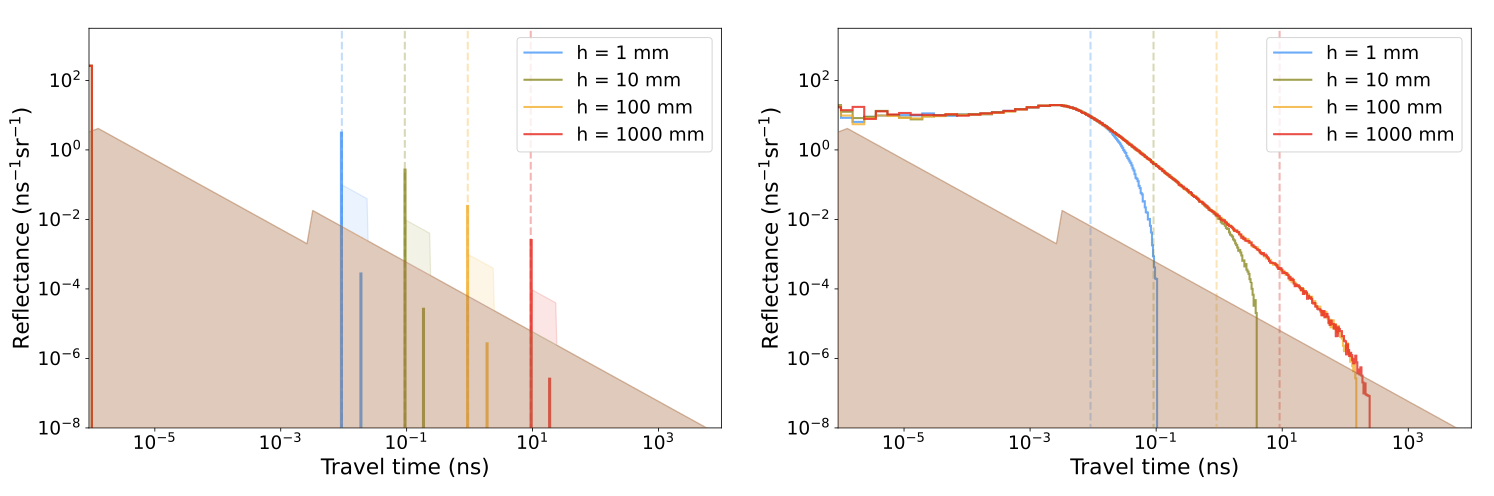
Figure 1: Effect of physical thickness on the waveform. The medium is pure CO2 ice with a thickness h. (left) In this situation, the compact slab is optically thin (τ0 ∼ 0.01) CO2 ice at 1064 nm being a very low absorbing medium (kCO2 ∼ 10-12). The visible features are the specular reflection and the Back and Forth (rays reaching the bottom of the medium and leaving it at the top). At 1000 mm the return time of the first Back and Forth almost reach BELA sampling interval of 12.5 ns but in this case the required thickness is 1335 mm. (right) The granular medium contains grain of 200 μm radius and porosity of 10%. the waveform distribution is not changed for thicker h in the shorter time domain, but rather after a threshold time that depends on h.
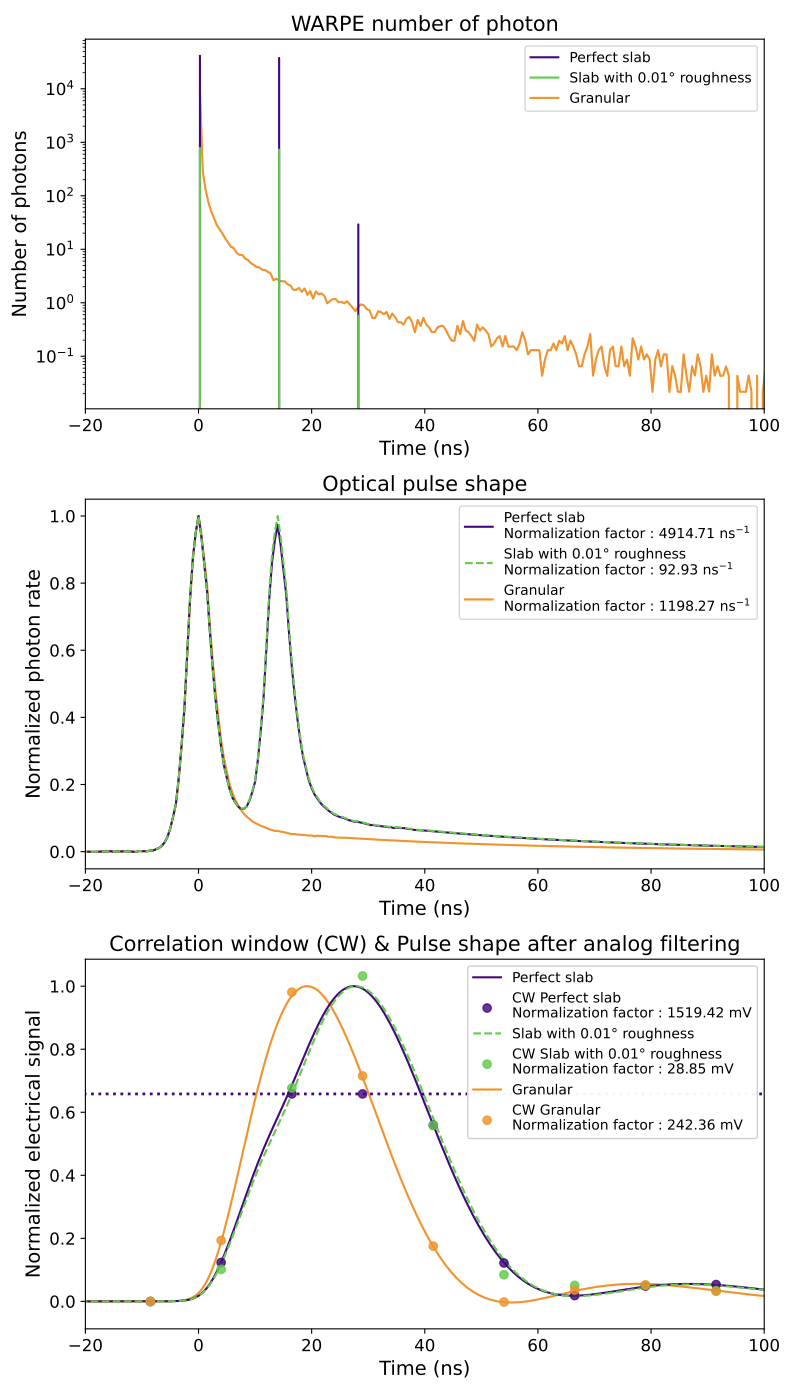
Figure 2: Realistic BELA pulse shape using WARPE and instrumental simulations (Nishiyama2026). (top) WARPE simulation of a perfect instrument with 3 cases: 1000 mm granular medium of pure CO2 ice with grain size of 200 μm and 10% porosity noted Granular ; 1500 mm pure slab of CO2 with no roughness noted perfect slab and finally the same slab with a mean roughness of 0.01°. (middle) The photons rate (in ns-1sr-1) reflected from the surface using realistic outgoing pulse shape from BELA (considering perfect receiver). Granular medium present a single peak, whereas the slab medium present 2 peaks due to the specular reflection at the top and at the bottom (direct Back and Forth). The third peak is negligible. Interestingly, the first peak shape is very similar in the slab and granular case. (bottom) The electric signal shape after analog filtering expected including both transmitter and receptor specification. This signal sampled at 12.5 ns is the one recorded by the BELA instrument. Granular and slab signals do not reach their maximum at the same time and their shape significantly differ due to the presence/absence of a second peak in optical pulse shape. The shape of the signal for slab with different roughness is similar however their intensities varies (Normalization factor are displayed). The purple dotted line indicates saturation threshold of 1000 mV from BELA. The green (and orange to a lower extent) dots do not perfectly match the curves due to added random noise in the signal sampled by BELA.
Conclusion and perspectives
We introduce a new approach to efficiently simulate the travel-time of photons in both granular and compact texture using as input physical parameters relevant for planetary surface characterization. Identification of microtextures relies on also on instrumental effect as they tend to hide smaller variations of physical properties. This study focuses on ices in PSR, but it could be extended to other cases such as mercury regolith with BELA, or icy moons’ surfaces with the Ganymede Laser Altimeter (GALA).
References
Andrieu et al. (2015), Applied Optics, https://doi.org/10.1364/AO.54.009228
Barron et al. (2025), Journal of Quantitative Spectropy and Radiative Transfer https://doi.org/10.1016/j.jqsrt.2025.109575
Barron et al. (2026), Simulation of laser travel-time on Mercury for BELA, Earth, Planets and Space (under review) (preprint on ArXiv)
Douté, Modelisation numerique de la reflectance spectrale des surfaces glacées du systeme solaire. application à l’analyse de spectres de triton et pluton et au traitement d’images hyperspectrales nims de io, Ph.D. thesis, Université Paris VII, thèse de doctorat dirigée par Schmitt, Bernard Terre, océan, espace Paris 7 1998 (1998).
Farrell et al. (1992), Medical Physics, https://doi.org/10.1118/1.596777
Gastellu-Etchegorry et al. (2016), Remote Sensing of Environment, https://doi.org/10.1016/j.rse.2016.07.010
Hapke, Theory of reflectance and emittance spectroscopy (1993), Cambridge university press
HosseiniArani et al. (2021), Planetary and Space Science, https://doi.org/10.1016/j.pss.2020.105088
Nishiyama et al. (2026), Return pulse shape simulations for predicting surface characterization of mercury by the bepi-colombo laser altimeter (bela): Implication to within-footprint roughness estimation by laser altimeters, Earth, Planets and Space (submitted soon).
Steinbrügge et al. (2018), Planetary and Space Science, https://doi.org/10.1016/j.pss.2018.04.017
Thomas et al. (2021), Space Science Reviews, https://doi.org/10.1007/s11214-021-00794-y
Wang et al. (1995), Computer Methods and Programs in Biomedicine, https://doi.org/10.1016/0169-2607(95)01640-F
How to cite: Barron, J., Schmidt, F., Andrieu, F., Nishiyama, G., Stark, A., and Hussmann, H.: Pulse shape and travel-time simulation to study the surface of Mercury, Europlanet Science Congress 2026, The Hague, The Netherlands, 7–11 Sep 2026, EPSC2026-80, https://doi.org/10.5194/epsc2026-80, 2026.


