
 1,1,2,3,2,4
- 1Université Paris-Saclay, CNRS, GEOPS, 91405, Orsay, France
- 2NASA Goddard Institute for Space Studies, New York, NY, USA
- 3Theoretical Astrophysics, Department of Physics and Astronomy, Uppsala University, Uppsala, Sweden
- 4Center for Climate Systems Research, Columbia University, New York, NY, USA
Context
The question of the existence of an ocean on Mars near the Hesperian-Amazonian transition has raised considerable controversy. Over the past decade, several studies have highlighted geomorphological evidence consistent with a Northern ocean hypothesis: tsunami deposits (Rodriguez, 2016; Costard, 2017), the identification of Lomonosov crater as a potential impact source for such tsunamis (Costard, 2019), paleoshoreline features (Li et al., 2025) and more.
On the other hand, the long-term stability of an ocean, whether in a warm-and-wet or cold-and-dry climate, has never been achieved with three-dimensional General Circulation Models (3D-GCMs) (Turbet, 2019; Kamada, 2022). Slab ocean simulations find that the ocean either freezes completely or causes water to accumulate as ice over the southern highlands, and that warm-enough scenarios produce intense rainfall and erosion near the shorelines, inconsistent with the geomorphological record.
However, a fully coupled dynamic ocean model can sustain a cold-and-wet climate regime with a stable ocean, while also reducing precipitation near the shorelines due to the lower mean global temperature (Schmidt, 2022). Building on this, Schmidt (2025) proposed a fully equilibrated water cycle by coupling the 3D-GCM with a simple ice sheet model.
Following Schmidt (2022), this study explores the parameter space allowing a stable ocean in a periglacial climate, further relaxing the constraints on both rainfall erosion and atmospheric conditions.
Methods
We use the updated version of ROCKE-3D, a 3D-GCM developed for terrestrial climate studies (Way et al., 2017; Tsigaridis et al., 2025), with a fully coupled dynamic ocean model. Simulations are run for ~ 100 Martian years to reach radiative equilibrium.
Results
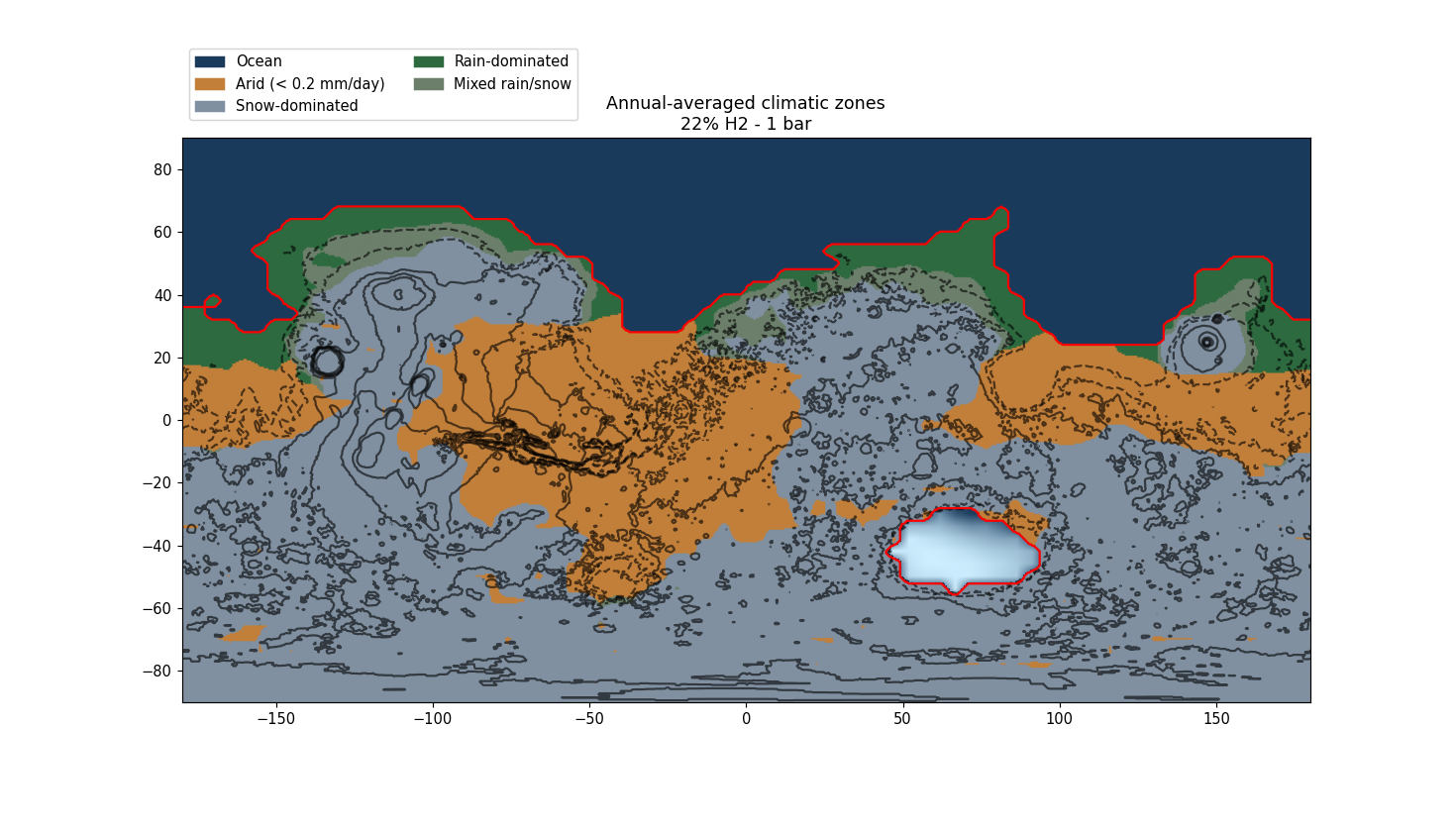
Figure 1 : Climatic zones obtained for a 1-bar atmosphere composed of CO2 with 22% H2.
Each climatic zone is defined from diagnostics averaged over the last 10 years of the simulation. Arid regions are identified using a threshold on total precipitation (rainfall + snowfall accumulation). Snow-dominated regions correspond to areas receiving at least twice as much rainfall as snowfall. Intermediate regions corresponds to mixed precipitation regimes.
This simulation exhibits a global mean surface temperature of approximately -6.7°C and an ocean mean temperature of ~ 6.4°C, leading to substantial rainfall over most regions located near the paleoshorelines. Such widespread rainfall could be reduced under colder climate conditions.
References
Costard, F., Séjourné, A., Kelfoun, K., et al., (2017). Modeling tsunami propagation and the emplacement of thumbprint terrain in an early Mars ocean. Journal of Geophysical Research: Planets
Costard, F., Séjourné, A., Lagain, A., Ormö, J., Rodriguez, J., Clifford, S., et al. (2019). The Lomonosov crater impact event: A possible mega‐tsunami source on Mars. Journal of Geophysical Research: Planets
Kamada, A., Kuroda, T., Kodama, T., Kasaba, Y., & Terada, N. (2022). Evolution of ice sheets on early Mars with subglacial river systems. Icarus
Li, J., et al., 2025. Ancient ocean coastal deposits imaged on Mars. Proceedings of the National Academy of Sciences
Rodriguez, J. A. P., et al., 2016. Tsunami waves extensively resurfaced the shorelines of a receding, early Martian ocean. Scientific Reports
F. Schmidt,M.J. Way,F. Costard,S. Bouley,A. Séjourné, & I. Aleinov, (2022) Circumpolar ocean stability on Mars 3 Gy ago, Proc. Natl. Acad. Sci. U.S.A. 119
Schmidt, F., Way, M. J., Quiquet, A., Aleinov, I., & Dumas, C. (2025). Ancient Mars climate with a polar ocean and ice sheet dynamics. Journal of Geophysical Research: Planets
Tsigaridis, K., Ackerman, A. S., Aleinov, I., Chandler, M. A., Clune, T. L., Colose, C. M., Del Genio, A. D., Kelley, M., Kiang, N. Y., Leboissetier, A., Perlwitz, J. P., Ruedy, R. A., Russell, G. L., Sohl, L. E., Way, M. J., and Wolf, E. T. (2025) ROCKE-3D 2.0: an updated general circulation model for simulating the climates of rocky planets, Geosci. Model Dev., 18
Turbet,M., & Forget,F. (2019) The paradoxes of the Late Hesperian Mars ocean. Scientific Reports
Way, M. J., Aleinov, I., Amundsen, D. S., Chandler, M. A., Clune, T. L., Del Genio, A. D., et al. (2017). Resolving orbital and climate keys of Earth and extraterrestrial environments with dynamics (ROCKE‐3D) 1.0: A general circulation model for simulating the climates of rocky planets. The Astrophysical Journal ‐ Supplement Series, 231(1), 12
How to cite: Desoubrie, B., Schmidt, F., Way, M. J., and Aleinov, I.: Late Hesperian Ocean with a Cold Climate Regime, Europlanet Science Congress 2026, The Hague, The Netherlands, 6–11 Sep 2026, EPSC2026-81, https://doi.org/10.5194/epsc2026-81, 2026.


