
 3,3,
3,3,- 1Nantes Université, École Centrale Nantes, Laboratoire des Sciences du Numérique de Nantes, France
- 2ESA, ESAC, Spain
- 3Université Paris-Saclay, CNRS, GEOPS, 91405, Orsay, France
Introduction
Europa’s surface is one of the youngest in the solar system, implying constant renewal due to endogenous processes linked to the presence of a global ocean of liquid water beneath its icy crust [1] and to the intense space weathering from the continuous bombardment by electrons and ions from Jupiter’s magnetosphere [2]. Understanding the surface composition is necessary to characterize the processes governing its evolution. Europa’s surface has been extensively studied by means of remote sensing data such as near-infrared spectroscopy. Many compounds such as hydrated sulfates, chlorinates and oxidants have been suggested and their spatial distributions were mapped [3,4,5]. In a previous work [6,7], multiple combinations of 3, 4 and 5 endmembers among a list of 15 relevant compounds suggested by previous studies were tested using a Bayesian MCMC approach combined with the Hapke model [8] on a single NIMS spectrum from a dark lineament of the trailing hemisphere.
Here, we evaluate an innovative sparse linear unmixing approach, which reduces the computation time to several seconds for this problem. This new method uses global optimization tools and accounts exactly for a sparsity constraint ( pseudonorm) while returning the full set of possible solutions, contrary to previous global optimization approaches that only estimate the best one [9, 10], although the global optimum alone is already significantly better than the solutions of other (inexact) sparse linear unmixing methods [11, 12, 13].
Dataset
In order to validate the method, we used the same dataset as in [6,7]. The target spectrum comes from the NIMS observation “e6e007ci’’ imaging a dark lineament of the Trailing Anti-Jovian hemisphere. Such a spectrum was initially selected in [6] as one of the darkest spectra of the NIMS dataset, with highly distorted water-ice bands, reflecting a surface composition significantly different from pure water ice, and therefore difficult to fit. The spectral library is also similar with the same 15 endmembers as in [6,7] and generated using the Hapke model from the initial optical constants as reported in [6], at the same observation geometry as the NIMS data, accounting for the spectral response of the instrument [14].
Method
We assume a linear mixture of the endmembers, under the abundance non-negativity constraint, the abundance sum-to-one constraint, and a sparsity constraint (few abundances are nonzero). The latter is enforced exactly (i.e., no relaxation) with a strict limitation of the l0 pseudonorm of the abundance vectors, making the optimization problem much harder, as it is essentially combinatorial. An abundance vector is said to be “acceptable” if its least-squares misfit falls below a threshold τ>0 depending on the noise level, as in [6].
A set of acceptable solutions is constructed using the Branch-and-Bound algorithm from [15] on the target spectra with the spectral library of 75 endmembers introduced above (15 compounds with 5 grain size each). This method provides the mathematically guaranteed exhaustive set of sparse and physically feasible solutions, by virtually enumerating all combinations, while requiring much lower computation time than exhaustive combinatorial enumeration, thanks to the pruning occuring in the Branch-and-Bound procedure. In addition, it can take into account a minimum abundance constraint, fixed here at 0.1 (e.g., an activated spectrum must have at least a 10% abundance value), which is usually very hard to enforce, yet it fits well in the Branch-and-Bound framework.
Results
The Branch-and-Bound algorithm initially returns a set of 200 solutions compatible with the noise level, which is post-processed to remove the 17 solutions not complying with a group exclusivity constraint (structured sparsity), i.e., solutions activating two (or more) spectra of the same material but with different grain sizes. Therefore, the final solution set includes 183 acceptable solutions, as illustrated in Figures 1 and 2. These numbers are in close agreement with the respectively 21 and 153 solutions found by [6]. Remarkably, there is no solution with only 3 endmembers, as also determined by [6,7].
Figure 3 goes into deeper details about the solutions. Each dot represents one of the 183 returned compatible solutions. The percentage of activation of each endmember in the set of solutions is given on the right. Strikingly, Sulfur Acid Octahydrate (SAO) at 50µm grain size is the only one present in every solution, showing that this component is absolutely necessary to the fit.
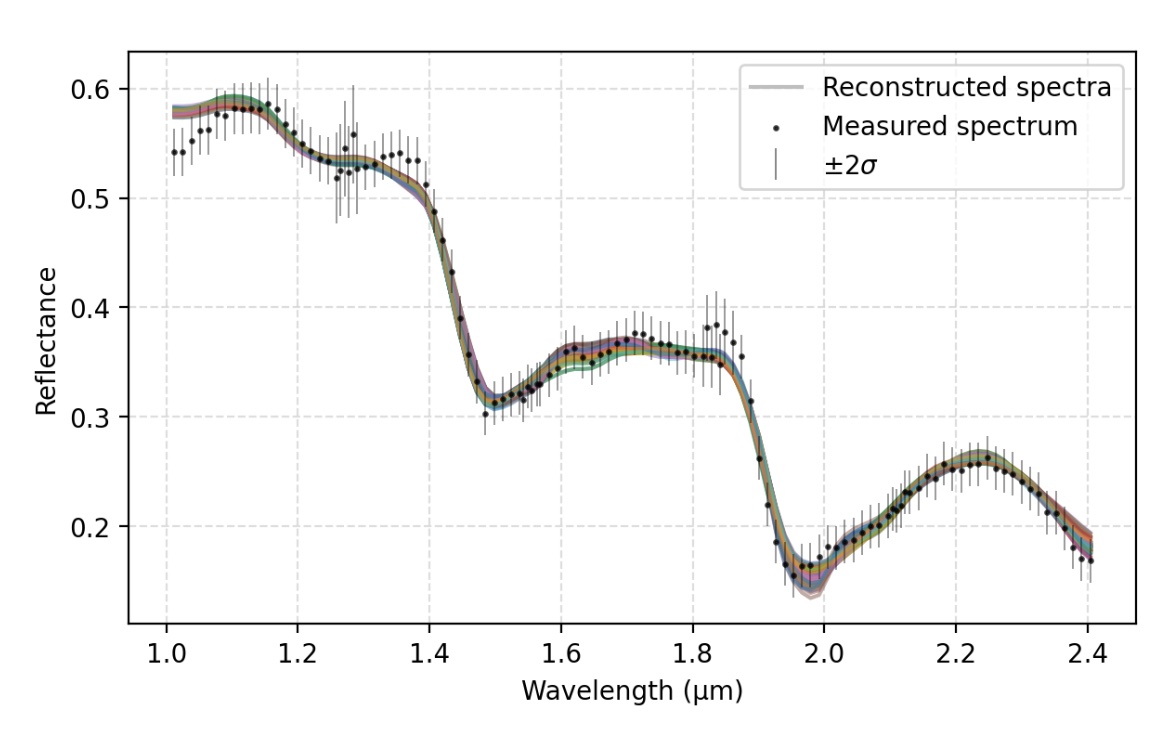
Figure 1: 183 acceptable solutions spectra reconstructed versus the observation.
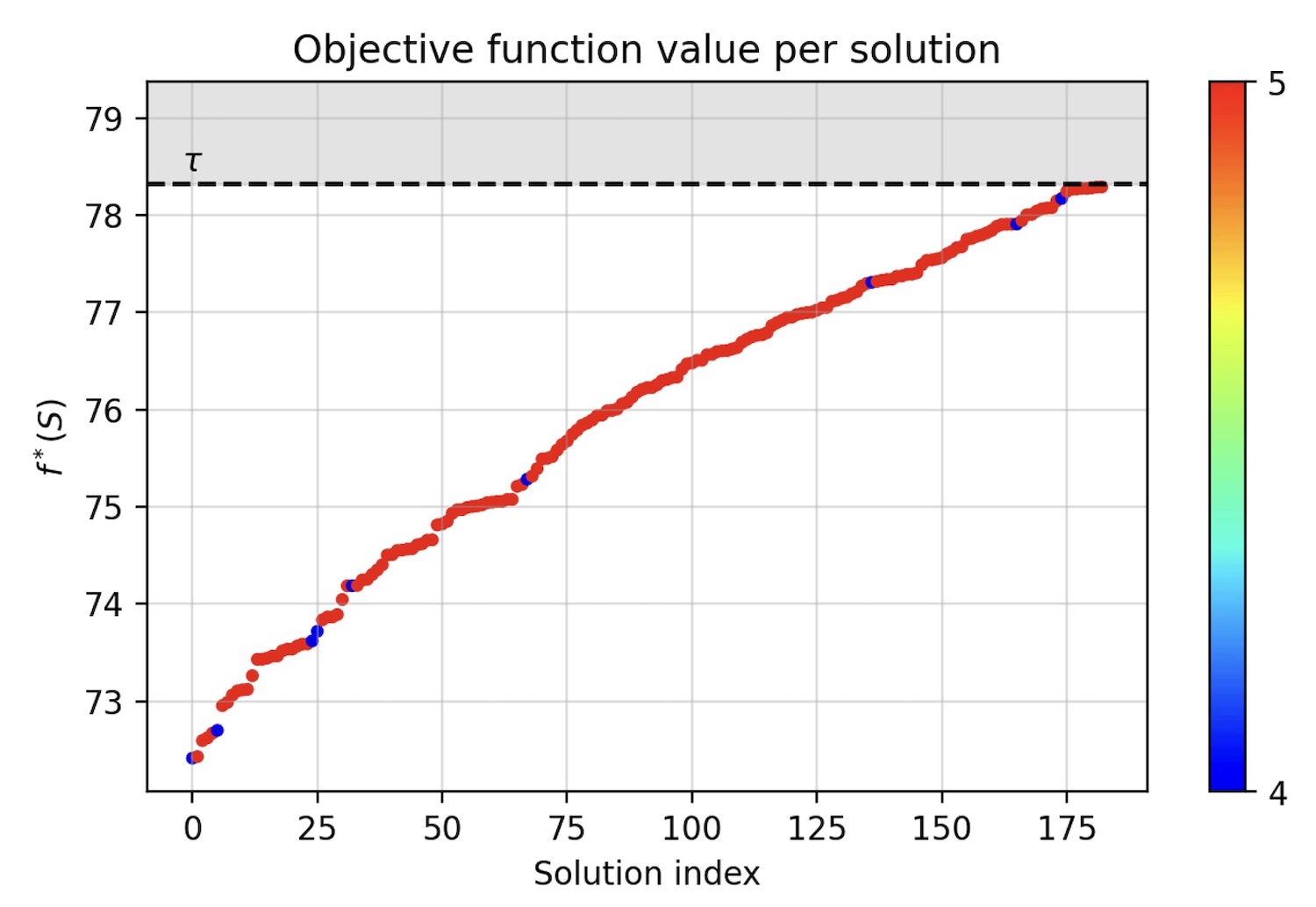
Figure 2: 183 acceptable solutions, sorted in increasing order of least-squares misfit. Most of them activate 5 endmembers, yet 9 acceptable solutions only activate 4.
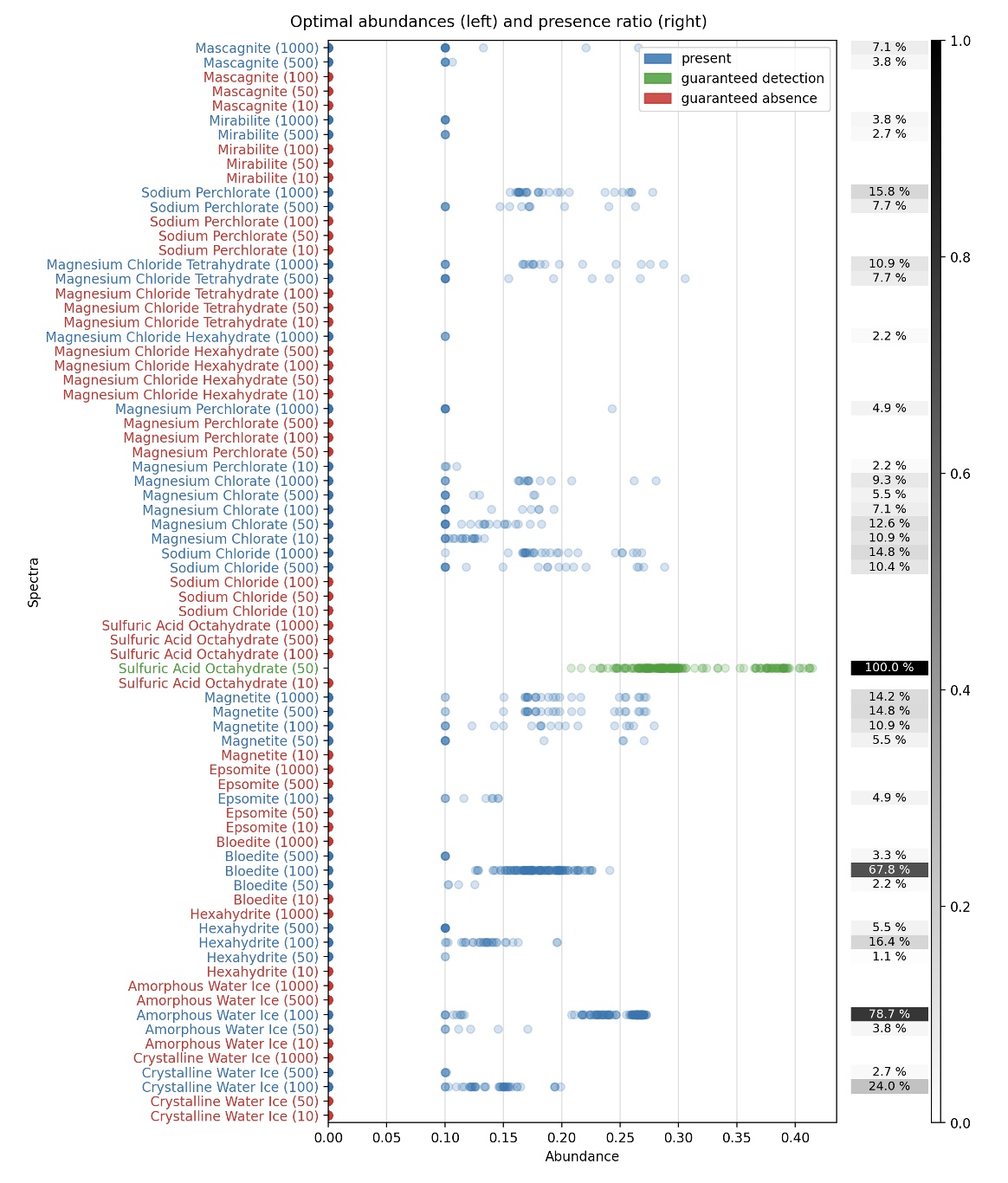
Figure 3: results from our analysis with 15 endmembers at grain size 10, 50, 100, 500, 1000 µm. The only spectra that is always present is the sulfuric acid octahydrate.
Conclusion
The linear unmixing method presented in this work, with sparsity and grain size, shows a striking agreement with a much more elaborated physical modeling and Bayesian Monte Carlo inversion from previous work. We show that most of the results from [6] can be reproduced within seconds, compared to weeks previously. This method thus is ready to be used on larger datasets, such as hyperspectral cubes, where maps of presence/absence of components can be quickly and reliably produced.
References
[1] Pappalardo, R et al. (1999) JGR ; [2] Carlson, R. W. et al. (2005) Icar. ; [3] Ligier, N. et al. (2016) A.J. ; [4] King, O. et al. (2022) PSS. ; [5] Villanueva, G. et al. (2023) Science ; [6] Cruz-Mermy, G. et al. (2023) Icar ; [7] Cruz-Mermy, G. et al. (2025) Icar ; [8] Hapke, B. (2012) Camb. Univ. Press. [9] Ben Mhenni R., et al, 2018 WHISPERS; [10] Latif, M. et al., EUSIPCO 2025 [11] Greer J. B.; IEEE TIP, vol. 21, no. 1, 2012; [12] Akhtar, N. et al. IEEE TGRS, 53, 4, 2015. [13] Tuia, D.; et al. IEEE TGRS, 54, 11, 2016. [14] Carlson, R. et al. (1992) ed. C.T. Russel. [15] Foix-Colonier, et al. “Beyond Optimization: Multisolution Branch-and-Bound for Sparse Spectral Unmixing”, 2026 IEEE Signal Processsing (under review).
How to cite: Foix Colonier, N., Cruz Mermy, G., Schmidt, F., Andrieu, F., and Bourguignon, S.: Investigating the composition of Europa’s surface from NIMS data using exact sparse linear unmixing, Europlanet Science Congress 2026, The Hague, The Netherlands, 7–11 Sep 2026, EPSC2026-83, https://doi.org/10.5194/epsc2026-83, 2026.


