
 ,
,- ESA-ESTEC, Science Engagement and Oversight Office, Netherlands (michela.valsecchi@ext.esa.int)
1. Introduction
In the coming decade, ESA’s Juice and NASA’s Europa Clipper missions will extensively study Jupiter's icy moons, with the primary goal of characterizing their habitability potential. A key question at the core of this investigation is to understand how subsurface oceans could have formed within Europa, Ganymede and Callisto and how they survived until present day.
As part of this investigation an important scientific objective of these missions is to improve the determination of the moon’s orbits, providing essential constraints on the long-term evolution of the Jovian System through a better characterization of the present orbital configuration, tidal interactions and subsequent tidal heating rate of the moon’s interiors.
Within this framework, Io plays a central role: as the innermost Galilean moon, it experiences intense tidal dissipation and, via the Laplace resonance with Europa and Ganymede, acts as a key energy transfer driver in the system. As a result of this dynamical coupling, tidal dissipation within Io influences the stability and the long-term evolution of the Laplace resonance, ultimately shaping the evolution of the entire Jovian system.
The combined flybys of JUICE and Europa Clipper, together with JUICE’s orbital phase, will tightly constrain the orbits of Europa, Ganymede and Callisto using high precision radio-science data [1,2]. Io, however, lies deep within Jupiter's harsh radiation belt and dense plasma torus. Because of this extreme environment, no close flybys are planned for Io. Its dynamic will be indeed constrained indirectly, primarily through its gravitational perturbations on Europa and Ganymede. This lack of direct radiometric measurements will result in an imbalanced data set, with a significant observational gap for Io. This will strongly affect the accuracy and robustness of the orbital solution outside the mission bounds [3]. Moreover, this instability will limit our ability to translate the present-day solution accuracy into strong constraints on the (recent) dynamical history of the system.
To mitigate this, we investigate the option of performing astrometry from the Juice spacecraft to complement the radio-science data set, specifically looking at possible opportunities offered by the Navigation Camera (NavCam) and JANUS high-resolution camera [4]. We assess how direct measurements of Io can bridge this measurement gap and improve the orbital solution with respect to a radio-science-only analysis.
2. Methodology
To quantify the potential achievable improvement, we map how uncertainties of potential optical measurements propagate through the dynamical models of the Jovian system. To this end, we perform a covariance analysis using Tudat [5], an open source high-fidelity orbit and parameter estimation software.
First, we directly extract the uncertainties on the moons’ orbits for a radio-science-based dynamical solution from recent Juice and Europa Clipper simulation analyses [2], representing the currently expected limits of the ephemerides solution attainable post-missions. We then simulate potential astrometric observations of Io from the Juice spacecraft, and quantify the relative improvement they bring with respect to the baseline radio-science solution.
Building on a previous Juice astrometry analysis [6] , we look at feasible observation windows by evaluating three main angular constraints. First, the solar phase angle must guarantee sufficient surface illumination. Secondly, a minimum angular distance from Jupiter’s limb must be ensured to prevent the planet’s glare and scattered light from saturating the detector. Thirdly, a minimum Sun- spacecraft-Io angle must be maintained to comply with spacecraft pointing constraints, preventing direct sunlight from entering the optical system. Furthermore, to allow an accurate limb detection, Io must cover a significant fraction of the camera’s FOV. This requirement translates into a constraint on JUICE-Io distance to ensure sufficient spatial resolution (km/pixel).
For each of the simulated observations, particular attention is paid to the expected error budget. Three major contributions are accounted for to the overall uncertainty: pointing correction errors, spacecraft position uncertainty and uncertainties related to determining the centre of figure. The former contribution is negligible; the second one is also small and can be directly accounted for by extracting the uncertainty in the spacecraft trajectory from the radioscience analyses mentioned above [1,2]. The last term is the dominating contribution to the total error budget and is evaluated as a function of the target within the camera FOV and illumination conditions.
We aim to identify optimal observation windows in which Io’s state vector can be best constrained, accounting for both operational limitations (e.g., data volume, camera availability) and for the feasibility conditions above. Preliminary results indicate that the most favorable conditions to constrain Io’s along-track position occur during JUICE’s high-inclination phase, when the spacecraft inclination will increase up to about 35° for magnetospheric studies. The ideal observation geometry to maximise sensitivity to Io’s along-track position requires the moon’s velocity vector (along its orbit) to be orthogonal to the spacecraft-Io line direction. However, during the planar phase, this corresponds to configurations where Jupiter is behind Io as seen from Juice, violating the minimum distance to Jupiter constraint and translating to unfeasible observations. Opportunities for Io astrometry during the high-inclination will thus be critical to constrain Io’s position along its orbit.
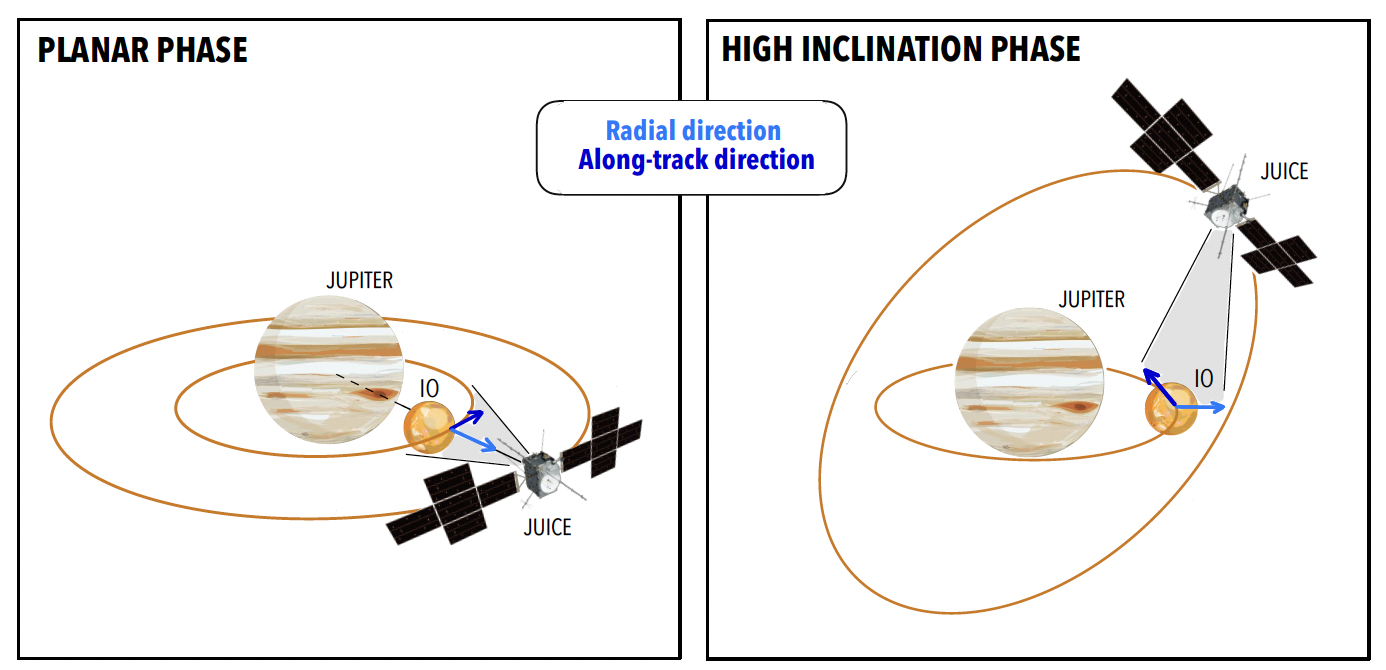
Image credits for Jupiter, Io, and Juice: ©ESA/ATG medialab
The results of this analysis will ultimately be fed back into mission operations planning. We will assess the operational feasibility of the observations, taking into account operational constraints and mission priorities. Our analysis will provide an integrated setup that will facilitate the integration of Io astrometry in the mission plan by allowing us to identify promising astrometry observations and weigh their relative contribution to the mission’ science objectives against the operational overhead.
References
[1] Magnanini, Andrea, et al. Astronomy & Astrophysics 687 (2024): A132.
[2] Fayolle, M.S., et al. Icarus 416 (2024): 116101.
[3] Fayolle, M.S., et al. Astronomy & Astrophysics 677 (2023): A42.
[4] Palumbo, P., Roatsch, T., Lara, L.M. et al. Space Sci Rev 221, 32 (2025).
[5] Dirkx, Dominic, et al. EPSC-DPS2025EPSC-DPS2025-673 (2025).
[6] Zenk, Kai, Dominic Dirkx, and Sam Fayolle. Planetary and Space Science 261 (2025): 106112.
How to cite: Valsecchi, M., Fayolle, S., and Witasse, O.: Prospects of constraining Io's dynamics with JUICE astrometry , Europlanet Science Congress 2026, The Hague, The Netherlands, 7–11 Sep 2026, EPSC2026-836, https://doi.org/10.5194/epsc2026-836, 2026.


