
 1,4
1,4- 1Freiburg University, Faculty of Environment and Natural Resources, Geosciences Department, Freiburg im Breisgau, Germany (anna.guelcher@geodynamics.uni-freiburg.de)
- 2Technische Universität Berlin, Berlin, Germany
- 3Deutsches Zentrum für Luft- und Raumfahrt (DLR), Berlin, Germany
- 4Jet Propulsion Laboratory, California Institute of Technology, Pasadena, CA United States
Venus hosts hundreds of enigmatic circular tectono-magmatic features known as coronae, whose origins, activity state, and role in planetary heat loss remain among the most persistent open questions in Earth and planetary sciences. Coronae display extraordinary diversity in size, morphology, topography, gravity signatures, and tectonic setting, indicating that they do not represent a single formation mechanism, but instead reflect a spectrum of dynamic processes. Understanding these structures is critical for deciphering Venus’ geodynamic evolution and present-day state. In particular, several coronae are among the prime candidates for ongoing tectonic and volcanic activity on Venus and therefore represent key targets for detecting active deformation, magmatism, and surface change with forthcoming missions such as ESA’s EnVision and NASA’s VERITAS.
Here, we first present results from a newly compiled global corona database [1] that systematically reassesses Venusian coronae using Magellan radar and topography datasets. The updated database contains 740 coronae (Figure 1), substantially more than previously catalogued, and defines coronae purely based on the original morphological definition using three identification criteria: (1) the presence of a partial or complete annulus of closely spaced concentric fractures, (2) with or without associated quasi-circular topographic relief, and (3) a minimum diameter of 60 km. Importantly, the term “corona” is descriptive rather than genetic and does not imply a specific formation mechanism. The expanded database reveals that coronae span a broad continuum of morphologies, geological settings, and can overlap with other surface feature nomenclature, such as volcanoes, paterae, novae, and arachnoids. The database further identifies numerous previously unrecognized corona-like structures, including ambiguous features embedded within tessera terrain. These observations demonstrate that coronae cannot always be treated as a uniform class of features and highlight that studies invoking specific formation scenarios may in practice investigate only subsets of the global corona population rather than the full morphological spectrum observed on Venus.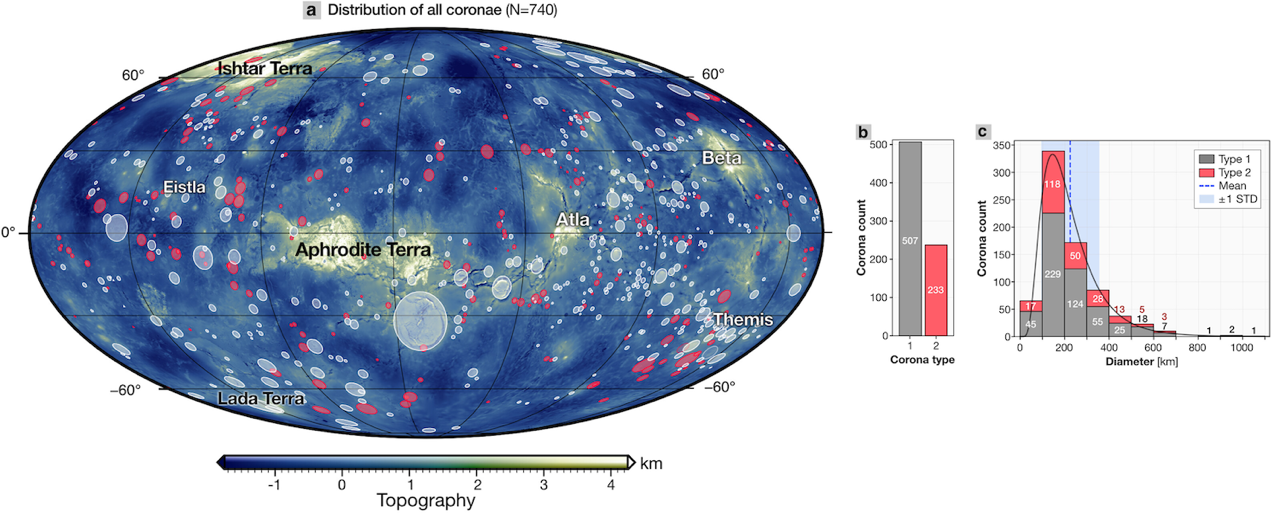
Figure 1. Global distribution centered at 130 degrees East of Venusian coronae according to our new database [1]. All 740 coronae are plotted as circles using their central coordinates and average radii. Type 1 coronae are shown in white and Type 2 in red. (b) Bar graph showing the number of Type 1 and Type 2 coronae. (c) Diameter-count distribution shown as a stacked histogram for Type 1 (gray) and Type 2 (red) coronae, together with a normalized lognormal fit (solid black line).
With the assumption that the largest coronae on Venus are formed by different types of plume-lithosphere interactions, we investigate their topography and gravity signatures in comparison with geodynamic models. We use recent three-dimensional thermo-chemical geodynamic models of plume-lithosphere interaction on Venus [2] that define four geodynamic end-member scenarios for plume-induced corona formation: (1) lithospheric dripping, (2) short-lived subduction, (3) embedded plume, and (4) underplated plume, reflecting different relationships between plume buoyancy and lithospheric strength. To enable direct comparison with observations, the modeled gravity signatures are rescaled to the spatial resolution of the Magellan gravity field, which has a typical spherical harmonic degree strength of ~75–90, corresponding to spatial resolutions of ~210–315 km. This relatively coarse gravity resolution severely limits detailed comparisons between observed and modeled corona gravity signatures, particularly for smaller-scale anomalies and narrow features. For example, only 75 out of all 740 coronae on Venus are considered “broadly resolved” in the Magellan gravity data. Nevertheless, by comparing predicted and observed free-air gravity anomalies together with topography, we identify distinct classes of coronae consistent with different styles and evolutionary stages of plume-lithosphere interaction, including scenarios in which crust is recycled back into the mantle through lithospheric delamination or subduction-like processes [3]. Of the 75 resolved coronae, 52 best match a mantle-lithosphere interaction scenario involving underlying buoyant mantle material and potentially ongoing tectono-magmatic activity.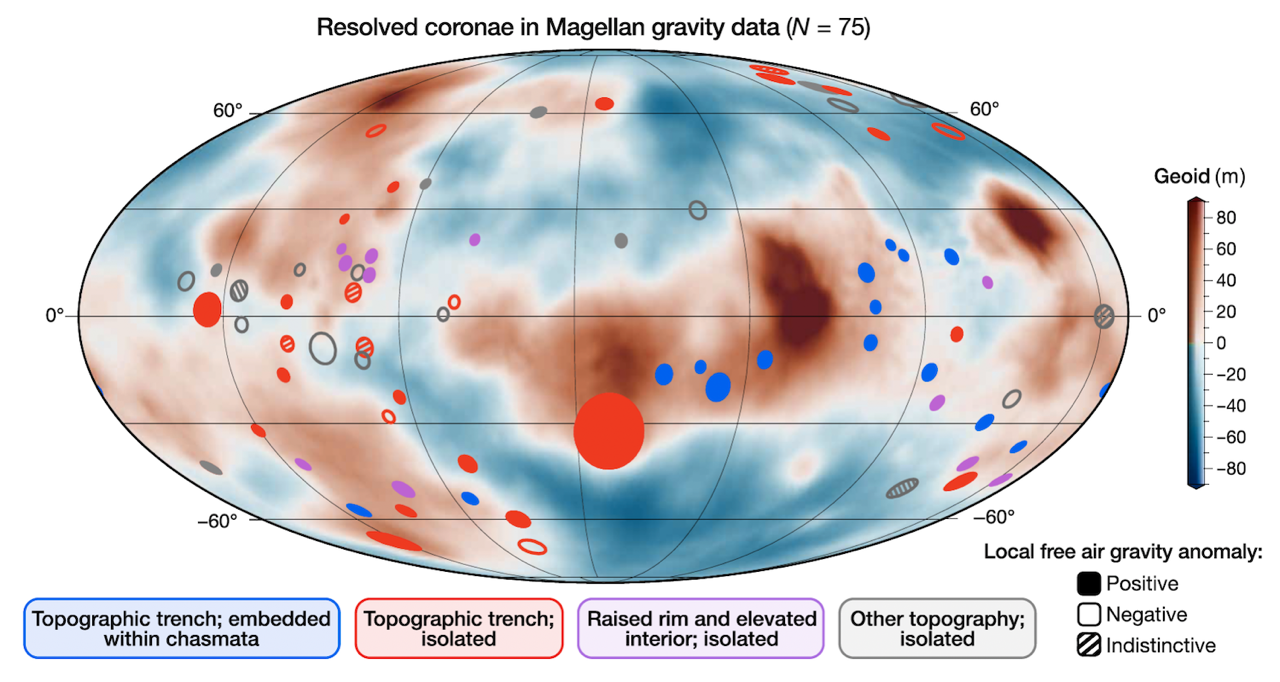
Figure 2. Global map centered at 130 degrees East showing the geoid and the 75 coronae considered resolved in the Magellan gravity data, coloured according to their topographic and gravity signatures [3]. Circle fill and outline indicate the associated free-air gravity anomaly type, while colors represent topographic classification. Coronae with positive free-air gravity anomalies are interpreted as active sites of ongoing plume–lithosphere interaction. Of these, coronae with topographic trenches (blue, red) match modeled crustal or lithospheric recycling at plume margins, whereas those with raised rims and elevated interiors (purple) best match modeled embedded or underplated plumes [3].
Importantly, our analysis further reveals that the limited spatial resolution of the Magellan gravity field could obscure or suppress positive gravity anomalies beneath some coronae, particularly where deep annular troughs surround an uplifted interior. This suggests that a subset of potentially active coronae could be effectively “hidden” in current geophysical datasets [3]. These coronae therefore represent key observables for forthcoming missions such as ESA’s EnVision and NASA’s VERITAS. Moreover, the improved gravity resolution of these missions is expected to resolve more coronae and substantially enhance our ability to distinguish between different tectonic and magmatic regimes on Venus.
References:
[1] Gülcher, A. J. P., Sabbeth, L., E. Stofan, and Smrekar, S. E. (2025), Coronae on Venus: an updated global database and insights into morphological, geologic, and lithospheric properties. Journal of Geophysical Research: Planets, vol. 130 (5), e2024JE008749. https://doi.org/10.1029/2024JE008749
[2] Gülcher, A. J. P., Gerya, T.V., Montési, L.G.J. and Munch, J. (2020) Corona structures driven by plume- lithosphere interactions and evidence for ongoing plume activity on Venus. Nature Geoscience, vol. 13, pp. 547-554, 10.1038/s41561-020-0606-1
[3] Cascioli, G., Gülcher, A. J. P., Marzarico, E., and Smrekar, S. E., (2025), A spectrum of tectonic processes at coronae on Venus revealed by gravity and topography. Science Advances, vol. 11 (20), eadt5932, https://doi.org/10.1126/sciadv.adt5932
Acknowledgements: This research was partially conducted at the Jet Propulsion Laboratory, California Institute of Technology, under contract (80NM0018D0004) with the National Aeronautics and Space Administration.
How to cite: Gülcher, A., Cascioli, G., and Smrekar, S.: Venus' coronae enigma: Insights and limitations from geodynamic models, topography, and gravity, Europlanet Science Congress 2026, The Hague, The Netherlands, 7–11 Sep 2026, EPSC2026-837, https://doi.org/10.5194/epsc2026-837, 2026.


