
 1,1,1,2,3,1,6,1
- 1INAF, IAPS, Rome, Italy (lorenza.giacomini@inaf.it)
- 2INAF, Osservatorio Astronomico di Padova, Padova, Italy
- 3Department of Physical Sciences, The Open University, Milton Keynes, UK
- 4Planetary Science Institute, Tucson, AZ, USA
- 5Johns Hopkins University Applied Physics Laboratory, Laurel, MD, USA
- 6Institute for Planetary Research, DLR, Berlin, Germany
Introduction:
On Mercury, faculae are high-albedo, spectrally red, deposits mostly originating from explosive volcanic eruptions (Kerber et al., 2009) whose sources are rimless depressions. These depressions are usually located in the center of the facula and interpreted to be volcanic vents. In this work we analyzed Agwo Facula and Abeeso Facula, sited within the western margin of Caloris basin (Fig.1) (22.39°N, 146.16°E and 21.82°N, 145.29E, respectively), performing an integrated geological map that takes into account both the morphological and spectral characteristics of the two features.
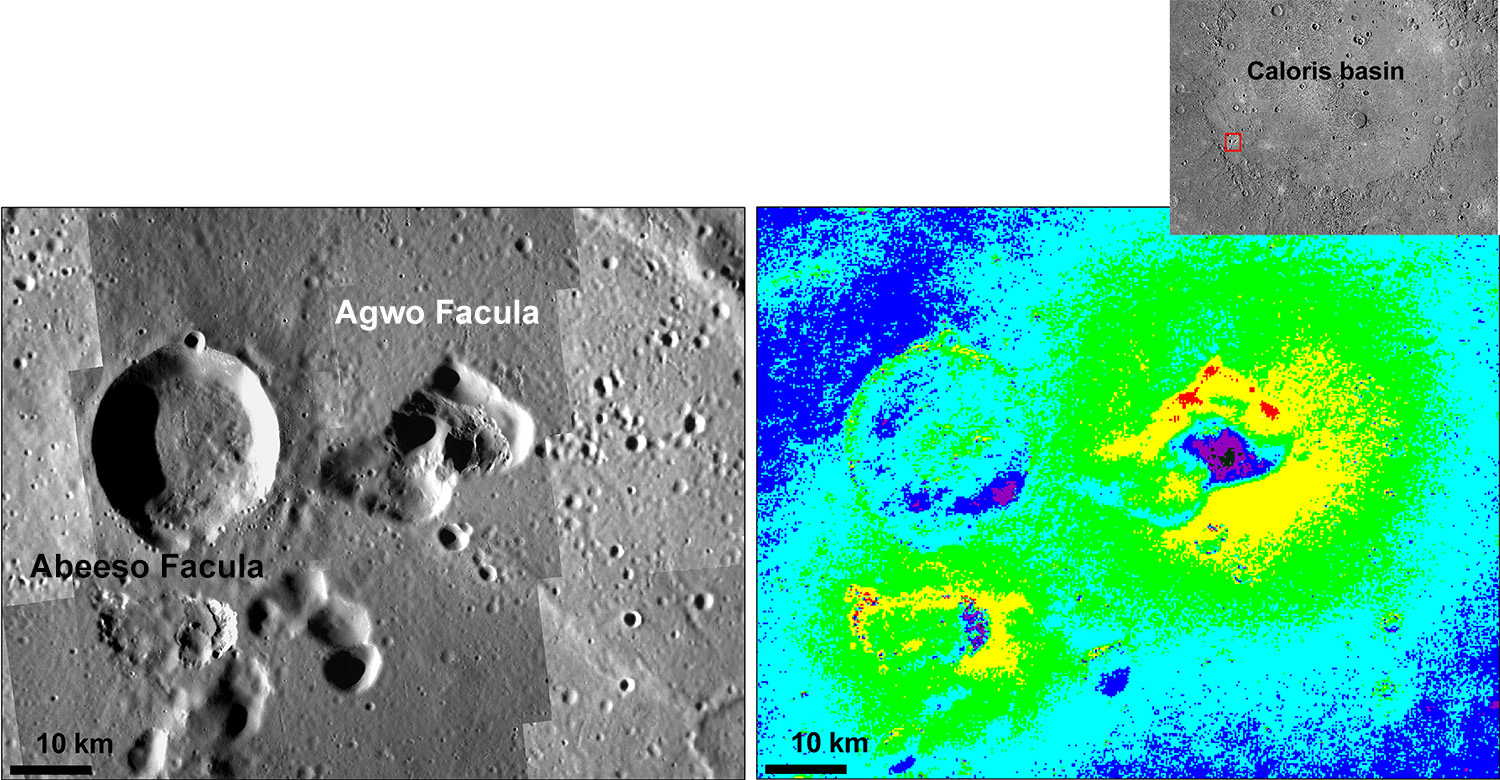
Fig.1 Upper panel: Location of the two faculae (red square) within Caloris basin floor. Left panel: Agwo Facula and Abeeso Facula in MDIS monochrome mosaics (i.e. NAC derived mosaics; MDIS BRD mosaic in the background); right panel: color map of the two faculae based on VIS slope (480/830 nm) in MDIS WAC image.
Data and methods:
In order to compile the Agwo and Abeeso Facula maps we used MDIS (MESSENGER Mercury Dual Imaging System) data. In particular, for Agwo Facula’s geomorphological map we used the MDIS NAC derived mosaics with a spatial resolution ranging from 20 m/pixel to 28 m/pixel and with different illumination conditions. For Abeeso Facula’s geomorphological map the main basemaps were MDIS NAC derived mosaics with a spatial resolution ranging from 25 to 56 m/pixel and with different illumination conditions.
Additionally, a BDR (Basemap reduced Data Record) MDIS mosaic, with a resolution of 166 m/pixel, was considered as ancillary basemap.
To compile the spectral map of the faculae, MDIS WAC 8-color images were used. In particular, the VIS slope between 480 and 830 nm was the basemap (spatial resolution of 209 m/pixel) to infer the spectral variation of both the faculae and detect different spectral units characterizing the pyroclastic deposits (Galiano et al., 2026).
Then, an integrated geological map was compiled merging the geomorphological and spectral information in order to highlight correspondences between morphologies and reflectance properties and to detect possible new units not discernible considering only the geomorphology.
Results and conclusions:
The geomorphological maps highlight that both Agwo Facula and Abeeso Facula experienced several explosive episodes. The terrain within the pits shows different surface texture and albedo, that allowed the distinction of several geological units. For Agwo the oldest units show an hummocky surface textures (due to small crater and mass wasting deposits); the intermediate units are characterized by a smoother surface, whereas the youngest ones appear more rough. For Abeeso, the oldest units include the smoother surfaces and the younger units encompass the rougher textured surfaces. Moreover, from the spectral point of view, both faculae highlight different units. Color mapping allowed the estimation of the pyroclastic deposits extent, not discernable with the solely monochrome images, since pyroclastic deposits do not show peculiar surface texture. Moreover, Agwo’s pyroclastic deposits show spectral units that appear roughly concentric to the youngest vents, whereas the Abeeso’s pyroclastic deposits show a more irregular pattern. The integrated geological map summarizes the information coming from the two maps and helped us to better understand the formation of these features.
References:
Galiano, A. et al., 2026. Spectral Evidence for Recent/Ongoing Activity in Mercury’s Praxiteles Basin. The Planetary Science Journal 7, 27. doi: 10.3847/PSJ/ae2fb9
Kerber, L., et al., 2009. Explosive volcanic eruptions on Mercury: Eruption conditions, magma volatile content, and implications for interior volatile abundances. Earth Planet. Sci. Lett. 285, 263–271. https://doi.org/10.1016/j.epsl.2009.04.037.
Acknowledgment
We gratefully acknowledge funding from the Italian Space Agency (ASI) under ASI-INAF agreement 2024-18-HH.0. This research was also supported by the International Space Science Institute (ISSI) in Bern, through ISSI International Team project #552 (Wide-ranging characterization of explosive volcanism on Mercury: origin, properties, and modifications of pyroclastic deposits). Contributions by D. Domingue and J. Weirich were also supported by NASA’s Solar System Working’s grant 80NSSC21K0165.
How to cite: Giacomini, L., Galiano, A., Galluzzi, V., Munaretto, G., Rothery, D. A., Domingue, D., Weirich, J., Jozwiak, L. M., Carli, C., D'Amore, M., and Palumbo, P.: Geological analysis of Agwo and Abeeso facula (Mercury), Europlanet Science Congress 2026, The Hague, The Netherlands, 7–11 Sep 2026, EPSC2026-839, https://doi.org/10.5194/epsc2026-839, 2026.


