
 1,2
1,2- 1University of Kent, School of Physics and Astronomy, United Kingdom of Great Britain – England, Scotland, Wales (rl454@kent.ac.uk)
- 2University of Belgrade, Faculty of Mathematics, Serbia (andjelka.kovacevic@matf.bg.ac.rs)
Kuiper Belt Objects (KBOs) preserve primitive material from the early Solar System providing valuable clues to irradiation, volatile transport, impacts, and long-term surface evolution in the outer Solar System. However, detailed spectroscopic characterisation of large KBO samples remains observationally expensive, creating a strong need for survey-scale photometric diagnostics that can identify physically interesting targets for further study. In the Vera C. Rubin Observatory Legacy Survey of Space and Time (LSST) era (Schwamb et al 2023), this question becomes especially timely: can broadband multiband photometry provide a useful first-stage physical discriminator for large outer Solar System populations, helping to connect survey discovery to physical interpretation, follow-up prioritisation, and eventually mission-relevant target selection (Kovačević, Mason, Ćiprijanović 2025)?
We explore this question using a prototype forward-modelling pipeline that maps different KBO surface and activity states into Rubin photometric space. The pipeline first generates synthetic spectra for a hypothetical KBO at 40 AU using the NASA Planetary Spectrum Generator (PSG, Kofman et al 2024), expressed in observer-frame flux appropriate for Rubin photometry. A second module then convolves these spectra with Rubin/LSST ugrizy throughput curves to derive synthetic AB magnitudes and colours.
We consider five representative, physically motivated cases spanning inactive, compositionally altered, mixed, and weakly active states (Figure 1a and Table 1). Run 1 is an inactive rocky baseline, modelled as an achondrite-dominated surface. Run 2 represents an organic-rich irradiated surface using achondrite plus an organic proxy. Run 3 represents an ice-rich, highly reflective surface. Run 4 is a mixed ice-organic state. Run 5 adopts the same mixed surface as Run 4 but adds an aerosol coma in order to test whether weak activity can produce a measurable displacement in colour-colour space.
The main result is that the simulated KBO surface and activity states occupy different regions of Rubin colour space, but the discriminatory power depends strongly on wavelength. Organic-rich cases produce systematically redder visible colours than the inactive baseline, especially in g-r and r-i. Ice-rich cases remain much closer to the baseline, consistent with a weaker reddening of the visible spectral slope. The mixed ice-organic case lies between these end members, as expected for a blended surface state. When a weak aerosol coma is added, the colours shift back toward flatter values: in the adopted example, g-r decreases from 0.5584 in the mixed-surface case to 0.4632 in the aerosol-coma case, while r-i decreases from 0.1991 to 0.1631. This behaviour is consistent with a greying effect in which coma scattering partially suppresses the red slope of the underlying surface (Figure 1 b1).
The colour-colour analysis shows that the clearest separation between physical states is found in the shorter-wavelength combinations, especially in the r-i versus g-r plane (Figure 1 b1). In the i-z versus r-i plane (Figure 1 b2) the same sequence remains visible, but it is more compressed. In the z-y versus i-z plane (Figure 1 b3), the sequence becomes nearly one-dimensional and the different physical cases are much harder to distinguish.
The weak-activity test is particularly relevant for Rubin time-domain Solar System science. To assess the detectability of weak activity, we compare the colour vector of the aerosol-coma case with that of the same mixed surface without an aerosol coma. The addition of a weak aerosol coma shifts the object to a distinct location in Rubin colour space. For the adopted uncertainty model, this displacement is statistically significant, with a SNR of approximately 5 (Figure 2). The corresponding displacement is quantified relative to propagated photometric uncertainties using a chi-squared metric and an overall significance-like quantity, SNR ≅√χ2. In the adopted proof-of-concept setup, a representative uncertainty of 0.01 mag per band is assumed. Although this proof-of-concept result should not be generalised to all weakly active KBOs, it shows that broadband photometry can retain a detectable signature of weak activity even without spectroscopy.
In this sense, Rubin photometry may help identify candidate objects whose colours are consistent with organic-rich, ice-modified, mixed, or weakly active states, thereby supporting prioritisation for spectroscopy, time-domain follow-up, and future mission-oriented target selection. The present study therefore serves as a proof of concept and as a starting point for a more systematic framework for prioritising outer Solar System targets in Rubin survey data.
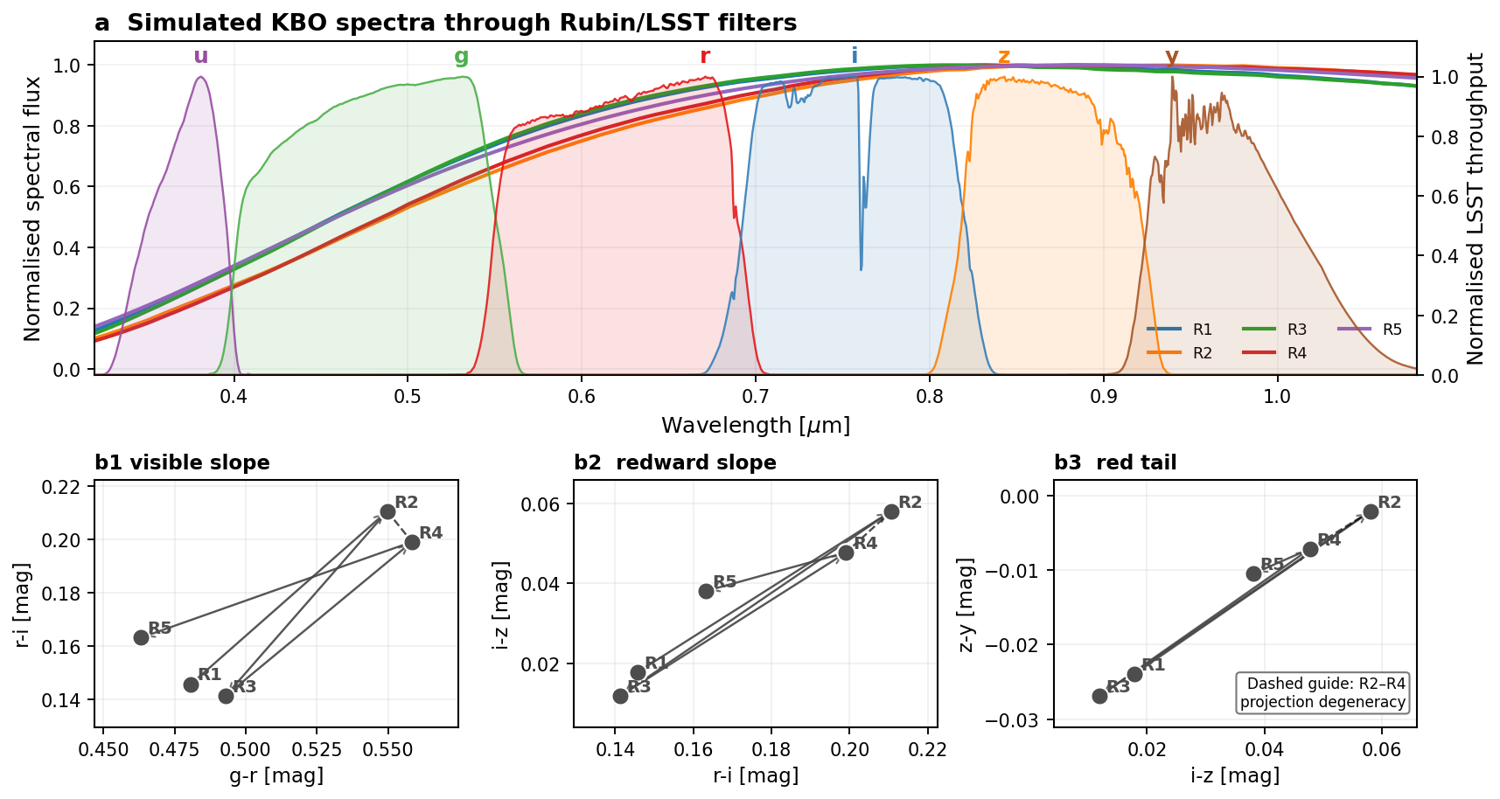
Figure 1: Prototype KBO classification for the LSST photometry era is deep integrations in the g, r, i bands. The top panel shows the simulated spectra over the LSST filters, illustrating how different surface and activity states map into Rubin photometric space. The bottom panels compare the diagnostic value of LSST filter pairs in terms of topology and dynamic range, showing that g−r, versus r−i is the primary discriminator, i−z provides only secondary validation for more extreme cases, and extension into the z−y regime yields diminishing returns because the sequences become increasingly compressed and degenerate.
| Run | Composition | Physical Driver | Expected Photometric Effect |
| R1 | Inactive Baseline | 100% Achondrite | Featureless rocky baseline |
| R2 | Irradiated Organics | 40% Organic Proxy, 60% Achondrite | Reddening (strong shift toward red visible colors) |
| R3 | Ice-Rich Surface | 30% Antarctica, 70% Achondrite | Reflective / Greying (closer to baseline) |
| R4 | Mixed State | 40% Achondrite, 30% Antarctica, 30% Organic | Blended red/grey signature |
| R5 | Aerosol Coma | R4 Composition + Weak Coma | Aerosol suppression of underlying red slope |
Table 1: Composition definitions for the five representative simulated KBO states, R1–R5.
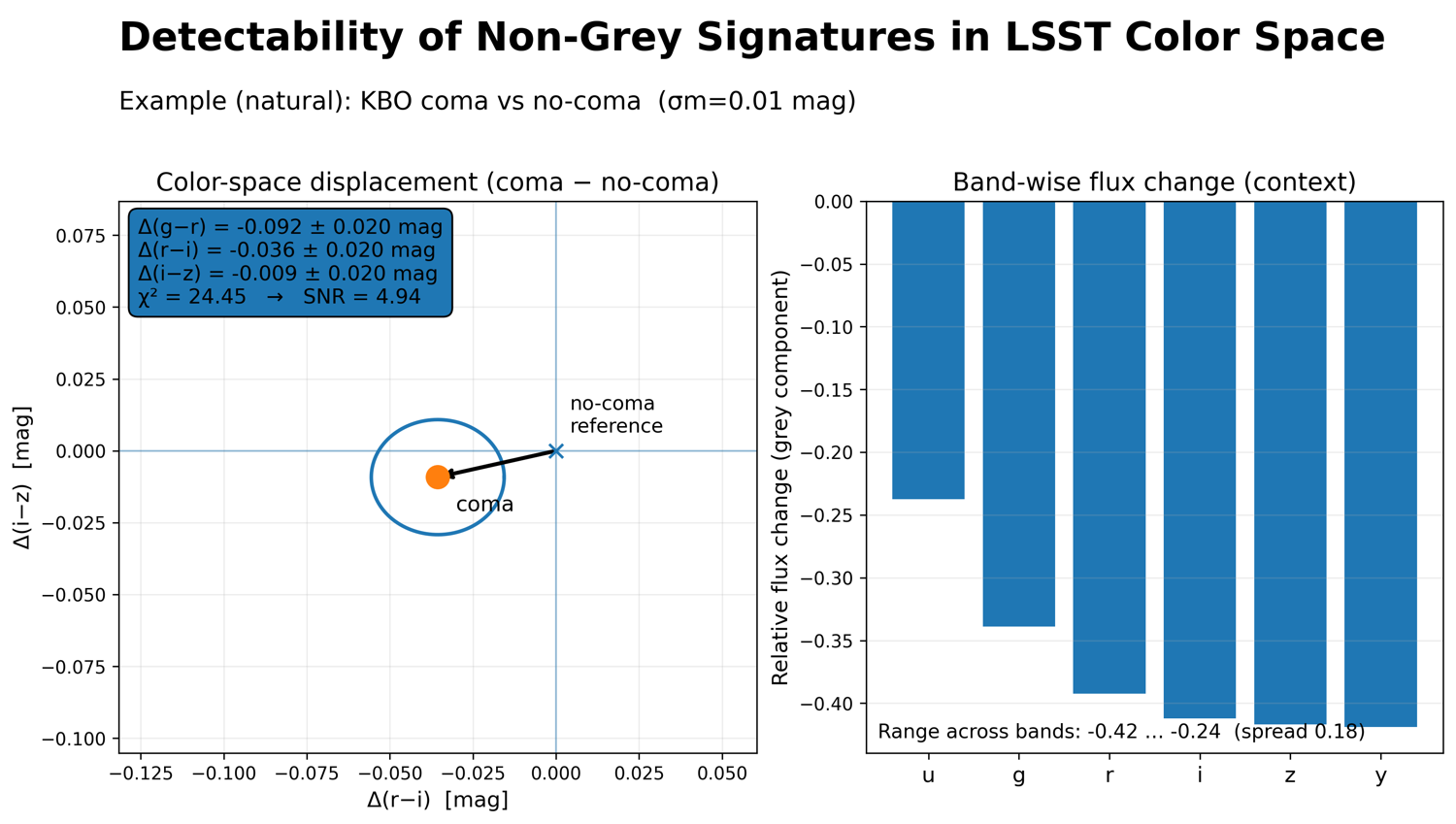
Figure 2: Detectability of non-grey signatures in LSST colour space for KBOs with a faint coma (σ = 0.01). Left: the coma induces a coherent displacement in colour space relative to the grey no-coma reference; grey dimming cancels, while the non-grey signal remains detectable. The displacement corresponds to SNR ≈ 5 under LSST uncertainties. Right: the underlying band-wise flux changes show a nearly grey dimming pattern, highlighting that only colour-space projections reveal the coma signature.
REFERENCES
Schwamb, M. E., et al. 2023, Tuning the Legacy Survey of Space and Time (LSST) Observing Strategy for Solar System Science, ApJS, 266, 22.
Kofman, V., et al. 2024, The Pale Blue Dot: Using the Planetary Spectrum Generator to Simulate Signals from Hyperrealistic Exo-Earths, Planetary Science Journal, 5 197
Kovačević, A. B., Mason, N. J., & Ćiprijanović, A. 2025, Multiscale astrobiology with the Vera C. Rubin Observatory Legacy Survey of Space and Time, Frontiers in Astronomy and Space Sciences, 12, 1594485.
How to cite: Long, B., Mason, N., and Kovacevic, A.: Broadband Rubin photometry as a first-stage physical discriminator for outer Solar System targets, Europlanet Science Congress 2026, The Hague, The Netherlands, 7–11 Sep 2026, EPSC2026-84, https://doi.org/10.5194/epsc2026-84, 2026.


