
 1,1
1,1- 1Institute of Planetary Research (DLR), Berlin, Germany (grellan.lambert@dlr.de)
- 2Nantes Université, Nantes, France (grellan.lambert@etu.univ-nantes.fr)
As evidence for an interior salty, liquid water ocean on Jupiter’s moon Europa has grown over the last few decades, so too has the interest in modelling its interactions with the ice shell. Water is a key ingredient of life as we know it, and as such Europa has become a prime candidate in the search for habitable environments beyond Earth. Europa experiences significant tidal heating due to gravitational interactions with Jupiter during its orbit, which could sustain a subsurface liquid water ocean (Sotin et al., 2009). Measurements of an induced magnetic field from the Galileo mission (Kivelson et al., 2000) suggest that the ocean likely contains salts, which could help keep the ocean in a liquid state. Spectral signatures of salts have been detected in endogenic regions of Europa’s surface, pointing towards the further existence of salts within the ice shell itself, in the form of brine reservoirs (Trumbo et al., 2019). On Earth, certain organisms (halophiles) can survive and even thrive in such highly salty environments. As such, the presence of brines within Europa’s ice shell are of great interest in understanding its potential habitability (Wolfenbarger et al., 2022).
Subsurface brine reservoirs could form via melting caused by impacts or by the convective transport of liquid inclusions from the ice-ocean interface (which consists of a semi-liquid, mushy layer) to the near-surface of the ice shell (Buffo et al., 2020). The upcoming Europa Clipper and JUICE missions could probe the existence of such shallow subsurface brine reservoirs via radar sounding and gravity measurements (Pappalardo et al., 2024). Thus, this work not only endeavours to understand the large-scale evolution of such brine reservoirs but also informs such future missions on their detection.
In this study, we perform several solid-state, 2D geodynamical simulations using a 30 km ice shell thickness. In our models, we vary parameters such as ice grain size (values of 1cm, 1mm, and 0.1mm), salinity (concentrations of 1 x Earth ocean and 4 x Earth ocean salinity), surface ice yield stress (in a range of 15 kPa to 180 kPa), and spatial distribution of brines (Fig. 1). The goal is to determine how the variation of these parameters influences the transport and later distribution of the brines within the ice shell.
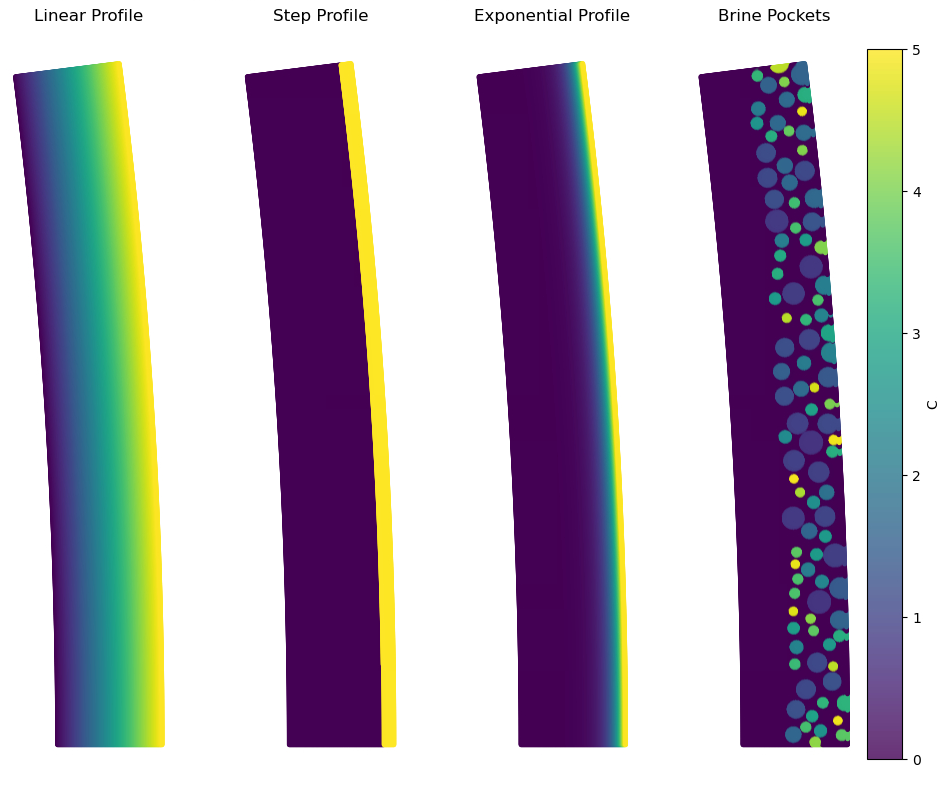
Figure 1: Non-dimensional density distribution for the four initial salt distribution scenarios.
The simulations are in a cylindrical geometry and are performed using the GAIA mantle convection code (Hüttig et al., 2013). GAIA is a finite-volume fluid flow solver that solves the conservation equations of mass, linear momentum, and thermal energy on a fixed computational grid. The advection and mixing of chemical components are modelled via a particle-in-cell approach, in which a transport equation is solved to move tracer particles carrying various chemical species according to the velocity field of the simulation. This method is essentially free of numerical diffusion and can treat the advection of an arbitrary number of different chemical components.
In our models, we test four distributions of salts through the ice shell: 1) a linear distribution, where, initially, the chemical density linearly decreases from the surface to the ice-ocean interface, 2) a step function, where the topmost 3 km (10%) of the ice shell are highly enriched in salts, 3) an exponential distribution, where the initial density profile decreases exponentially with depth, and 4) brine pockets, which consists of randomly generated brine pocket circles of radii between 250 and 2500 m and of varying salt concentrations. For the brine pockets distribution, we test two further scenarios, one where these brine pockets only exist in the upper half of the ice shell and another where they are distributed throughout the entire shell depth.
In our models we use a variable thermal conductivity and thermal expansivity, and include a pressure- and temperature-dependent composite Arrhenius viscosity that considers diffusion creep, dislocation creep, grain boundary sliding and basal slip. Furthermore, we investigate the effects of surface mobilisation on material transport and mixing. To this end, we employ a pseudo-plastic rheology where surface mobilisation occurs as soon as convective stresses exceed a predefined yield stress. We systematically decrease the yield stress until surface mobilisation takes place. This helps us determine the boundary between cases with surface mobilisation and surface material transport within the deeper ice shell, and cases that lie in a stagnant lid regime, a regime where an immobile layer forms at the top of the convective domain, due to the strong temperature-dependent viscosity. In the stagnant lid regime, the densest materials are trapped close to the surface and do not participate in the convection. In cases with surface mobilization, surface material can be brought into the deeper part of the ice shell, thereby facilitating surface-to-ocean exchange.
Our study will show how salts are redistributed over time throughout the ice shell under different initial conditions and will help guide future missions in the detection of such reservoirs. Further studies could build upon this work by varying the ice shell thickness and incorporating the effects of tidal heating.
References:
Sotin et al., Europa, (2009).
Trumbo et al., Science Advances 5, (2019).
Hüttig et al., PEPI 220, 11, (2013).
Kivelson et al., Science, 289, 1340-1343, (2000)
Wolfenbarger et al., Geophysical Research Letters, 49, (2022)
Buffo et al., Journal of Geophysical Research: Planets, 125, (2020)
Pappalardo et al., Space Science Reviews, 220:40, (2024)
How to cite: Lambert, G., Plesa, A.-C., and Hussmann, H.: Transport and mixing of salts in Europa’s ice shell: A geodynamic perspective, Europlanet Science Congress 2026, The Hague, The Netherlands, 7–11 Sep 2026, EPSC2026-844, https://doi.org/10.5194/epsc2026-844, 2026.


