
 ,,,
,,,- Technical University of Munich, TUM School of Engineering and Design, Department of Aerospace and Geodesy, Germany (marc.amoros@tum.de)
Introduction:
Water migration in the lunar regolith is controlled by surface temperatures, sorption kinetics, and surface properties. Previous modeling studies have shown that, under a sustained influx of water molecules at the lunar surface, the diurnal thermal cycle can drive a downward migration of water [1, 2]. This process, often described as thermal pumping, occurs because molecules desorb more efficiently from warmer near-surface grains and can re-adsorb at greater depths, where lower temperatures increase their residence time. In a recent study [3], we showed how this process is mainly influenced by the desorption energy. Both that work and the present study are carried out within the VOLARIS project [4], which aims to advance the understanding of the Moon’s water cycle by combining simulations and experimental studies.
Previous modeling efforts, including our own [3], used a single desorption energy for all available binding sites on grain surfaces. However, previous temperature-programmed desorption experiments [5] indicated that lunar regolith grains contain a heterogeneous population of adsorption sites with a broad distribution of binding energies. Surface diffusion dictates how efficiently water molecules can hop between these binding sites. A recent study assumed this process to be either infinitely efficient, where an adsorbed molecule instantaneously finds the deepest available binding site, or nonexistent [6]. In reality, the behavior of surface diffusion likely lies between these two extreme cases. Laboratory and theoretical studies suggest that adsorbed water molecules may hop between neighboring binding sites on the same grain if they overcome a surface diffusion barrier (Ediff), often parameterized as a fraction of the desorption energy (Ed), Ediff= α · Ed, with typical values of α ranging from 0.2 to 0.7 [7, 8].
Methodology:
Our goal is to determine the physical conditions under which thermal pumping remains effective when adsorbed molecules can be redistributed among binding sites. To do this, we developed a one-dimensional model that couples three processes: heat transfer in the regolith, grain surface diffusion between binding sites, and inter-grain diffusion through the porous subsurface. The adsorption model represents the grain surface as a discretized distribution of binding energies, divided into 50 equal-width energy bins. Molecules can move between these bins via thermally activated hopping rates, following the formulation derived by He et al. [6].
To model inter-grain diffusion, we use the formulation introduced by Schörghofer [5], in which diffusion is driven by gradients in the desorption rates between adjacent grains. This approach accounts for the micro-roughness and high surface area of lunar grains by including the probability that a desorbed molecule re-adsorbs onto the same grain before escaping into the pore space and migrating to another grain.
Preliminary results:
We performed numerical experiments with a constant supply rate at the surface of 10-15 kg/(m2 s) over 10 lunations. Simulations initialized with completely dry regolith show that most incoming water remains near the surface, gradually filling the deepest available binding sites. Once molecules occupy these high-energy sites, they are effectively trapped under typical lunar surface temperatures and do not participate in downward migration. To study the role of surface diffusion after the deepest binding sites are partly occupied, we initialized the substrate with a surface coverage of 0.0001%. In these simulations, water can migrate downward by repeatedly adsorbing to and desorbing from weaker binding sites.
One can see in Fig. 1 how the modeled water abundance is sensitive to the diffusion barrier ratio α. A lower diffusion barrier allows more efficient redistribution among binding sites, making it more likely that lower-energy sites are occupied and enhancing overall migration during one lunation.
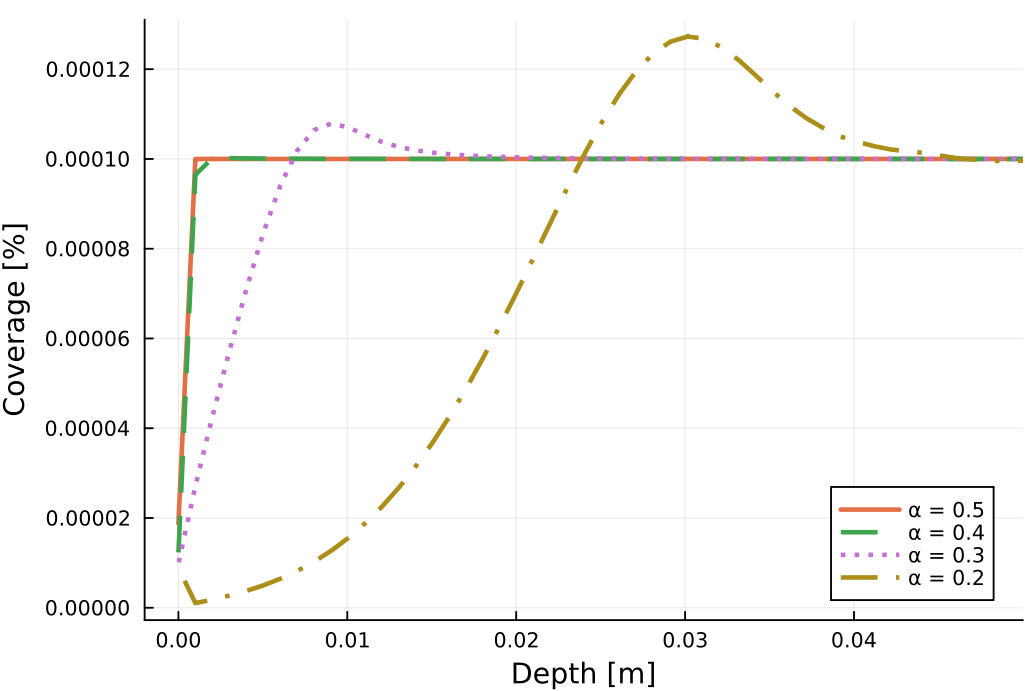
Figure 1: Coverage profile over depth after 10 lunations at the equator, at 0h LT, with different surface diffusion conditions.
Conclusions:
These results show how surface diffusion is a key uncertainty factor in predicting the depth distribution and residence time of lunar water. Therefore, further constraining the surface diffusion barrier and the distribution of desorption energies is essential for evaluating in which regions thermal pumping transports water into the lunar subsurface.
Acknowledgments:
This work is funded by the European Union (ERC, VOLARIS, 101164002). Views and opinions expressed are however those of the author(s) only and do not necessarily reflect those of the European Union or the European Research Council. Neither the European Union nor the granting authority can be held responsible for them.
References:
[1] Reiss, P., Warren, T., Sefton‐Nash, E., & Trautner, R. (2021). Dynamics of subsurface migration of water on the Moon. Journal of Geophysical Research: Planets, 126(5), e2020JE006742.
[2] Schörghofer, N., & Aharonson, O. (2014). The lunar thermal ice pump. The Astrophysical Journal, 788(2), 169.
[3] Amorós-Trepat, M., Brecher J. N., and Peschel, A., and Reiss, P. (2026). The Sensitivity of lunar water migration to physical soil parameters, Lunar and Planetary Science conference 57th, Abstract #1634.
[4] Reiss, P., Amorós-Trepat, M., Brecher J. N., and Peschel, A. (2025). Insights into the lunar water cycle, The Project Repository Journal, vol. 24, pp.86–89.
[5] Jones, B. M., Aleksandrov, A., Dyar, M. D., Hibbitts, C. A., & Orlando, T. M. (2020). Investigation of water interactions with Apollo lunar regolith grains. Journal of Geophysical Research: Planets, 125(6), e2019JE006147.
[6] Schörghofer, N. (2025). Diffusion-adsorption of Water Vapor in Chemically Activated Lunar Soil. The Planetary Science Journal, 6(7), 164.
[7] He, J., & Vidali, G. (2014). Application of a diffusion–desorption rate equation model in astrochemistry. Faraday Discussions, 168, 517-532.
[8] Sarantos, M., & Tsavachidis, S. (2021). Lags in desorption of lunar volatiles. The Astrophysical Journal Letters, 919(2), L14.
How to cite: Amorós-Trepat, M., Brecher, N., Peschel, A., and Reiss, P.: Studying the Influence of Surface Diffusion on Lunar Subsurface Water Migration, Europlanet Science Congress 2026, The Hague, The Netherlands, 7–11 Sep 2026, EPSC2026-849, https://doi.org/10.5194/epsc2026-849, 2026.


