
 4,3,2,2,2,
- 1Université Grenoble Alpes / CNRS-INSU, IPAG, Grenoble, France (sylvain.doute@univ-grenoble-alpes.fr)
- 2INAF - Osservatorio Astronomico di Padova, Italy
- 3IAPS Roma, Italy
- 4Université de Nice-Sophia Antipolis, CNRS-INSU, Laboratoire Lagrange, Observatoire de la Côte d’Azur, France
- 5Aix Marseille Univ, CNRS-INSU, CNES, LAM, Marseille, France
- 6INAF - Osservatorio Astronomico di Roma, Italy
In 2029, the Extremely Large Telescope (ELT) operated by the European Southern Observatory (ESO) will see its first light [Fig. 1]. Thanks to its 39-metre primary mirror and built-in adaptive optics, the telescope will offer extreme angular resolution (approximately 6 milliarcseconds at a wavelength of 1 µm and approximately 12 milliarcseconds at 2.2 µm) and sensitivity (limiting ABmag of 30 in K with S/N>=5 ), which will be harnessed by versatile instrumentation to carry out unprecedented observations of a wide variety of astrophysical objects. In particular, the MICADO camera (Davies et al., 2021, ESO Messenger, Vol. 182, pp. 17–21) will offer exceptional capabilities in broad and narrow band imaging (53" × 53" and 20" × 20" fields of view (FoV) with a pixel scale of, respectively, 4 and 1.5 mas), astrometry (precision of 10–50 µas), and slit spectroscopy (R ~ 20,000 for point sources and R ~ 10,000 across the slit) in the near-infrared (0.8–2.4 µm). A few years later, the HARMONI integral-field spectrometer (1.4–2.5 µm) will be the key instrument for corroborating and enriching MICADO’s spectroscopic results (approximately 30,000 spectra with a pixel scale of up to 6 mas and simultaneous H+K spectrum acquisition at R = 1500). These MICADO and HARMONI observations, which are unprecedented, will be made possible by MORFEO (Ciliegi et al., 2021, Messenger, Vol. 182, pp. 13–16), a multi-conjugate adaptive optics (MCAO) system. MORFEO will provide, under average atmospheric conditions over a large FoV (60"), a diffraction-limited correction for atmospheric turbulence achieving a Strehl ratio = 0.44 in K band, 0.08 in J band for 50% of the sky.
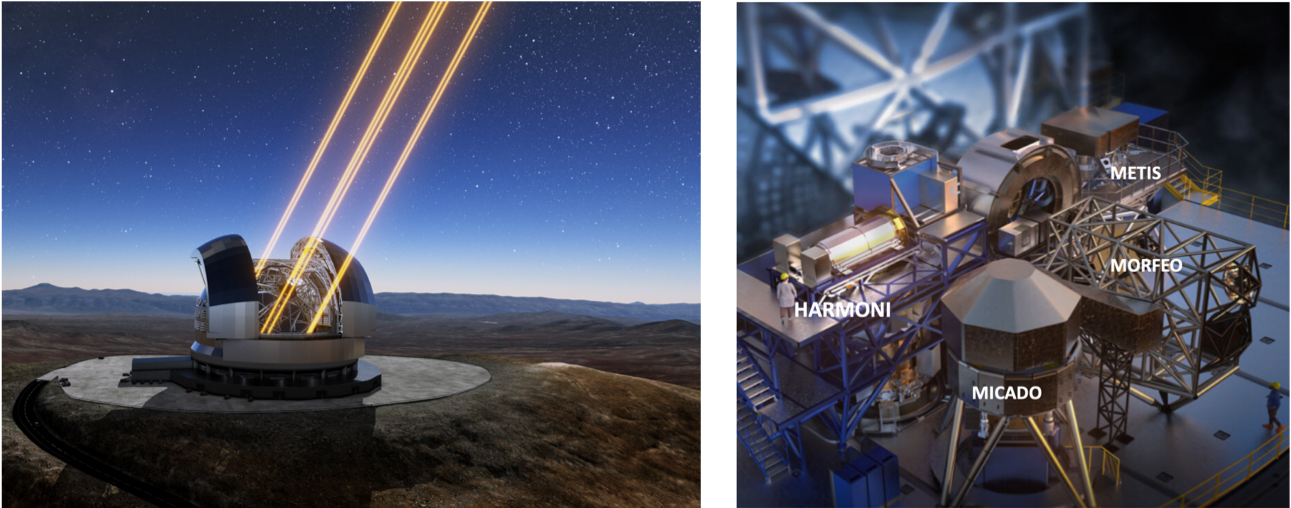
Fig 1. (Left) The ELT in action with its six lasers fired to probe the atmospheric turbulence. (Right) A representation of the first light instruments gathered on their Nasmyth platform. (credits ESO).
With its high sensitivity and spatial resolution capabilities (down to approximately 5 km at Ceres, 12 km at Ganymede, 25 km at Titan and 120 km at Pluto), the ELT+MICADO/MORFEO will enable unique Solar System science. For instance, icy dwarf planets will be spatially resolved for the first time using a ground-based telescope. However, achieving exceptional results requires careful scientific preparation in advance when using a complex facility such as the ELT, which will be in high demand. The MORFEO science team contributes to these activities by identifying the science cases that will benefit most from the former instruments. For each case, the group lists key open scientific questions, states specific measurement goals, and establishes requirements for achieving these goals in terms of instrumental modes, filters, spectral resolution, sensitivity, spatial resolution. These requirements are then translated into instrument performance, adaptive optics (AO) operations adapted to non sidereal objects, observing strategies and quantitative demonstrations using simulations and analysis of images/spectra [Fig. 2, 3]. Note that the simulations rely on comprehensive object models (shape, topography, distribution of components, etc.) fed by laboratory data (reflectance measurements, transmission spectroscopy, etc.) and ephemeris web requests that determine the acquisition geometry. Other important inputs include the camera models and PSFs delivered by MCAO or SCAO, as well as all the characteristics of the ELT optical train. The raw data produced by planetary image synthesis and telescope instrument data simulation is then processed, calibrated and subjected to spatial deconvolution if needed. The final goal is to demonstrate the feasibility of the science cases while identifying the risks.
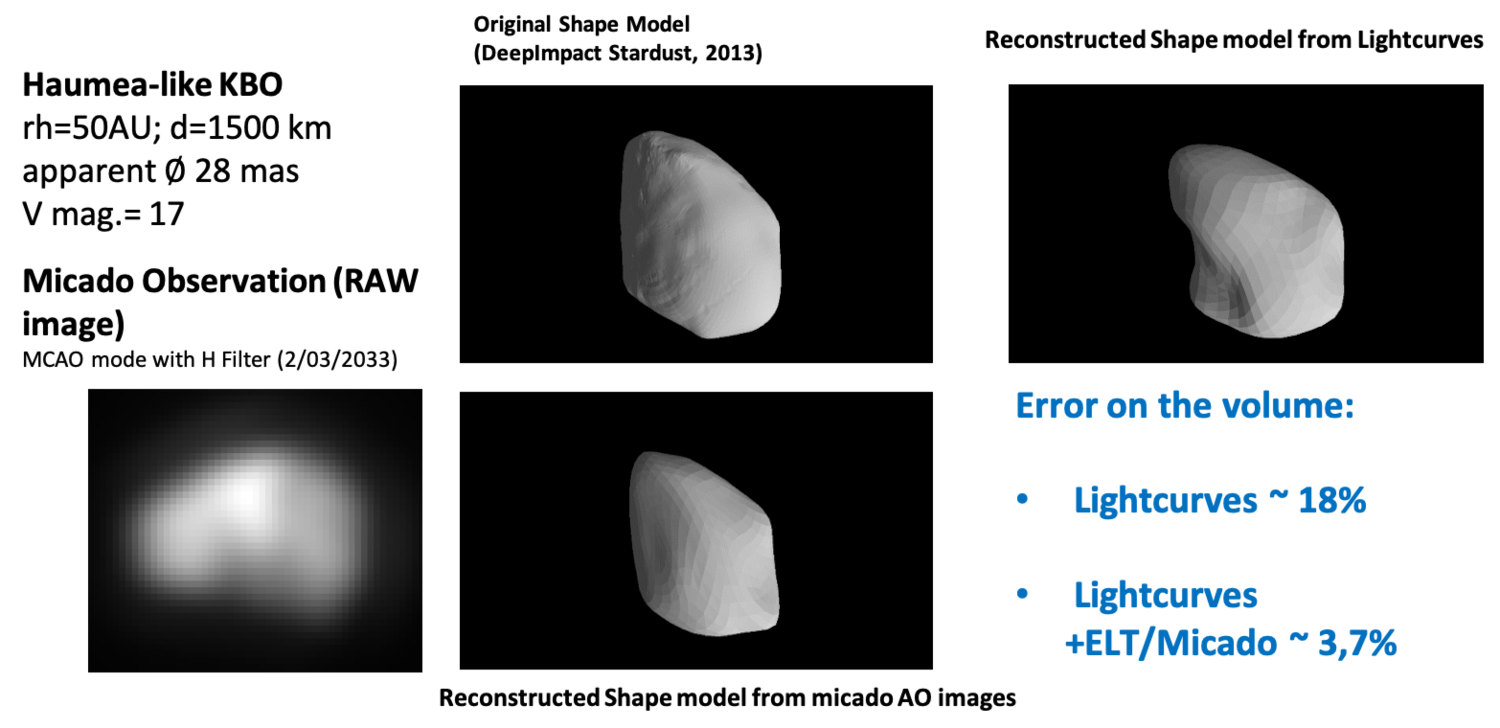
Fig. 2 Simulation of MICADO synthetic images of an Haumea like dwarf planet and analysis aimed at reconstructing the original shape model used in the simulation.
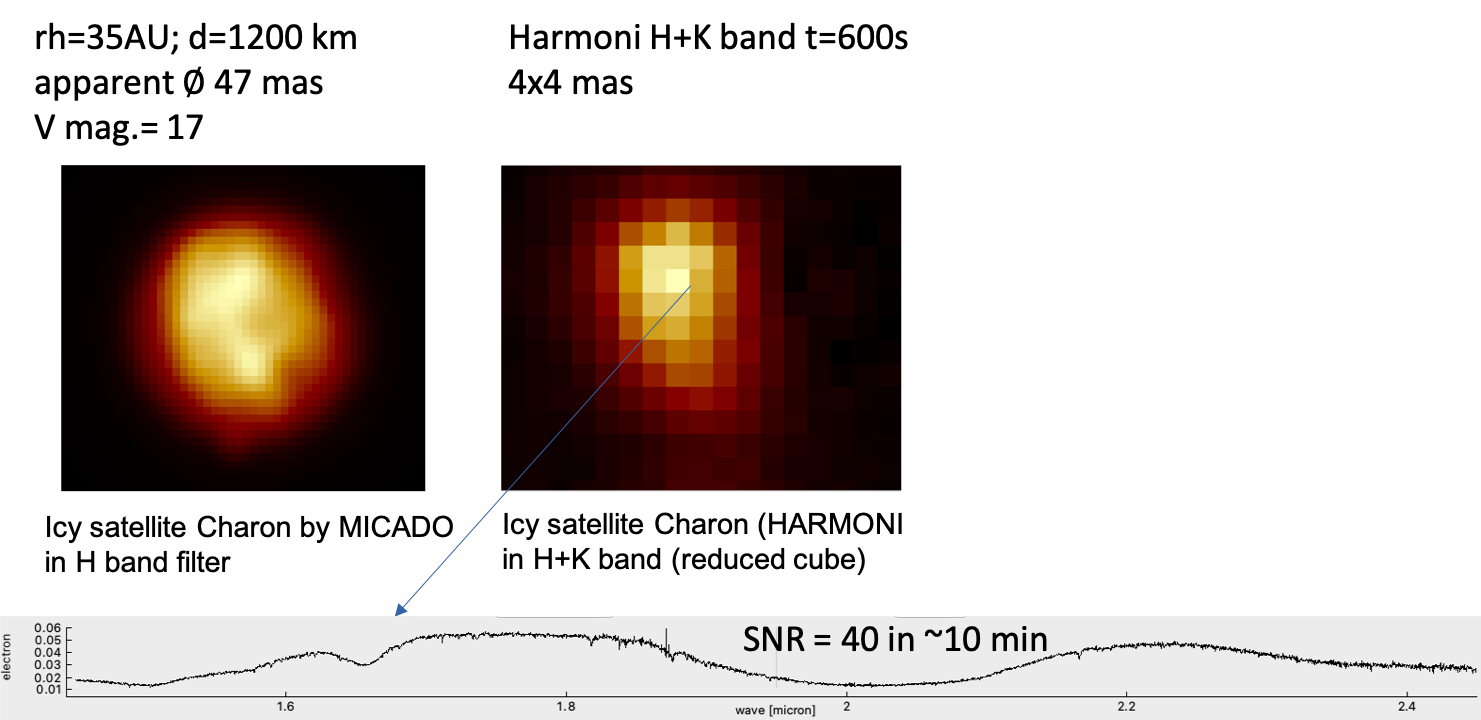
Fig. 3 Simulation of raw MICADO (left) and reduced HARMONI (right) images of Charon in the H+K band.
The science cases are organised into three main themes: (i) understanding the origins, geology, activity and evolution of icy worlds (i.e. satellites of giant planets and icy dwarf planets); (ii) small bodies (e.g. asteroids, Trojans, Centaurs, TNOs and comets) as witnesses to the formation and dynamics of the early Solar System; (iii) giant planet atmospheres as laboratories for investigating large-scale fluid dynamics and physicochemical phenomena.
Icy worlds will benefit from spatially resolved observations, which will allow us to reconstruct their shapes, map their large-scale geology and compositional heterogeneities, and determine their physical properties, such as their local surface temperatures for ices. The same kind of observations and investigations will be conducted with asteroids larger than 10 km and Trans-Neptunian Objects (TNOs) larger than 500 km. For smaller objects, longitudinal variations in global composition will be accessible via slit spectroscopy with very high spectral resolution and an unprecedented signal-to-noise ratio (SNR). Particular attention will be paid to determining the orbital and internal properties (density) of asteroids and TNOs in multiple systems. Finally, the variability of aerosol properties and minor gas abundances (CH₄, NH₃, H₂S), as well as the wind field (by tracking clouds), will be accessible with unprecedented detail at different spatial and temporal scales (yearly to monthly) in the atmospheres of giant planets, especially Uranus and Neptune.
With the arrival of the ELT and in conjunction with the James Webb Space Telescope, new discoveries regarding many objects in the solar system are on the horizon. However, the extraordinary size and specific characteristics of this next-generation telescope—particularly the widespread use of adaptive optics—will require meticulous preparation of observations for the most promising scientific cases. This preparation, led by the scientific teams of the instrument consortia, involves numerous aspects that need to be presented to the community using concrete examples.
Acknowledgment : S. D. would like to express his gratitude to the Institut des Sciences de l'Univers (INSU), the Centre National d’Etudes Spatiales (CNES), and the ANR for their support in preparing for the ELT through the PNP Origins and PEPR ORIGINS programmes. Meanwhile, A. L., M. P., J. B. and G. M. gratefully acknowledge the support of INAF-MORFEO in their own preparation activities.
How to cite: Douté, S., Beccarelli, J., Carry, B., Delsanti, A., Grassi, D., Ieva, S., Lucchetti, A., Munaretto, G., Pajola, M., and team, T. M.: Preparing Solar System object observations with the Extremely Large Telescope, Europlanet Science Congress 2026, The Hague, The Netherlands, 7–11 Sep 2026, EPSC2026-863, https://doi.org/10.5194/epsc2026-863, 2026.


