

- Université de Reims, LEATP, Reims, France (pascal.rannou@univ-reims.fr)
The photochemical haze layer in the stratosphere and the condensation haze (hereafter, mist) in the lower stratosphere and troposphere completely cover Titan and play a dominant role in its climate. Beneath the haze layer, clouds are formed with a geographic and time pattern that is directly connected to the seasonal meteorological cycle. The instrument VIMS has observed a large amount of clouds of different nature during thirteen years of the Cassini mission.
In this work, we present the procedure and the underlying hypothesis used to characterize the cloud physical properties. Once the surrounding haze is fixed, we are able to retrieve the cloud top altitude, the cloud column opacity and when it is possible, the droplet effective radius. We will display preliminary results and will show comparisons with climate models. We will also discuss the method and its limitation discussed. A typical result obtained with an observation of a cloud at mid latitude is displayed in Figure 1.
With the upcoming very large telescopes (Extremely Large Telescope, Thirty Meter Telescope,...) with high sensitivity and spectral resolution, this work shows it is important to fully understand past observations and to obtain as much information as possible from them. Finally, fully characterizing Titan’s atmosphere and climate with models to obtain the most accurate analysis and results from them is a major present-day objective to prepare for future missions to Titan such as Dragonfly.
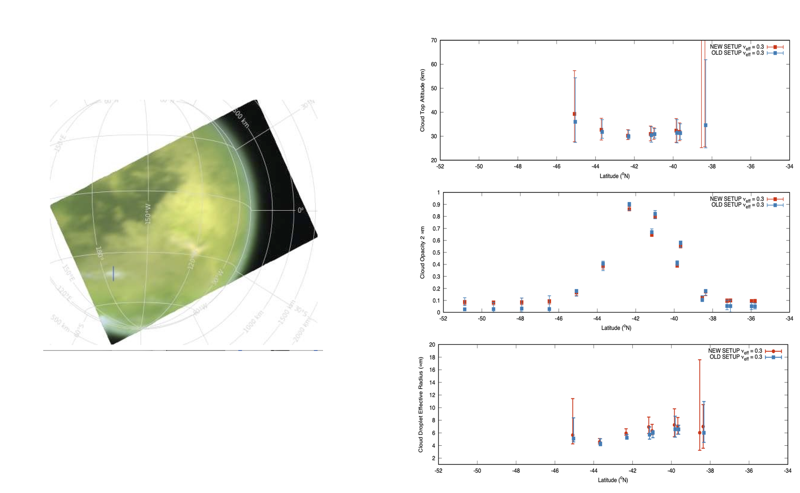
Figure 1 : Left: Clouds observed with VIMS (1481591044_1) during the flyby T88 on 13 Dec 2004 at about 40°S. The blue line shows a latitudinal cut used for the retrieval. Right top: Physical properties of the cloud retrieved as a function of the latitude along the blue latitudinal cut shown at left with VIMS data as publicly available and with VIMS data corrected for the intensity.
How to cite: Rannou, P. and Petetin, C.: Cloud physical properties in Titan's atmosphere as probed with VIMS/Cassini., Europlanet Science Congress 2026, The Hague, The Netherlands, 7–11 Sep 2026, EPSC2026-873, https://doi.org/10.5194/epsc2026-873, 2026.


