EPSC Abstracts
Vol. 19, EPSC2026-877, 2026, updated on 02 Jul 2026
https://doi.org/10.5194/epsc2026-877
Europlanet Science Congress 2026
© Author(s) 2026. This work is distributed under the Creative Commons Attribution 4.0 License.

Orientation and rotation model of Ganymede: Which parameters to fit?
 1,1,1,2
- 1Royal Observatory of Belgium, Systèmes de Référence et Planétologie, Bruxelles, Belgium (m.yseboodt@oma.be)
- 2KU Leuven, Belgium
Accurate orientation and rotation models for the Galilean satellites are essential to correctly interpret data from instruments GALA, 3GM, and JANUS onboard the Juice mission. We describe here an orientation/rotation model for Ganymede intended to assist in interior property inference by identifying the parameters to be estimated.
Our present model aims for a precision of approximately 0.001° (roughly 46 meters on the surface) during the 2035 Ganymede Circular Orbit (GCO) phase of 6 months.
Orientation and Libration Modeling:
We model the spin axis orientation and prime meridian location using the classical angles relative to the International Celestial Reference Frame (ICRF): the right ascension α, declination δ, and the rotation angle W. The W angle includes the physical libration γu defined relative to uniform rotation. For more information regarding the libration, see the poster Van Hoolst et al. (2026), this conference.
The expressions for the α, δ, W angles of the spin axis are sums of a linear polynomials and of a trigonometric series :
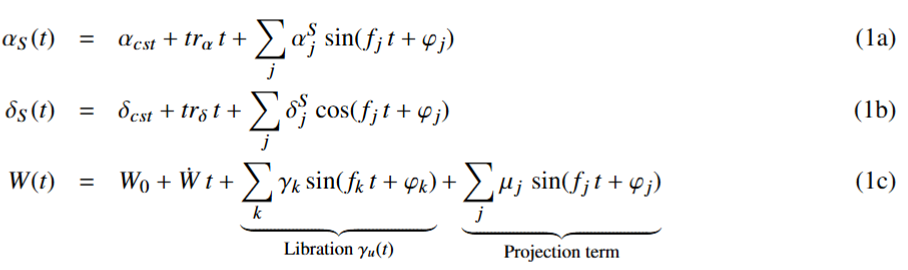
The numerical values of the model are given in Table 1 for the orientation angles and Table 2 for the librations.
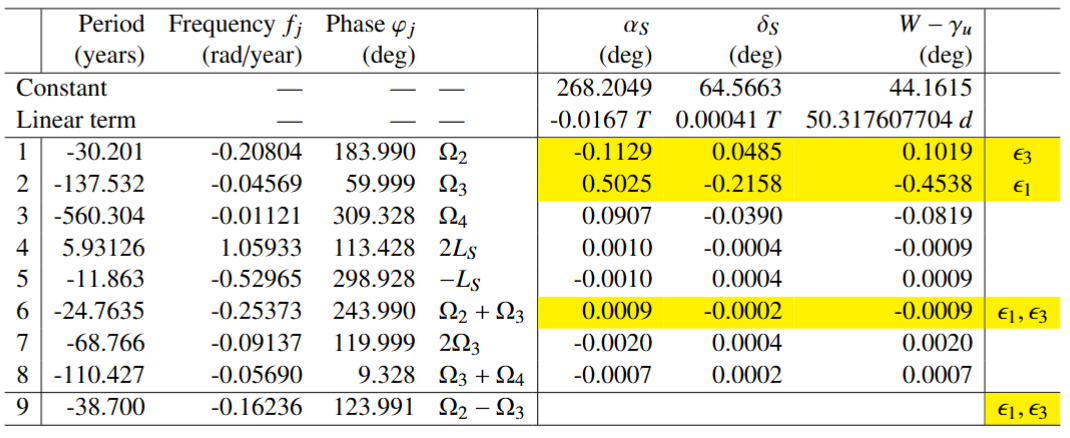
Table 1: Orientation parameters for a rigid, solid Ganymede. Based on the NOE orbital theory, nine periodic terms are identified. Amplitudes sensitive to the presence of a liquid elastic layer are highlighted in yellow.
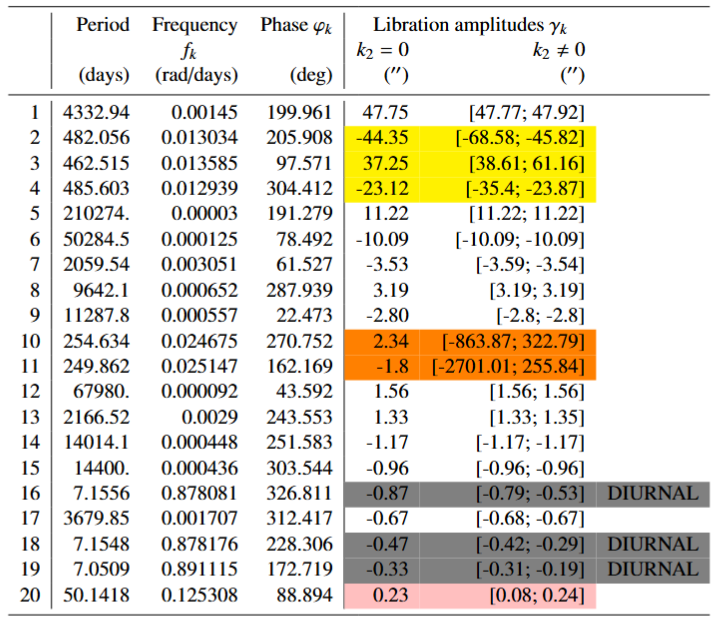
Table 2: Libration table for a rigid and solid satellite (k2 = 0) and range (k2 ≠ 0) if there is a liquid layer. We have a series of 20 libration frequencies. The truncation threshold of 0.1 as chosen here is below the aimed precision of 0.001°, but allows to see the diurnal libration in the series. Amplitudes sensitive to the presence of a liquid layer are highlighted.
Different SPICE kernels are provided for a solid and rigid satellite in planetary Physical Constants Kernels (PCK), available at https://lara.oma.be/GalileanSat.
Recommended Parameters for Orientation Model Inversion:
This study identifies the orientation parameters most sensitive to Ganymede's interior structure, specifically the presence of a subsurface liquid ocean, as highlighted in Table 1. However, to ensure robust inversion given a limited number of observations, the set of estimated parameters must be minimized.
We recommend fixing the lines that are independent of the interior to reduce correlations. For the spin orientation, four specific lines (lines 1, 2, 6, and 9) were identified as being interior-dependent. Given their long periods (∼30-560 years) relative to the 6-month duration of the GCO phase, we suggest modeling the combined effect of these four frequencies as a linear trend in right ascension and declination, rather than as a series of periodic oscillations.
Furthermore, we establish a relationship between the orientation angles α, δ and two obliquity amplitudes ε1 and ε3, which provide a more effective basis for constraining interior models.
Recommended Parameters for Libration Model Inversion:
For the libration model, to minimize the number of fitted parameters and because separating all individual frequencies over a 6-month duration is likely unfeasible, we again recommend fixing the terms that are independent of the interior. We suggest merging groups of close small frequencies into single periodic terms. This applies to groups with periods of 462–485 days (lines 2, 3, and 4) and 249–254 days (lines 10 and 11).
Three lines have a diurnal/quasi-diurnal period close to 7.1 days (lines 16, 18, and 19). Merging them into a unique diurnal frequency may introduce some error (because the beating term is ignored), depending on the interior model. Note that their amplitude is rather small (less than 1 as), and it may not be possible to estimate them given the expected measurement accuracy. The same applies to the 50-day libration period.
Three lines have a diurnal/quasi-diurnal period close to 7.1 days (lines 16, 18, and 19). Merging them into a unique diurnal frequency may introduce some error (because the beating term is ignored), depending on the interior model. Note that their amplitude is rather small (less than 1 as), and it may not be possible to estimate them given the expected measurement accuracy. The same applies to the 50-day libration period.
References:
M. Yseboodt and R.-M. Baland. Transformation of orientation and rotation angles of synchronous satellites: Application to the Galilean moons. Icarus, 450:116977, 2026. doi:10.1016/j.icarus.2026.116977
How to cite: Yseboodt, M., Baland, R.-M., and Van Hoolst, T.: Orientation and rotation model of Ganymede: Which parameters to fit?, Europlanet Science Congress 2026, The Hague, The Netherlands, 7–11 Sep 2026, EPSC2026-877, https://doi.org/10.5194/epsc2026-877, 2026.


