
 1,1,2,3,4,4,5
- 1Department of Physics, University of Oxford, Oxford, United Kingdom (bethan.gregory@physics.ox.ac.uk)
- 2Laboratoire de Météorologie Dynamique (CNRS/SU/IPSL), Paris, France
- 3Centre for Atmospheric Science, University of Cambridge, Cambridge, United Kingdom
- 4School of Physical Sciences, The Open University, Milton Keynes, United Kingdom
- 5Laboratoire Atmosphères et Observations Spatiales, Paris, France
Despite constituting a tiny fraction of the Mars atmosphere, trace gases can play an important role in controlling atmospheric chemical cycling. However, some discrepancies between observed distributions of trace gases and modelled values indicate that there are ongoing processes in Mars’ atmosphere that are not fully understood.
Hydrogen chloride (HCl) was the first new gas detected by the ExoMars Trace Gas Orbiter (TGO)[1,2], with observations from the Atmospheric Chemistry Suite (ACS) and Nadir and Occultation for Mars Discovery (NOMAD) instruments showing a strong seasonal variation over the last several Mars years. With a few exceptions, detections almost exclusively occur during the second half of the year (at solar longitudes between 180° and 360°). This is during southern hemisphere spring and summer, when temperatures, atmospheric dust content, and water vapour concentrations are higher, and ozone concentrations are low. Previous modelling has shown that heterogeneous chemical reactions involving dust or ice aerosols play a key role in controlling this seasonal pattern[3,4,5,6].
Here we use the Mars Planetary Climate Model[7,8], a 3-D global circulation model with photochemistry, to investigate some potential sources and sinks of HCl in the Martian atmosphere, which could account for the seasonal variation in measurements and the observed correlations and anticorrelations with other atmospheric factors. Firstly, we examine the indirect effect of heterogeneous chemistry of OH and HO2 interacting with ice. We compare the effect of two different heterogeneous chemical schemes[9,10] on HCl distributions via their effect on other oxidative species such as O and O3. Secondly, we investigate the isolated effects of two further heterogeneous pathways involving water ice—one HCl source and one sink. Specifically, we model the uptake of HCl onto water ice, which has been studied before, and its subsequent release back to the atmosphere during ice sublimation, which has not been included in previous models.
Our preliminary results (e.g., Figure 1) show that the latter cycling could account for some of the seasonality of the HCl observations. HCl concentrations remain close to the ground during the first half of the year, and then increase at higher altitudes during the second half of the year, where they could be detected by TGO's instruments. Even without the addition of other HCl sources and sinks in the model, we expect this pattern to be repeated over multiple Mars years, reproducing at least part of the annual appearance and disappearance of HCl through the recycling of chlorine.
Continuing to reconcile models and observations of the cycling of HCl and other trace gases is important for achieving a more complete understanding of atmospheric processes operating on Mars today, as well as those that have played a key role over Mars’ history.
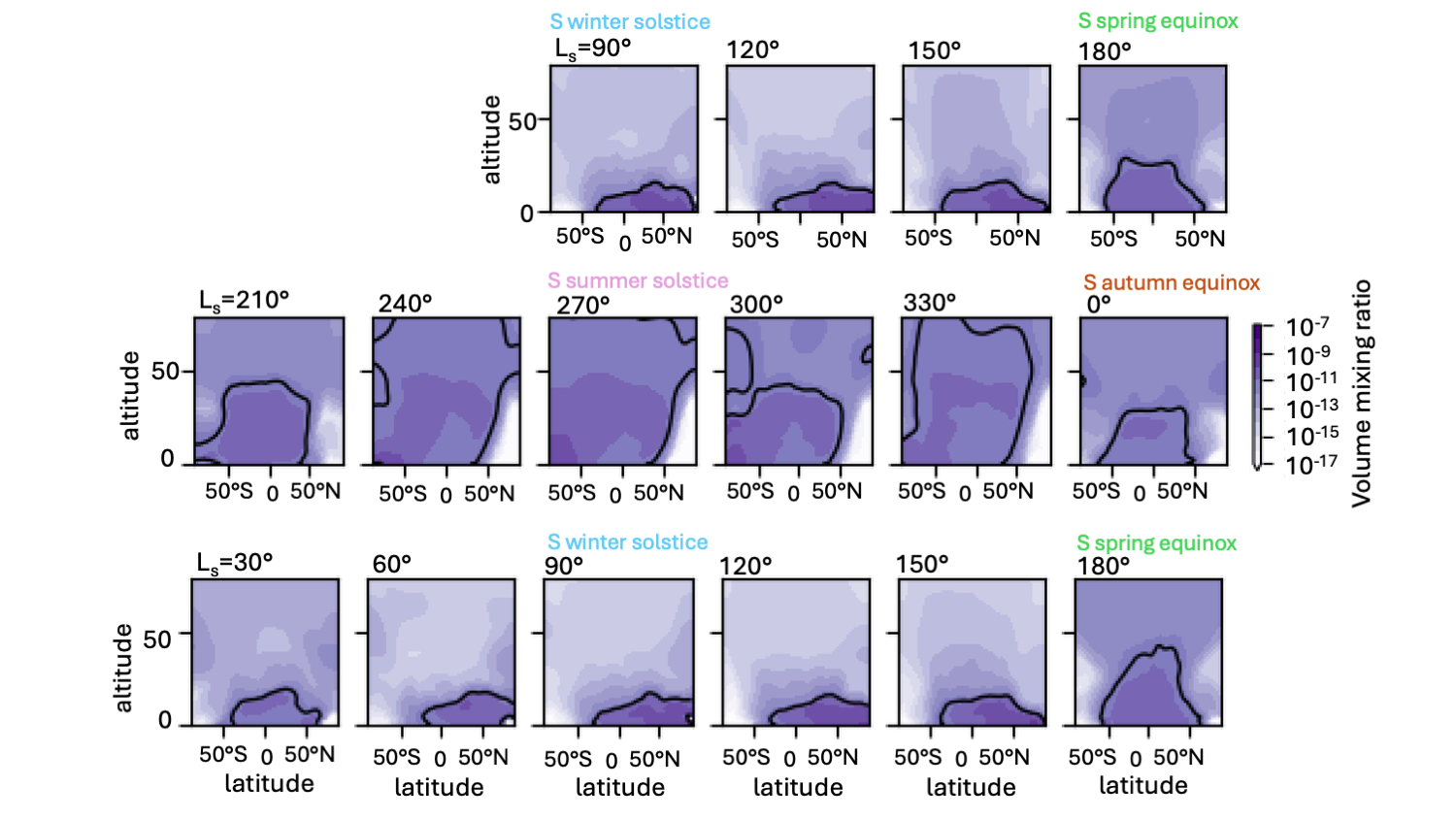
Figure 1: Preliminary model results showing seasonal distributions of HCl over more than one Mars year. Each panel shows zonally-averaged HCl volume mixing ratios with altitude and latitude, and there are 30° of solar longitude between each panel. The black contour indicates a mixing ratio of 0.5 ppbv, which is the detection limit for TGO ACS.
[1] Korablev O. I. et al. (2021). Sci. Adv., 7, eabe4386. [2] Olsen K. S. et al. (2021). Astron. Astrophys., 647, A161. [3] Benne, B., et al. (2025). Astron. Astrophys., 699, A362. [4] Rajendran, K. et al. (2025). JGR: Planets 130(3), p.e2024JE008537. [5] Streeter, P. M. et al. (2025). GRL 52(6), p.e2024GL111059. [6] Taysum, B. M. et al. (2024). Astron. Astrophys., 687, A191. [7] Forget, F., et al. (1999). JGR: Planets 104, E10. [8] Lefèvre, F., et al. (2004). JGR: Planets 109, E7. [9] Brown M. A. J. et al. (2022). JGR: Planets, 127, p.e2022JE007346. [10] Lefèvre, F., et al. (2021) JGR: Planets, 126, p.e2021JE006838.
How to cite: Gregory, B., Olsen, K., Millour, E., Brown, M., Rajendran, K., Streeter, P., Patel, M., and Lefèvre, F.: Modelling interactions with ice to understand the seasonal variation of HCl, Europlanet Science Congress 2026, The Hague, The Netherlands, 7–11 Sep 2026, EPSC2026-879, https://doi.org/10.5194/epsc2026-879, 2026.


