
 1,1,1,
- 1TU Dortmund University, Image Analysis Group, Department of Electrical Engineering and Information Technology, Germany (tom.sander@tu-dortmund.de)
- 2Korea Institute of Geoscience and Mineral Resources, 124 Gwahak-ro Daejeon 34132, Republic of Korea
Introduction
Lunar swirls are a unique class of surface features defined by sinuous, high-albedo markings that lack distinct topographic or stratigraphic expression. These features are influenced by crustal magnetism, regolith maturation, and space weathering, yet decades of orbital observations have not resolved the competing hypotheses for their formation. Proposed models include solar wind shielding by localized mini-magnetospheres [1, 2], surface scouring from cometary impacts [3], and electrostatic transport of fine-grained regolith [4, 5]. Previous efforts to distinguish among these hypotheses have primarily relied on qualitative interpretation, mineralogical correlations [6], and linear regression methods [7]. However, these traditional approaches are limited in their capacity to capture the complex, high-dimensional, and nonlinear relations present in multimodal planetary datasets. To address the need for advanced data integration in planetary science, this study introduces a multimodal machine learning model that synthesizes distinct categories of orbital datasets, such as spectral and radar measurements, to identify the unified physical signatures of lunar swirls.
Methodology
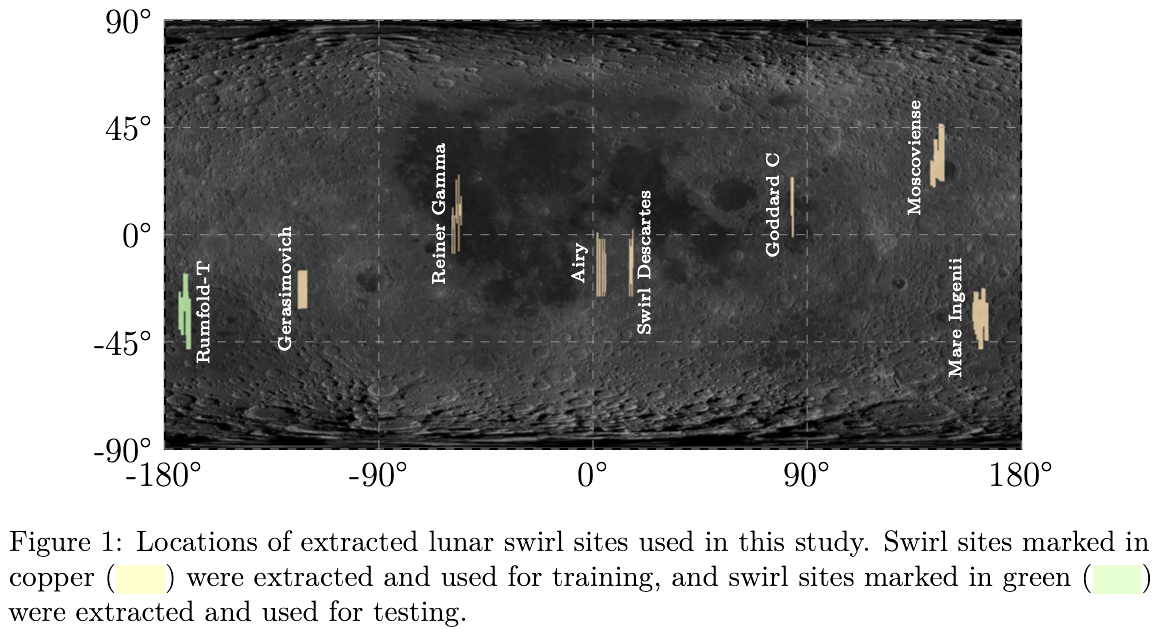
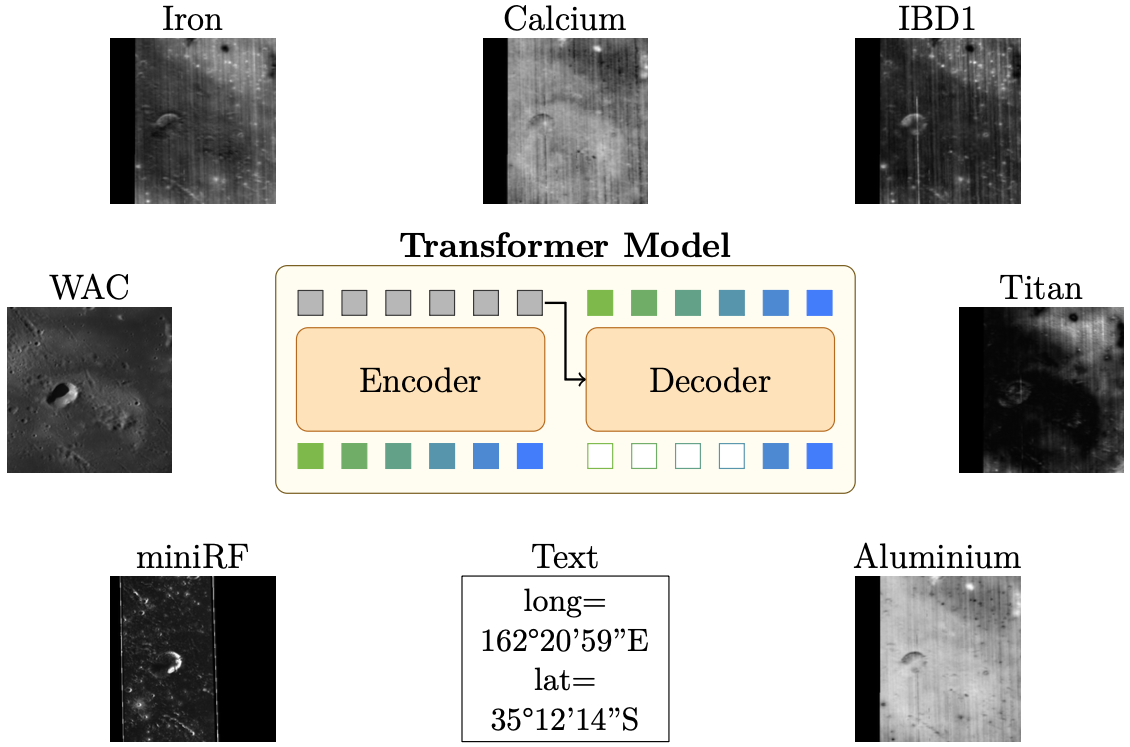
Drawing on recent breakthroughs in foundational vision-language models (VLA), a state-of-the-art multimodal Masked Autoencoder (MAE) based on a Transformer architecture was developed and trained on 12 distinct remote sensing modalities. The dataset covers 56 sites across 8 recognized lunar swirls (see Figure 1). As shown in Figure 2, the model processes heterogeneous input modalities, including image-like geophysical observations (such as LRO WAC reflectance, LRO Mini-RF radar backscatter, M3-derived elemental abundance maps, and brightness temperature) and textual spatial position information, which are jointly routed through a shared Transformer encoder-decoder. To approach the unique characteristics of each input, image-based modalities are compressed into discrete latent tokens using a dedicated, pre-trained VQ-GAN-style tokenizer, while textual coordinate modalities employ a structured, regex-based tokenization method. This brings the training dataset up to 39 million individual tokens. The Transformer encoder processes a visible subset of these tokens, and the decoder reconstructs the masked subset for each modality, compelling the network to acquire robust cross-modal geophysical relationships. The model underwent rigorous validation by repeated stratified cross-validation, followed by deployment as an exploratory tool using Leave-One-Out (LOO) ablations, Leave-One-In (LOI) evaluations, and Representational Similarity Analysis (RSA).
Results
Deploying the validated Transformer as an exploratory probe revealed quantitative constraints on the physical nature of lunar swirls. Leave-One-Out and Leave-One-In ablations identified plagioclase abundance as the most critical modality for boundary delineation, while Wide Angle Camera (WAC) reflectance emerged as the most independently sufficient dataset. Representational Similarity Analysis further demonstrated that the network encodes geophysical content along directions geometrically distinct from spatial coordinates. This confirms the model successfully captures a shared physical context across swirl sites, rather than relying on location-specific biases. By extending this ablation logic to the spatial domain, we found that the dependence of optical reflectance on mineralogical inputs is significantly stronger within swirl interiors than in the surrounding terrain. Crucially, no comparable enhancement in cross-modal coupling was observed for thermal emission or Mini-RF radar backscatter. This distinct asymmetry provides the empirical signature predicted by the maturation-retardation hypothesis, clearly separating it from competing scenarios, including cometary impacts or dust transport.
Discussion and Conclusion
The enhanced optical-compositional coupling observed inside lunar swirls is the empirical signature uniquely predicted by the maturation-retardation hypothesis [8, 9]. Reduced solar wind exposure preserves the structural relationship between regolith composition and observed brightness, a relationship that is otherwise obscured by accumulated nanophase iron in normally weathered background terrain [8, 11]. Alternative scenarios, such as cometary impacts [3], electrostatic dust transport [4], or thermophysical modification, do not predict this specific asymmetry. Instead, these alternative formation models would suggest that thermal or radar properties should exhibit similarly enhanced coupling to other physical domains within the swirls. This work characterizes the analytical limits of current orbital archives, highlighting that orbital data alone cannot definitively distinguish solar-wind shielding from other mechanisms that equivalently slow regolith maturation. Resolving the deeper structural and magnetic origins of swirls requires in-situ measurements, such as those planned for the upcoming Lunar Vertex mission [10]. Our results show that machine learning can extract complex, non-linear relationships from existing planetary datasets. This not only maximizes the data from legacy missions but also helps prioritize targets for future surface exploration.
References
[1] Bamford, R., et al., "Minimagnetospheres above the lunar surface and the formation of lunar swirls", Physical Review Letters, 2012.
[2] Deca, J., et al., "Reiner gamma albedo features reproduced by modeling solar wind standoff", Communications Physics, 2018.
[3] Schultz, P.H., Srnka, L.J., "Cometary collisions on the moon and mercury", Nature, 1980.
[4] Garrick-Bethell, I., et al., "Spectral properties, magnetic fields, and dust transport at lunar swirls", Icarus, 2011.
[5] Domingue, D., et al., "Topographic correlations within lunar swirls in mare ingenii", Geophysical Research Letters, 2022.
[6] Domingue, D., et al., "Spectrophotometric and topographic correlations within the mare ingenii swirl region: Evidence for a highly mobile lunar regolith", The Planetary Science Journal, 2023.
[7] Chrbolková, K., et al., "Reflectance spectra of seven lunar swirls examined by statistical methods: A space weathering study", Icarus, 2019.
[8] Hess, M., et al., "Processes governing the vis/nir spectral reflectance behavior of lunar swirls", Astronomy & Astrophysics, 2020.
[9] Zhao, W., et al., "Formation of lunar swirls: Implication from derived nanophase iron abundance", Remote Sensing, 2025.
[10] Vines, S., et al., "Lunar vertex: A prism science investigation of the Reiner gamma lunar magnetic anomaly and swirl", EGU, 2023.
[11] Kramer, G.Y., et al., "M3 spectral analysis of lunar swirls and the link between optical maturation and surface hydroxyl formation at magnetic anomalies", Journal of Geophysical Research: Planets, 2011.
How to cite: Sander, T., Wohlfarth, K., Arnaut, M., Hess, M., and Wöhler, C.: Investigating Lunar Swirls Using a Multimodal Transformer: A Masked Autoencoder Approach for Integrating Heterogeneous Planetary Remote Sensing Data, Europlanet Science Congress 2026, The Hague, The Netherlands, 7–11 Sep 2026, EPSC2026-883, https://doi.org/10.5194/epsc2026-883, 2026.


