
 1,1,1,4
- 1Universität Münster, Institut für Planetologie, Münster, Germany (bastian.gundlach@uni-muenster.de)
- 2Faculty of Aerospace Engineering, Delft University of Technology, Delft, The Netherlands
- 3LTU, 98192 Kiruna, Sweden
- 4Institute for Geophysics and Extraterrestrial Physics, TU Braunschweig, 38106 Braunschweig, Germany
Enceladus, Saturn’s sixth-largest moon, is encased in a crust of nearly pure water ice that makes it one of the most reflective bodies in the Solar System (Howett et al., 2010). This "fresh-material"-like appearance is due to the continuous fallout of icy grains from the moon’s massive south polar plume (Postberg et al., 2011), which recoats the surface in a bright, porous regolith.
Enceladus is arguably the most geophysically active moon in the Solar System, presenting a high-priority target for the next generation of planetary exploration. Recognizing its immense astrobiological potential, the European Space Agency (ESA) has identified an Enceladus orbiter and lander as the primary candidate for its L4 flagship mission within the Voyage 2050 framework.
Current data suggest a surface dominated by a continuous fallout of plume-derived ice grains, ranging from sub-micron to tens of micrometers in diameter (Jaumann et al., 2008; Postberg et al., 2011; Scipioni et al., 2017; Morello & Berg, 2024). While the moon’s south polar plumes provide a direct window into its subsurface ocean (Postberg et al., 2009), the physical state and observable signatures of the resulting surface regolith remain difficult to directly probe and therefore poorly constrained.
Fortunately, experiments have provided the first insights into the compressional behavior (compression curve: Φ(p); here Φ is the volume filling factor and p the applied pressure) of micrometer-sized water ice particles at low temperatures (Lorek et al., 2016; Kreuzig et al., 2023), which can be translated into a lander intrusion depth. Based on the recent work by Blum et al. (2026), the laboratory findings and the very low gravity of the icy moon, we developed a model to predict the intrusion depth of a potential lander. Initial results indicate intrusion depths in the mm to cm range as presented in Fig. 1, while further details regarding the model will be presented at the conference.
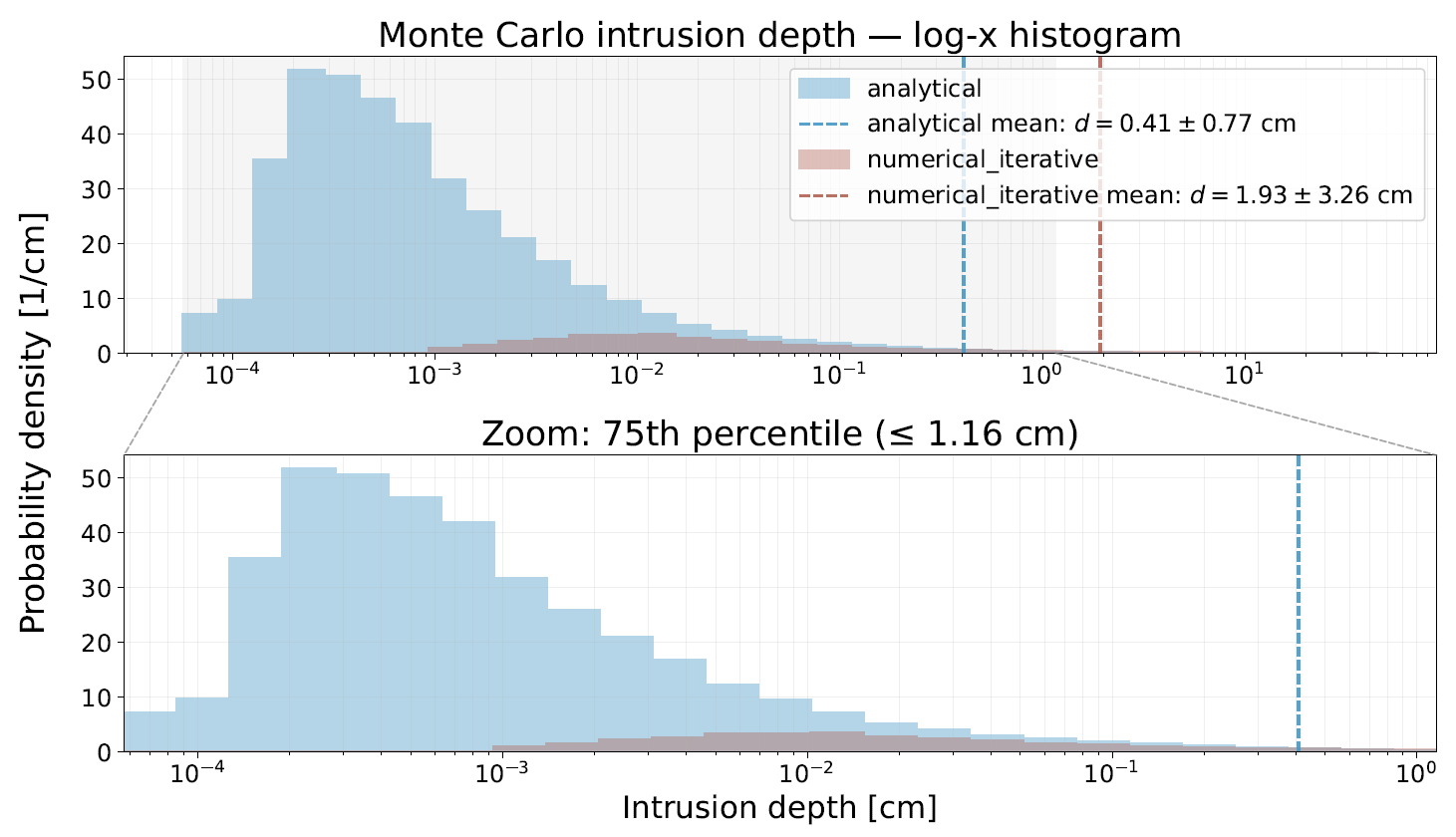
Fig. 1: Monte Carlo analysis showing a nominal intrusion depth of 0.4 cm (analytical mean), and 1.9 cm (numerical iterative mean).
References:
Howett et al. (2010) – DOI: 10.1016/j.icarus.2009.07.016
Postberg et al. (2011) – DOI: 10.1038/nature10175
Jaumann et al. (2008) – DOI: 10.1016/j.icarus.2007.09.013
Scipioni et al. (2017) – DOI: 10.1016/j.icarus.2017.02.012
Brown et al. (2006) – DOI: 10.1126/science.1121031
Gundlach et al. (2018) – DOI: 10.1093/mnras/sty1839
Morello & Berg (2024) – DOI: 10.1016/j.jqsrt.2024.109018
Lorek et al. (2016) – DOI: 10.1051/0004-6361/201526565
Kreuzig et al. (2023) – DOI: 10.1093/rasti/rzad049
Blum et al. (2026) – DOI: 10.1051/0004-6361/202558471
How to cite: Gundlach, B., Aussel, B., Rückriemen-Bez, T., Güttler, C., Ligterink, N., Cazaux, S., Hagermann, A., and Blum, J.: Enceladus surface: modeling intrusion depth for future lander missions, Europlanet Science Congress 2026, The Hague, The Netherlands, 6–11 Sep 2026, EPSC2026-885, https://doi.org/10.5194/epsc2026-885, 2026.


