
 1,1,1,2,1,1,1,1,
- 1INAF-IAPS, Rome, Italy
- 2Department of Climate and Space Sciences and Engineering, University of Michigan
- 3Southwest Research Institute
The polar regions of Jupiter represent one of the most complex dynamical environments in the solar system, characterized by a series of persistent, geometrically organized cyclonic structures [1]. Despite extensive observation, the fundamental origin, vertical structure, and chemical composition of these circumpolar cyclones (CPCs) remain key open questions in planetary science. Moreover, the polar caps are recognized as regions where high-energy particles, accelerated by Jupiter’s powerful magnetic field, drive intense aurorae and interact directly with atmospheric gaseous species in the upper atmospheric layers [2,3]. A primary consequence of this interaction is the presence of dense, thick stratospheric hazes that produce prominent signals in the ultraviolet (UV) [4] and can be effectively probed at near-infrared (NIR) wavelengths [5,6,7]. However, the specific composition and vertical distribution of the polar troposphere have historically remained elusive due to the extreme viewing geometries and the limitations of previous instrumentation.
The Jovian Infrared Auroral Mapper (JIRAM) provided the first preliminary maps of optical depth and minor species concentrations derived from 5 μm radiance measurements [8]. These early findings suggested that while the cyclones are optically thick, their average values are significantly lower (by a factor of 2 to 3) than those observed in equatorial regions. Nevertheless, the concentrations of minor species within these regions appeared largely comparable to equatorial values.
In this work, we present the first rigorous multiple-scattering atmospheric retrieval analysis of JIRAM spectra captured at the poles. Our objective is to characterize the polar troposphere in terms of aerosol vertical structure, particulate composition, and gaseous ammonia (NH3) content. We focused our investigation on the data acquired during JIRAM’s fourth perijove passage (PJ4). To ensure the integrity of the multiple-scattering retrievals and avoid the instabilities common to extreme viewing conditions, we implemented a strict selection criterion, retaining only spectra acquired at incidence angles lower than 85°. Under these constraints, the spatial resolution was found to be sufficient for a detailed study of the South Pole, specifically focusing on two distinct cyclones—CPC1 and CPC3—and their immediate surrounding regions, see Fig. 1. Due to the extreme energetic conditions at the poles the selected JIRAM spectra are extremely noisy, mostly because of the presence of a source of stray light, that becomes more significant at the viewing conditions of the polar regions and that we removed using the methods presented in [9]. The resulting reduced spectra reveal solar reflected radiances that are two orders of magnitude lower than equatorial observations and one order of magnitude lower than those recorded at lower latitudes, see Fig. 2.
For the forward modeling and retrieval, we utilized the NASA Planetary Spectrum Generator (PSG) [10], following the multiple-scattering methodology established by [11]. We modeled the solar-reflected spectral region (2.0–3.1 μm) using a discrete three-layer atmospheric scheme: (i) a box-like tropospheric haze layer at ∼ 0.2-0.4 bar, composed of small (0.1–0.3 μm) pure-reflecting particles; (ii) an intermediate Gaussian cloud deck at ∼ 0.7 bar, where we tested both tholin-like particulates and pure ammonia ice; and (iii) a deep Gaussian cloud at ∼ 1.2 bar with refractive indices consistent with ammonium hydrosulfide (NH4SH). The vertical distribution, density, and effective radii of these aerosols were treated as free parameters, along with the deep concentration and relative humidity of gaseous ammonia.
Our findings yield several insights: (i) in order to model the 2.0-2.4 μm region of the JIRAM spectra we need to include a stratospheric haze as in [5,6,7,]; (ii) the spectral fits do not necessitate the presence of pure ammonia ice particulates within the CPCs; (iii) the deep cloud layers within the CPCs are situated at greater depths (higher pressures) than in surrounding regions, whereas the upper-level clouds exhibit an upward displacement; (iv) the retrieved tropospheric haze and cloud densities are consistently one order of magnitude lower than those at lower Jovian latitudes; (v) the integrated aerosol opacity within the CPC core is higher than in the immediate intra-cyclonic environment; and (vi) retrieved NH3 concentrations are in agreement with MWR data.
To explain these observations, we propose a dynamical model wherein upwelling within the cyclone core produces adiabatic cooling. This ascending motion must be balanced by compensatory subsidence; the descending air warms adiabatically, shifting the local condensation level downward and causing the deep cloud top to appear deeper in the atmosphere.
While the low tropospheric aerosol density values are consistent with the measured solar radiances and the results of previous NIR retrievals [5], they are not trivial to explain from a theoretical point of view. We explore various sink mechanisms that may govern this environment, including: the tropopause temperature barrier, the over-abundance of cloud condensation nuclei (CCNs), the Clausius-Clapeyron barrier, the inhibition of UV photon penetration, and the potential for rain-out effects.
References:
[1] Adriani A., Mura A., Orton G., Hansen C., Altieri F., et al. 2018, Nature, Volume 555, Issue 7695, pp. 216-219
[2] Hue V., Cavalié T., Sinclair J. A., Zhang X., et al. 2024, Space Science Reviews, Volume 220, Issue 8, id.85
[3] Castagnoli C., Dinelli B. M., Altieri F., Migliorini A., et al. 2025, The Planetary Science Journal, Volume 6, Issue 4, id.93
[4] Hord C. W., West R. A., Simmons K. E., Coffeen D. L., et al. 1978, Science, Volume 206, No. 4421
[5] Zhang X., West R. A., Banfield D., Yung Y. L., 2013, Icarus, Volume 226, Issue 1, September–October 2013, Pages 159-171
[6] Banfield D., Conrath B. J., Gierasch P. J., Nicholson P. D., Matthews K., Icarus, Volume 134, Issue 1, July 1998, Pages 11-23
[7] Rodriguez-Ovalle P., Guerlet S., Fouchet T., Harkett J., et al. 2024, A&A, 691, A51
[8] Adriani A., Bracco A., Grassi D., Moriconi M. L., Mura A., et al. 2020, Journal of Geophysical Research: Planets, Volume 125, Issue 6
[9] Grassi D., Mura A., Castagnoli C., Biagiotti F., et al. 2026, CNSP26 congress
[10] Villanueva G. L., Smith M. D., Protopapa S., Faggi S., Mandell A. M., 2018, J. Quant. Spec. Radiat. Transfer, 217, 86
[11] Biagiotti, F., Grassi, D., Liuzzi, G., et al. 2025, Monthly Notices of the Royal Astronomical Society, staf38
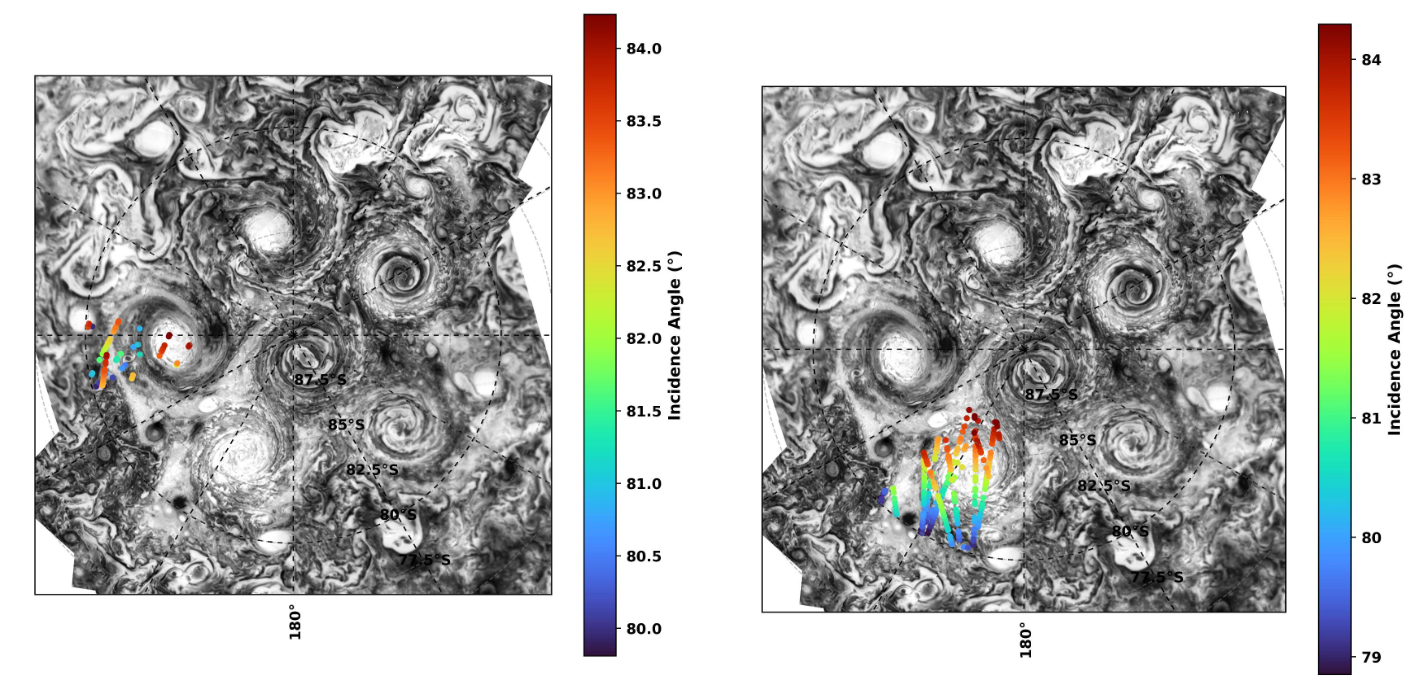
Fig. 1
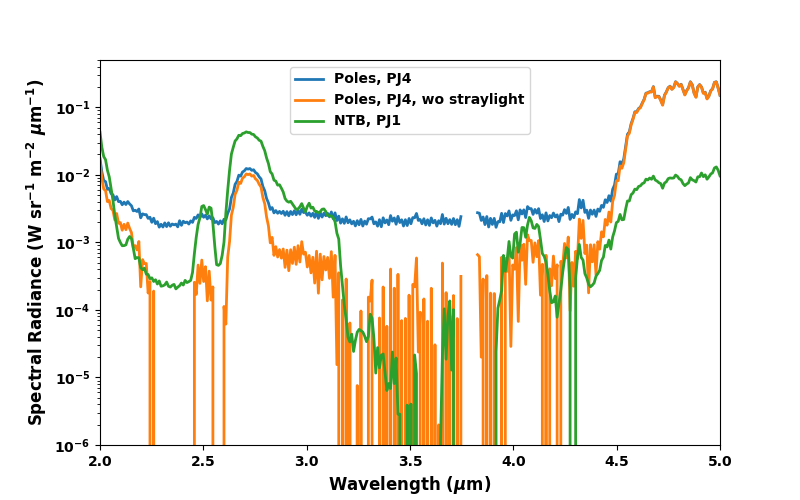
Fig.2
How to cite: Biagiotti, F., Scarica, P., Davide, G., Mura, A., Li, C., Piccioni, G., Castagnoli, C., Adriani, A., Plainaki, C., Tosi, F., Sordini, R., Cicchetti, A., Noschese, R., and Bolton, S.: Probing the Tropospheric Architecture of Jupiter’s CPCs with Juno/JIRAM: New Constraints on Aerosols and Gaseous Ammonia, Europlanet Science Congress 2026, The Hague, The Netherlands, 7–11 Sep 2026, EPSC2026-886, https://doi.org/10.5194/epsc2026-886, 2026.


