
 ,,,,
,,,,- Delft University of Technology, Faculty of Aerospace Engineering, Delft, Netherlands (e.s.steenstra@tudelft.nl)
Introduction: Venus is a high-priority target for understanding the fundamental processes behind climate change and planetary evolution [1,2]. A robotic lander mission offers a unique opportunity to address key unresolved scientific objectives outlined in the Venus exploration roadmap. Here, we introduce the mission concept KYTHERA [3], a long-duration lander designed for Venus. The concept includes a novel lander architecture, an EDL sequence, landing site selection, and a planned timeline of scientific operations. Together, these elements demonstrate the feasibility of sustaining a lander mission on the Venusian surface for more than 200 Earth days [3].
Science objectives and requirements: Key science questions identified by VEXAG [4] focus on Venus’s early evolution, past habitability, atmospheric dynamics, and interior–surface structure and composition. It was found that a long-term robotic lander could reasonably investigate the volatile cycle, surface composition, tectonics, volcanism, and atmosphere–surface interactions. Scientific return depends on the landing site, including elevation and geological context. For the mission concept, various requirements were derived. These include landing site selection, supported by pre-descent imagery, favoring volcanic plains to reduce EDL risk while sampling representative Venusian terrain. Site selection balances safety, geology, altitude, proximity to potentially active features, and orbiter communication. The monitoring and detection of potential temporal variability in atmospheric chemistry and possible seismic activities were considered a major scientific focus [5]. Another major scientific requirement is chemical analyses of Venusian surface lithologies - at least 20 surface analyses were deemed to be required to characterize the mineralogy and calibrate orbiter data. Mission requirements emphasize long-duration surface operations exceeding 200 Earth days to enable seismic monitoring and atmospheric observations over nearly a Venus day. The lander relies on a relay orbiter in a 24-hr elliptical orbit [5], with insertion assumed between 2035-2037. System requirements include TRL >5 components, a total mass of <350 kg, power below 25% of mass and planetary protection consistent with COSPAR Category II.
Results: Landing site selection: Landing site selection is critical for both scientific return and feasibility. A key requirement is that the site be located within terrain that is geologically representative of Venus. The volcanic plains of Venus—particularly the widespread rp1 unit [6]—offer the most suitable environments, as they balance geological representativeness with favorable landing conditions. Two candidate regions were identified: Lakshmi Planum and Lada Terra. Lakshmi Planum provides lower P-T conditions, offering increased engineering margins, though it may be less representative of global Venusian geology. In contrast, Lada Terra presents a more challenging environment due to higher P–T conditions but is of significant scientific interest, owing to the presence of nearby potentially active coronae and promising seismological targets. Based on current assessments, Lakshmi Planum has been provisionally selected, pending further detailed analysis.
Lander design: The lander design (Fig. 2) includes defined power, mass, and size budgets, with configurations for EDL and a deployable seismometer. Key components are a hot–cold box system and Stirling generators for active cooling. The cold box houses temperature-sensitive instruments, while the overall structure follows proven Venera-style designs suited to Venus’s harsh surface.
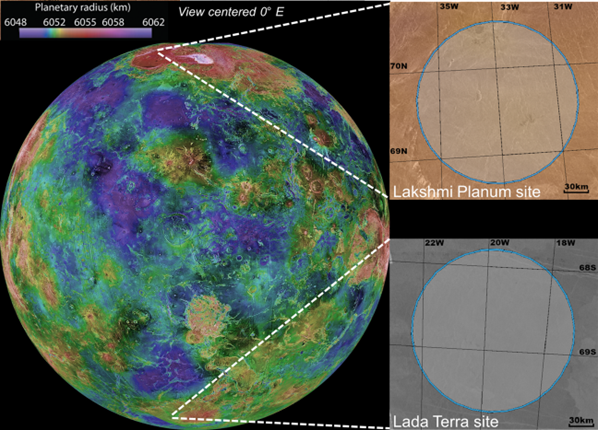
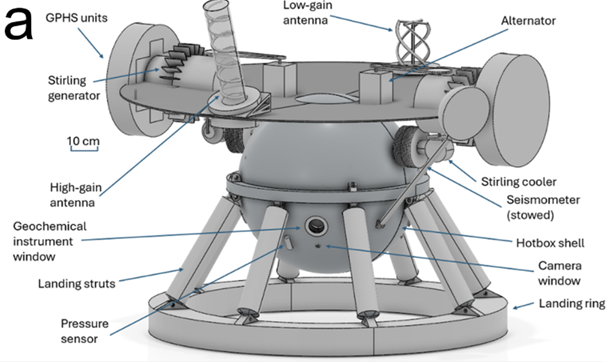
Fig. 1: Identified potential landing sites Fig. 2: KYTHERA lander design
Power and thermal control: Long-duration survival on Venus’ surface requires active cooling [7]. A Stirling radioisotope generator system was considered to provide both thermal control and electricity, supported by passive thermal strategies, heat pipes during cruise, phase-change materials during entry, and a vacuum-insulated hot–cold box design to minimize heat leakage after landing. The temperature evolution of the hot box and cold box was modeled throughout the mission timeline.
Experimental and analytical packages: The payload was selected by balancing science goals with limits on mass, power, data, and durability. Most instruments are housed in a cooled cold box for thermal stability and structural support. DAVINCI's VMS is adapted for long-term surface use. The cold box also includes a Raman LIBS geological analyzer for remote elemental and mineral analysis. Seismic measurements are performed by the externally deployed HOTTech seismometer, while additional sensors monitor wind, radiation, and P-T conditions.
Mission timeline and science operations: Science operations begin during descent, with the VMS conducting atmospheric analyses every ~200 m. After landing, imaging provides geological context and supports seismometer deployment, followed by continuous seismic and environmental monitoring for up to 200 Earth days. Atmospheric composition is measured every ~12 hrs, while >20 Raman LIBS surface analyses characterize geology. Thermal modeling indicates active cooling can maintain required operating temperatures during early surface operations.
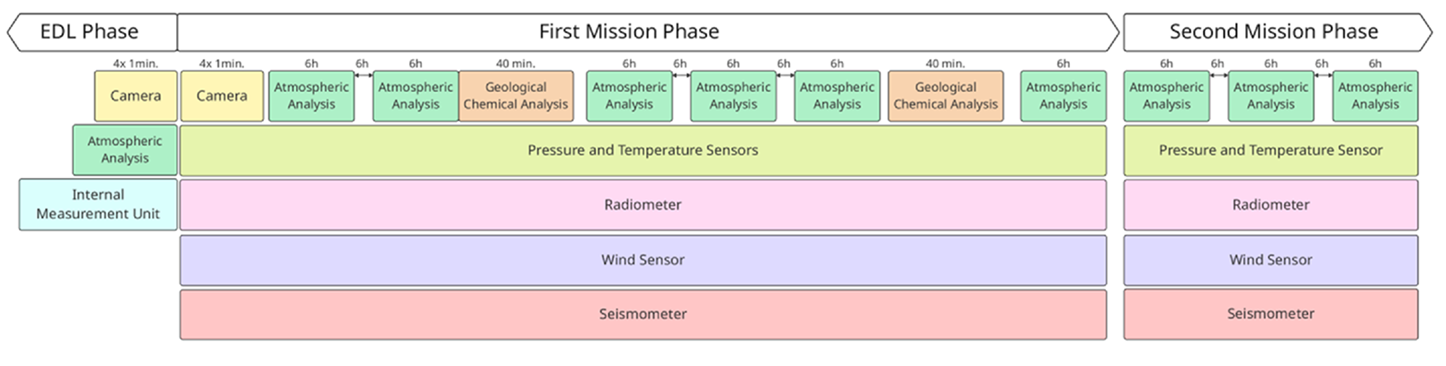
Fig. 3: Science operations timeline
Conclusions and outlook: This study presents a new concept for a long-duration Venus lander mission which addresses most defined key science objectives [1,4]. Many of these objectives cannot be achieved by orbiter missions alone, underscoring the critical role of a long-duration lander in advancing understanding of Venus’s geology, atmosphere, and evolution [5]. The results clearly highlight the need for additional studies on the performance and feasibility of instrumentation and materials under Venus’ harsh surface environment, which will be explored in the future in the newly established Delft High-P/T Laboratory for Planetary Materials where the extreme Venusian surface environment can be directly simulated.
Acknowledgments: This work is the compiled result of the 2025 AE-TU Delft DSE. ESS acknowledges funding of ERC StG VenusVolAtmos.
References: [1] NRC, Vision and Voyages for Planetary Science in the Decade 2013-2022 [2] Widemann et al. (2023) Space Sci Rev [3] Farkas et al. (2026) Adv Space Res, in press [4] VEXAG Roadmap for Venus Exploration [5] Kremic et al. (2020) Plan Space Sci [6] Ivanov & Head (2011) Plan Space Sci [7] Landis (2021) Act Astron
How to cite: Steenstra, E., Farkas, G., Geldolf, A., Lorenci, L., Methner, R., Pavel, M., Potharaju, L., Topper, S., Van Gestel, J., Wijgerse, T., Xin, M., Aerts, G., Jorritsma, J., and Schrama, E.: Venus Surface Exploration With The Long-Duration Lander Mission Concept ‘KYTHERA’, Europlanet Science Congress 2026, The Hague, The Netherlands, 7–11 Sep 2026, EPSC2026-89, https://doi.org/10.5194/epsc2026-89, 2026.


