
 1,6
1,6- 1INAF, Trieste, Italy (laura.silva@inaf.it)
- 2University Tor Vergata, Rome, Italy
- 3Centro de Astrobiología (CSIC-INTA), Madrid, Spain
- 4University of Padova, Italy
- 5INAF, Arcetri, Firenze, Italy
- 6Politecnico di Torino, Italy
The search for life beyond the Solar System requires operational definitions of planetary habitability that can be used both to rank promising exoplanets and to predict the conditions under which atmospheric biosignatures may arise and be detected. Climate models provide the physical framework to quantify surface habitability by describing the spatial and temporal distribution of temperature, liquid water availability, and radiation environments. Yet the production of biosignatures depends on biological processes that operate at much smaller scales. By coupling climate physics with biological response functions to temperature and radiation, we aim to link local biological limits to planetary-scale habitability and observable biosignature potential.
Here we present the work carried out within the Italian Space Agency-funded ASTERIA collaboration, which brings together astrophysicists, biologists, and climatologists. The project measures the responses of cyanobacteria to non-Earth-like environmental conditions (Barbisan et al., 2026) and explores how these biological responses can be integrated into climate-based estimates of photosynthetic habitability, oxygen production potential, and biosignature detectability. The work is focused on both tidally-locked rocky planets orbiting M-dwarf stars, and Earth-like analogues, in view of next generation instruments.
For rocky planets orbiting M-dwarf stars, we have performed a systematic study of the potential habitability over a representative sample of observed exoplanets (Bisesi et al., 2026a), by applying our version of the 3D climate model PLASIM. We have linked the predicted surface temperature and irradiance maps to cyanobacterial response functions (Maris et al., 2026 in prep), thereby translating local biological limits into planetary-scale estimates of photosynthetic habitability and oxygen production potential. The irradiance response of photosynthetic activity (here based on Mycrocistis aeruginosa and M. weisembergii cyanobacteria) is modulated by a biological temperature response. To simplify the calculation, in the current implementation, we considered the two cases of a mesophile and thermophile-like cyanobacterial.
A representative case is shown in Fig. 1 for an aquaplanet with parameters of TOI-700 d. Preliminary results extended to the full sample of considered exoplanets, indicate that surface temperature is more limiting the potential oxygenic productivity than the irradiance: under-illuminated regions are generally frozen and therefore non-productive, while sub-stellar cloud cover can mitigate excessive irradiation. We have also explored the potential detrimental effects on photosynthetic productivity by stellar UV radiation (Billi et al., in prep).
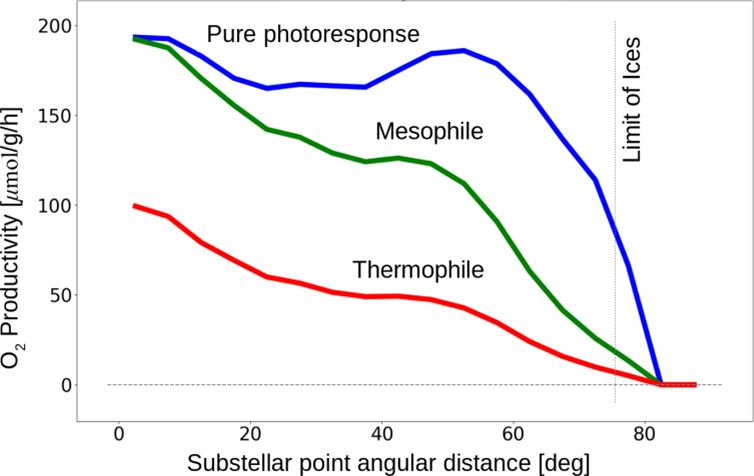 |
Fig.1 Averaged Oxygen productivity profiles (μmoles of O2/g of Chl a/h), as a function of the angular distance from the substellar point, for the irradiance-only response (blue) and irradiace and temperature responses (green and red).
|
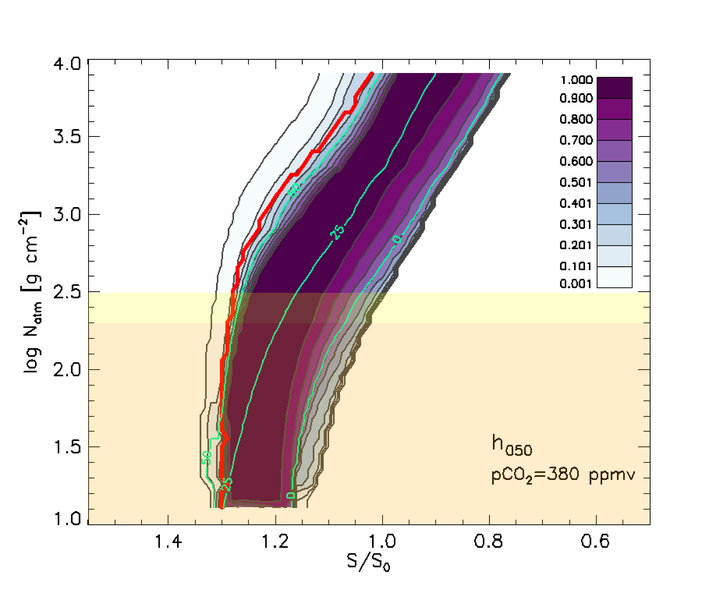
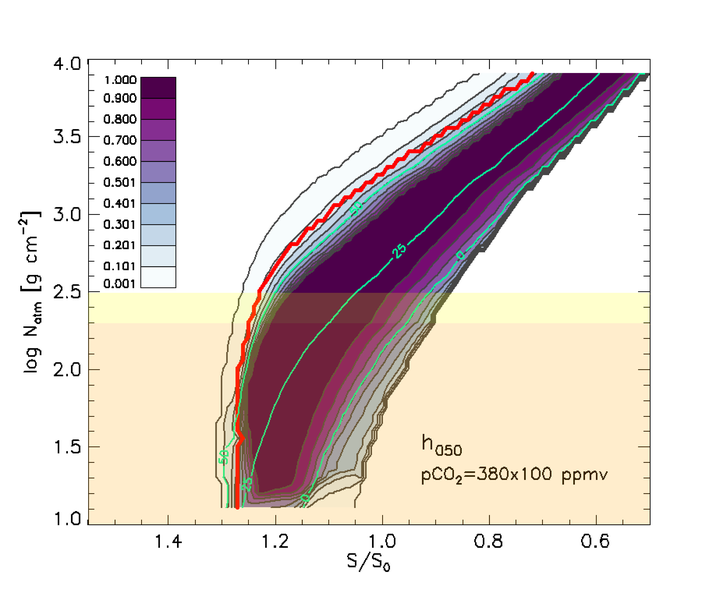
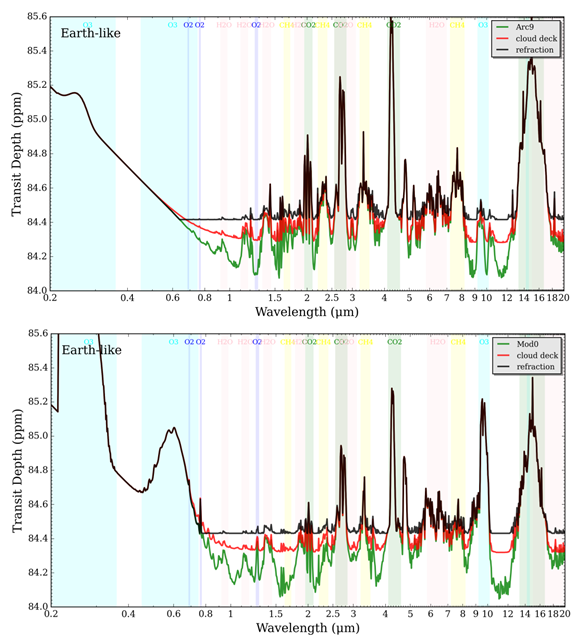
For Earth analogues we adopt a lower complexity model pRT-ESTM (Bisesi et al., 2026b). In this model we have interfaced the radiative transfer code petitRADTRANS (Mollière et al., 2019) with our EBM-class climate model ESTM (originally interfaced with the radiative transfer code CCM, Vladilo et al., 2015; Silva et al., 2017). This new model allows us to explore any atmospheric composition and directly link climate and habitability explorations with the corresponding observables. Given the current lack of confirmed detections, we have performed large parametric studies aimed at expanding our understanding of potential habitability under a wide range of orbital, planetary, atmospheric and biological assumptions. In particular, we introduced a temperature-based habitability index (Silva et al., 2017), which provides a quantitative measure of the fraction of the planetary surface compatible with temperature limits suitable for oxygen producers and consumers (Fig.2 left). This index has served as the basis for our habitability studies, and, combined with different biological responses, allows to link habitability to potential observables. We present recent results concerning systematic studies of photosynthetic potential and corresponding biosignatures (see Fig. 2, right) obtained by considering a large range of atmospheric compositions.
  |
 |
|
Fig.2 Left: Range of habitable solutions (vs pressure and insolation, and two CO2 abundances) by adopting a biologically motivated temperature range of 0–50◦C, representative of conditions potentially suitable for the activity of oxygen-consuming and -producing organisms (Silva et al., 2017). Shaded region indicates the range of surface pressures for which the surface dose rate due to secondary particles produced by Galactic Cosmic Rays exceeds 100 mSv yr−1. Right: Transit spectra for a CO2-rich Earth analogue and 100 ppm O2 (up), compared with that for a modern Earth composition. |
References
- Barbisan, M. Barbato, M. Maris, L. Silva, B. Boccia, N. La Rocca, L. Coccola, L. Poletto, N. Trivellin, F. Peron. UV LED-based solar flare simulator for space environment studies, Proc. SPIE 13913, Light-Emitting Devices, Materials, and Applications XXX, 139130G, 4 March 2026; https://doi.org/10.1117/12.3077482
- Bisesi, G. Murante, J. von Hardenberg, J. A. Caballero, M. Maris, D. Billi, N. La Rocca, and L. Silva. Assessing the Climate and Habitability of Tidally Locked Rocky Exoplanets. Astrobiology, under review, 2026a.
- Bisesi, G. Murante, A. Provenzale, J. von Hardenberg, M. Maris, and L. Silva. Interaction between vegetation and Snowball phases in the late Proterozoic Earth. IJA, accepted, arXiv e-prints, art. arXiv:2603.25321, March 2026b. doi:10.48550/arXiv.2603.25321.
- Molliére, J. P. Wardenier, R. van Boekel, Th. Henning, K. Molaverdikhani, and I. A. G. Snellen. petitRADTRANS. A Python radiative transfer package for exoplanet characterization and retrieval. , 627:A67, July 2019. doi: 10.1051/0004-6361/201935470.
- Silva, G. Vladilo, P. M. Schulte, G. Murante, and A. Provenzale. From climate models to planetary habitability: temperature constraints for complex life. International Journal of Astrobiology, 16(3):244–265, July 2017b. doi: 10.1017/S1473550416000215.
- Vladilo, L. Silva, G. Murante, L. Filippi, and A. Provenzale. Modeling the Surface Temperature of Earth-like Planets. , 804 (1):50, May 2015. doi: 10.1088/0004-637X/804/1/50.
How to cite: Silva, L., Maris, M., Bisesi, E., Murante, G., Billi, D., Caballero, J. A., La Rocca, N., Battistuzzi, M., and von Hardenberg, J.: Coupling Biological Responses and Climate Physics to Assess Exoplanet Habitability and Biosignatures, Europlanet Science Congress 2026, The Hague, The Netherlands, 7–11 Sep 2026, EPSC2026-897, https://doi.org/10.5194/epsc2026-897, 2026.


