

- University of Vienna, Institute of Meteorology and Geophysics, Department of Meteorology, Austria (shijil.umer@univie.ac.at)
The Habitable Zone (HZ) is classically thought of as a continuous orbital space surrounding a star. Most studies that try to estimate the extent of the HZ ignore the evolutionary history of the star during its Pre-Main-Sequence (PMS) and how the decreasing stellar luminosity during this era can affect the composition of planets at different orbital distances. The carbonate-silicate weathering cycle could have particularly interesting consequences when the PMS of the star is taken into account. This process consumes atmospheric CO2 depending on surface water availability and surface temperatures with warmer conditions allowing faster removal of CO2 .
During the PMS, the star derives most of its energy from gravitational contraction. Low mass stars such as M-Dwarves tend to have much higher luminosity during this phase compared to their Main Sequence (MS). Hence as the star undergoes the PMS to MS transition (hereafter referred to as the P2M transition), their luminosity decreases and the HZ shifts closer to the star due to the drop in stellar flux received at a certain orbital distance. The P2M transitions lasts for an order of 100 Myrs for early M-Dwarfs to 1 Gyr for late M-Dwarfs (Baraffe et al 2015, Ramirez and Kaltenegger 2014} - longer than the planet formation timescales. Thus, during this transition, the atmospheres of the orbiting planets will experience a considerable change in forcing from its host star, potentially leading to changes in atmospheric composition (Luger and Barnes 2015).
In this study, we take into account the P2M transition and assume that the planet is sufficiently tectonically inactive to have insignificant CO2 outgassing compared to modern Earth. Planets closer to the star experience higher surface temperatures (due to increased insolation throughout the P2M) and thus lose their atmospheric CO2 more rapidly. However, their proximity to the star allows the surface to be habitable. The planets much farther from the star (experiencing lower insolation) retain sufficient atmospheric CO2 allowing the greenhouse effect to make the planetary surface habitable in the MS. However, some planets orbiting the star between these two extremes will receive too little stellar flux and possess insufficient atmospheric CO2 to make the surface habitable. This forms the crux of the Banded Habitable Zone (BHZ) hypothesis. BHZ means that the HZ is split into two - with a region of space in between the two segments that is in a snowball state incapable of hosting surface liquid water (see Figure 1).
A two-column model constrained by top-of-atmosphere radiative balance and a simple one-dimensional radiative-convective scheme is constructed to calculate the day-side surface temperatures of the planets. The planets are all assumed to be tidally-locked. The stellar spectra of M-Dwarfs peak in the near-IR part of the spectrum where the absorption bands of water vapour and CO2 dominate. Thus, the atmosphere can be expected to absorb a significant amount of the incoming stellar radiation, reducing the lapse rate of the atmosphere and suppressing convection (Eager-Nash et al 2020). The 1-D radiative-convective model takes into account the atmospheric absorption of both the downward flux of the near-IR stellar radiation, as well as the upward flux of the long-wave radiation emitted by the surface. This simple, computationally inexpensive model provides a valuable approach for calculating the atmospheric evolution during the multi-million-year-long P2M transition.
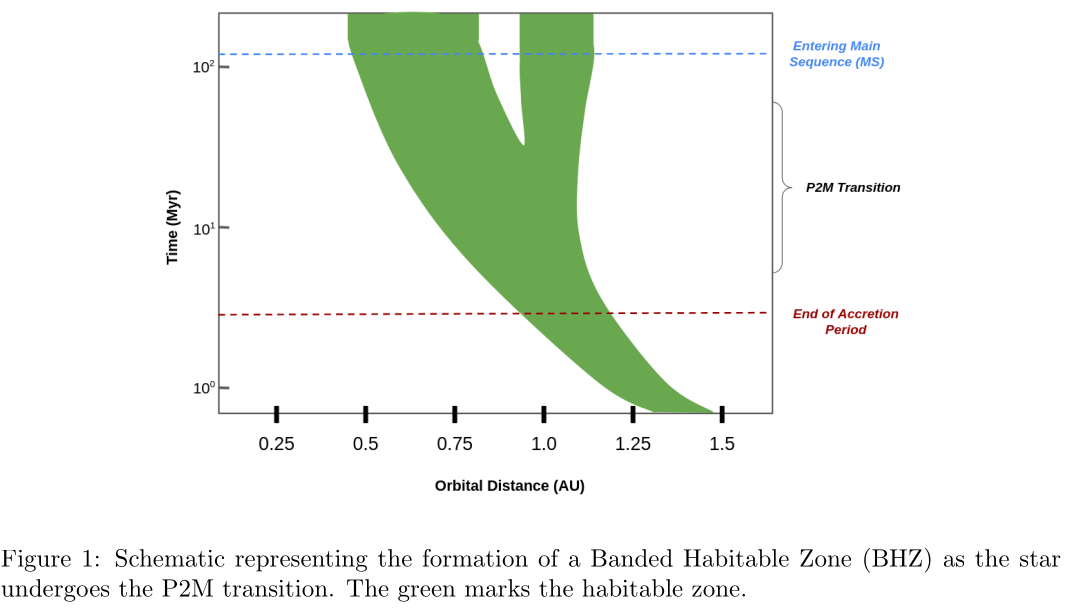
Results obtained using this simple model indicate that the non-linear behaviour of the atmospheric CO2 removal, coupled with the competition between the planetary atmosphere's greenhouse effect and the decreasing insolation of the host star during the P2M transition, can potentially generate a BHZ.
References:
- Isabelle Baraffe, Derek Homeier, France Allard, and Gilles Chabrier. New evolutionary models for pre-main sequence and main sequence low-mass stars down to the hydrogen-burning limit. Astronomy & Astrophysics, 577:A42, 2015. doi: https://doi.org/10.1051/0004-6361/201425481.
- Jake K. Eager-Nash, David J. Reichelt, Nathan J. Mayne, F. Hugo Lambert, Denis E. Sergeev, Robert J. Ridgway, James Manners, Ian A. Boutle, Timothy M. Lenton, and Krisztian Kohary. Implications of different stellar spectra for the climate of tidally locked Earth-like exoplanets. Astronomy & Astrophysics, 639:A99, 2020. doi: 10.1051/0004-6361/202038089.
- R. Luger and R. Barnes. Extreme Water Loss and Abiotic O2 Buildup on Planets Throughout the Habitable Zones of M Dwarfs. Astrobiology, 15(2):119–143, 2015. doi: 10.1089/ast.2014.1231.
- Ramses M Ramirez and Lisa Kaltenegger. The habitable zones of pre-main-sequence stars. The Astrophysical Journal Letters, 797(2):L25, 2014. doi: 10.1088/2041-8205/797/2/L25.
How to cite: Umer, S. and Voigt, A.: Possibility of Banded Habitabile Zones around M-Dwarf Stars, Europlanet Science Congress 2026, The Hague, The Netherlands, 7–11 Sep 2026, EPSC2026-901, https://doi.org/10.5194/epsc2026-901, 2026.


