
 1,1,
1,1,- 1Faculty of Aerospace Engineering, Technische Universiteit Delft, The Netherlands (g.w.p.m.aerts@tudelft.nl)
- 2Institute for Mineralogy, Münster University, Germany
- 3Department of Earth Sciences, Vrije Universiteit Amsterdam, The Netherlands
Introduction: Within the Venusian volcanic plains, long meandering channels have been identified and classified as so-called ‘canali’ (e.g. [1]). Canali are channels of great length that are thought to have been formed by melts and/or fluids on the Venusian surface. Canali may have formed through a combination of mechanical and thermal erosion or collapse of subsurface lava flows [2]. The morphological properties of canali show a great degree of similarity to terrestrial rivers [3], suggesting that the fluid that formed them must have been a low-viscosity fluid, likely similar in viscosity to water. Additionally, the extreme length and constant width of the longest canali imply that the responsible fluid was stable over a vast distance and thus a large amount of time. Water cannot have been responsible for the formation of canali, as liquid water is unstable due to the high surface temperatures. Instead, a magma or fluid-rich melt is more likely to have carved the canali. However, ordinary basaltic magmas are too viscous to form the observed channel geometries [4], and would also cool too quickly and could, therefore, not produce the observed length of the channels. Several other candidates have been proposed based on stable mineral phases on the Venusian surface. This study aims to constrain the melting behaviour of carbonate melts relevant to the Venusian crust while assessing their potential as a source for the formation of canali on Venus.
Methods: We performed high-pressure and -temperature experiments in a Bristol-type end-loaded piston cylinder press. Experiments were conducted at the Institute for Mineralogy, Münster University, and the Department of Earth Sciences, VU, Amsterdam. Three compositions were studied. All compositions consisted of 75 wt% Ocean Island Basalt (OIB), a basaltic equivalent to the Venusian upper crust, while the remaining 25% consisted of either Na2CO3, CaCO3, or a mixture of 50 wt% Na2CO3 and 50% CaCO3. The OIB was created by mechanically mixing reagent grade powders of SiO2, Al2O3, Na2CO3, MgO, CaCO3, TiO2, Fe2O3, K2CO3 and MnO under ethanol, after which the material was decarbonated and molten into a glass. The glass was ground into a fine powder, after which the corresponding carbonate was added to obtain the final three compositions. Starting compositions were directly loaded in 2.0 mm outer diameter, 1.7 mm inner diameter Pt capsules. Three loaded capsules, each containing one of the three starting compositions, were placed in boron-nitride (BN) three-holed spacers. The capsule-containing BN spacers were loaded into regular ½ inch talc-pyrex assemblies. A ruby disc was placed on top of the BN spacer, followed by an MgO sleeve containing a 1.6 mm outer diameter and a 4-bore alumina thermocouple sleeve containing thermocouple wires. At the top of the assembly, a hardened steel plug and pyrophyllite ring were placed. Temperatures were measured using W95Re5 – W74Re26 (type C) thermocouple wires placed at the assembly hotspot. A total of 15 experiments were performed, all lasting 2 hours, while temperature and pressure were varied (T = 1050, 1100, 1200, 1300, 1400 °C; P = 0.5, 0.85, 1.7 GPa). Capsules were subsequently polished to expose the interior. Phases were identified and major element concentrations were measured using EPMA at Münster University and the Netherlands Geological Facility at Utrecht University.
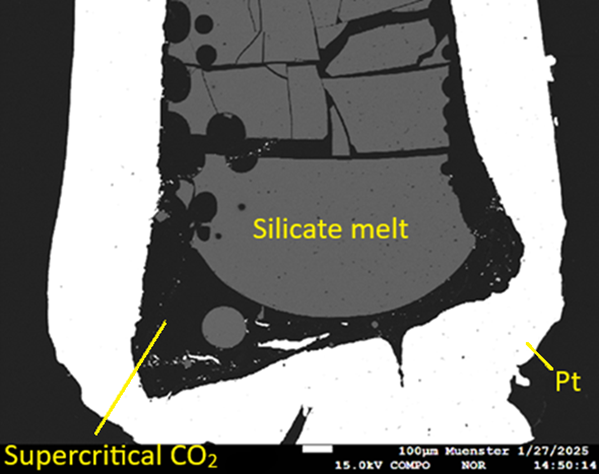
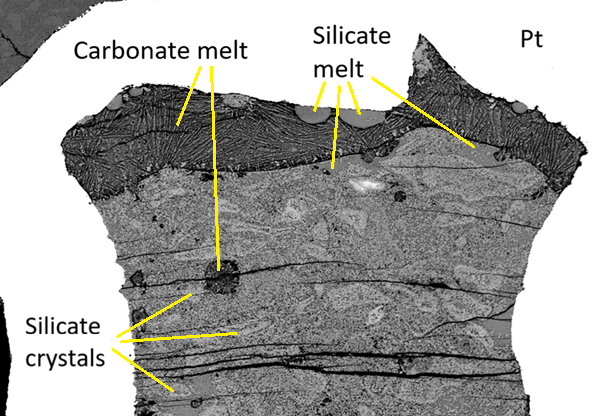
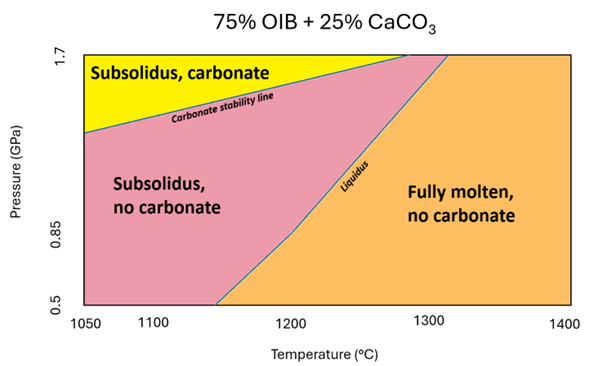
Results: Various phases were identified. The OIB+Ca experiments did not produce carbonate melt under any of the experimental conditions, CaCO3 broke down to CaO and CO2 before the liquidus of the system was reached (Fig 1). Both the OIB+Na and the OIB+mix experiments produced carbonate melt at 1100 °C at various pressures (Fig 2). Details will be presented at the conference. Our results are used to create OIB + carbonate stability fields (Fig. 3).
|
|
|
Figure 1. CaCO3 has decomposed fully, resulting in an ultra-calcic silicate melt coexisting with a supercritical CO2 phase at 0.85 GPa, 1300 °C. |
Discussion: Pure CaCO3 does not produce carbonate melts under the explored experimental conditions. In contrast, pure Na2CO3 or a mixture of the two will produce carbonate melt at some of the experimental conditions. Depending on the oxygen fugacity and composition of carbonates in the Venusian crust, this may have various implications. Carbonates in the Venusian crust may have various origins. Carbonates have been suggested to result from evaporated oceans [5], liquid immiscibility of carbonated silicate melt [2], or buried reaction products as a result of chemical weathering [6]. Basic studies have been performed on the chemical composition of chemically weathered Venusian minerals and/or rocks (e.g. [7]), but more a qualitative approach is needed to fully understand weathering rates and processes. Depending on the geotherm, these potential carbonates might remain solid, melt to from carbonate melts or dissociate to produce CO2. If carbonate melt is stable, a mechanism to concentrate and erupt the melt would be required to act as a canali-forming source. Experimentally studying the rheological properties of carbonates will lead to a better understanding of the potential carbonatites hold as a canali-forming source. Additionally, this study has implications for the solubility of CO2 in silicate melt. Experiments show that the solubility increases with increasing pressure. Given the abundance of CO2 in the Venusian atmosphere, carbonatites and/or carbonated magmas have played a major role in the outgassing of CO2 and, thus, the evolution of Venus.
|
|
|
Figure 2. Stable carbonate melt coexisting with silicate melt at 1.7 GPa, 1100 °C. |
|
|
|
Figure 3. Schematic estimated stability field of 75% OIB + 25% CaCO3. |
Acknowledgements: This study was supported by the ERC StG VenusVolAtmos and NWO M-Invest Canali awarded to ESS.
References: [1] Komatsu et al. (1992), GRL. [2] Trussell et al. (2025), Science Advances. [3] Bray et al. (2007), JoGR.[4] Treiman (2009), 40th LPSC 2009. [5] Zolotov (2018), RiMaG. [6] Kargel et al. (1994), Icarus. [7] Santos et al. (2023), JGR Planets.
How to cite: Aerts, G., Jorritsma, J., Berndt, J., Klemme, S., van Westrenen, W., and Steenstra, E.: An experimental perspective on the feasability of the formation of Venusian canali via carbonatitic melts, Europlanet Science Congress 2026, The Hague, The Netherlands, 7–11 Sep 2026, EPSC2026-912, https://doi.org/10.5194/epsc2026-912, 2026.


