
 1,4,3,3,3,1
- 1Imperial College London, Earth Science and Engineering, London, United Kingdom (nid20@ic.ac.uk)
- 2Royal Holloway University of London, United Kingdom
- 3German Aerospace Center (DLR), Microwaves and Radar Institute, Germany
- 4isardSAT, Spain
ESA's EnVision mission will deliver some of the first new high-resolution radar maps of Venus since Magellan, with the VenSAR instrument operating in HH/HV dual-polarisation S-band at 30 m and 10 m resolutions [1]. Venus' surface is dominated by volcanic terrain [3], so understanding what the new missions may 'see' requires analysis of radar signatures at barren, volcanic terrains on Earth. The Askja volcanic system in Iceland is well-suited to isolating surface-roughness effects on radar backscatter [2]: basaltic composition, minimal topography and vegetation cover, and accessibility for ground-truth validation [6,7]. We address whether radar can be used to differentiate, provide age constraint, and characterise the emplacement and modification of volcanic surfaces, and whether these signatures are preserved at VenSAR specifications.
Seven lava flow age units erupted from the Askja volcano, ranging in age from the 1961 Vikrahraun to >7,000 BP, were characterised using fully polarimetric Synthetic Aperture Radar (SAR) data acquired using the DLR’s F-SAR system for NASA JPL and the VERITAS team in August 2023 [4,5]. These datasets include X-band (3.1 cm), S-band (9.2 cm), and L-band (22.6 cm) at 2 m spatial resolution. Flow units have been mapped using S-band HH radar imagery, stratigraphic relationships, and field data; absolute ages are from the ÍSOR digital geological database [9] and Sæmundsson et al. [10,11] (Figure 1).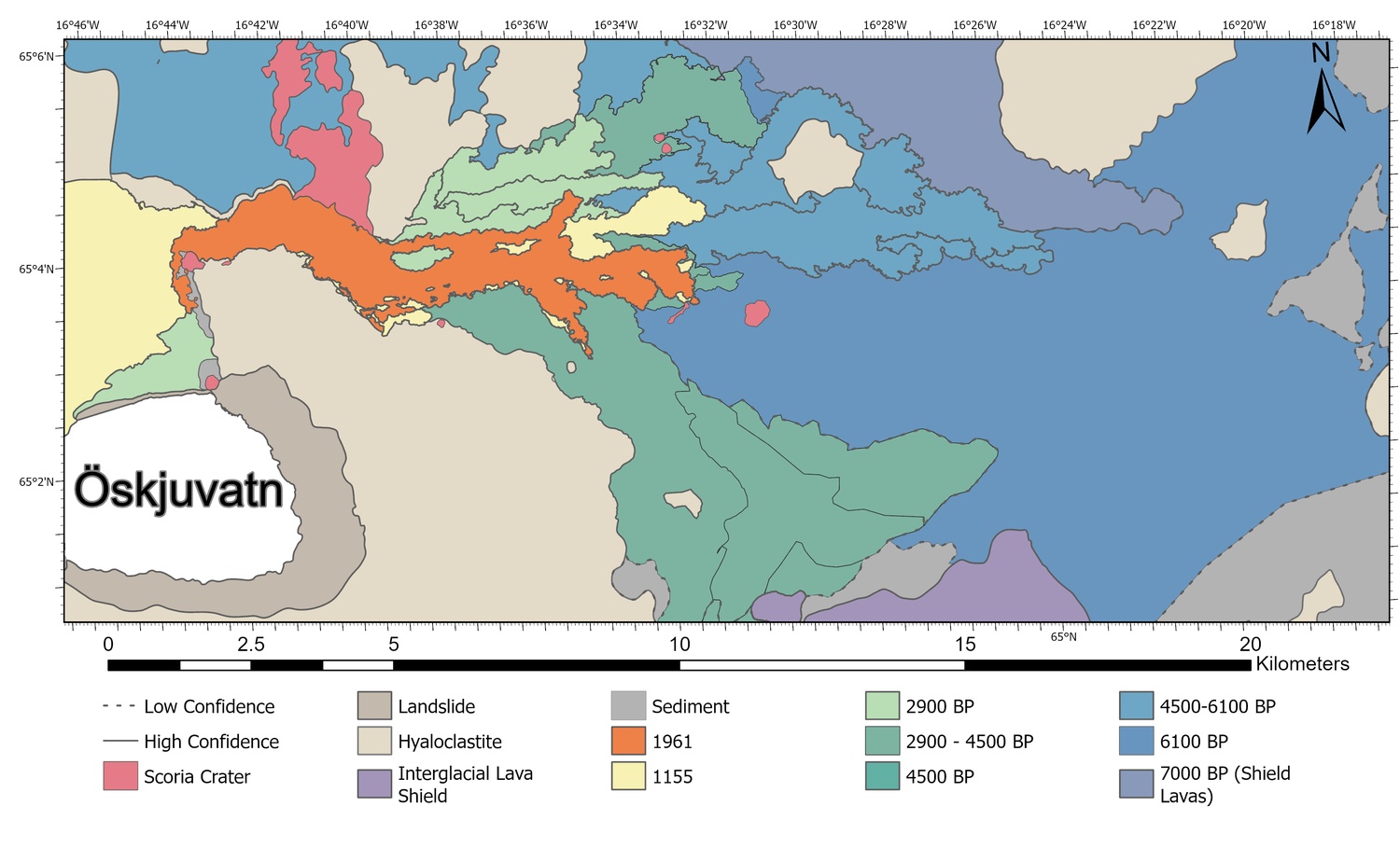
Figure 1. Geological map of the Askja volcanic system showing the seven flow units examined in this study [9-11].
Across the Askja flow sequence, mean S-band HH γ0 decreases systematically with flow age. The 1961 Vikrahraun flow has a mean γ0 of -7.0 dB; the >7,000 BP Shield Lavas reach -14.0 dB (Figure 3). This backscatter decrease is driven by post-emplacement weathering, smoothing, and mantling (Figure 2). The 5th percentile of the per-pixel distribution drops 8.7 dB across the age sequence; the 95th percentile drops only 4.6 dB. Weathering therefore smooths the smoothest regions preferentially. Backscatter also decreases with increasing incidence angle (10-15 dB decrease from 10° to 80°), consistent with typical radar scattering behaviour from rough surfaces.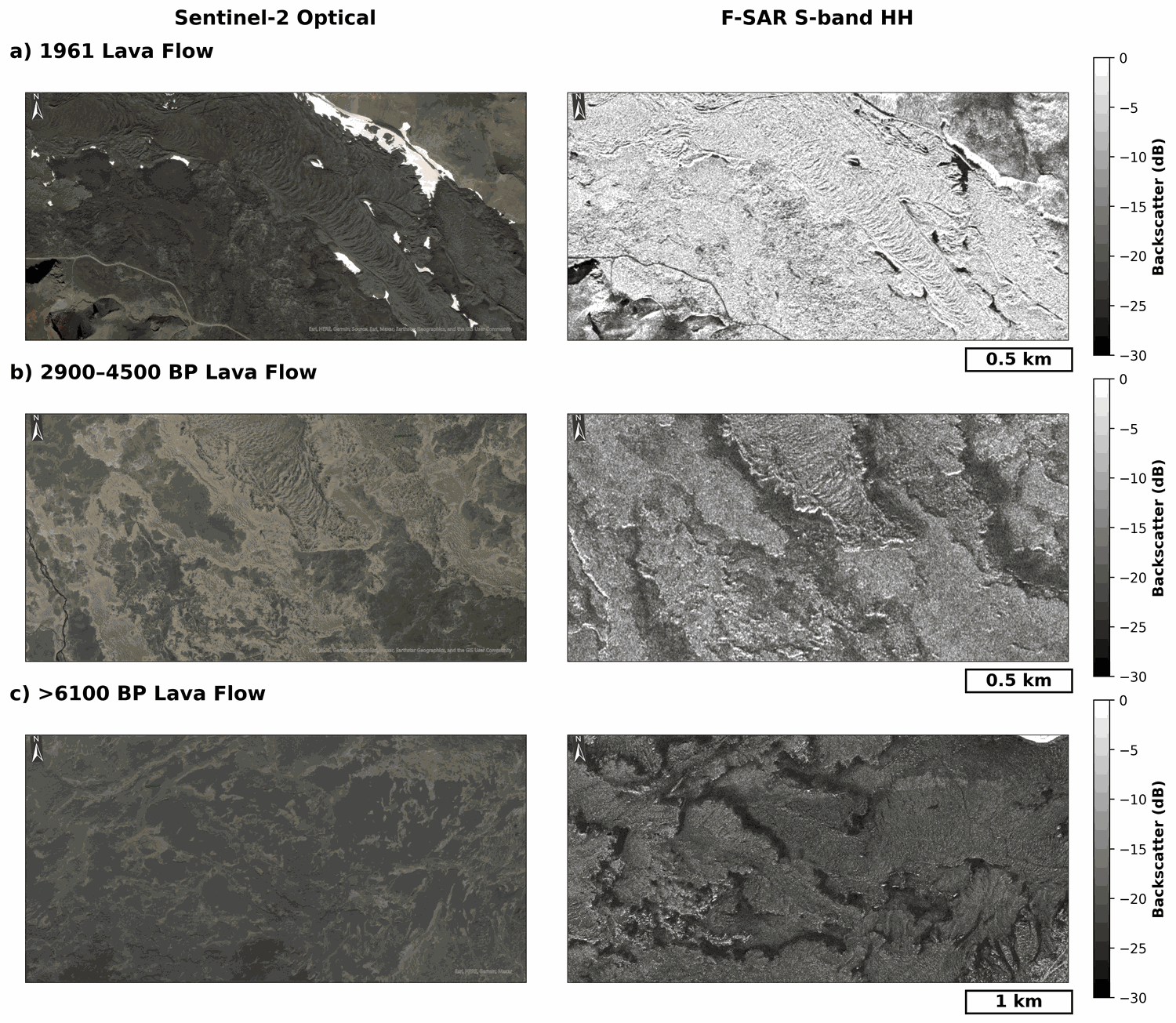
Figure 2. Three end-members of the Askja chronosequence (1961 Vikrahraun, 2900-4500 BP, and >6100 BP) shown as paired Sentinel-2 optical (left) and F-SAR S-band γ0 HH at 2 m (right).
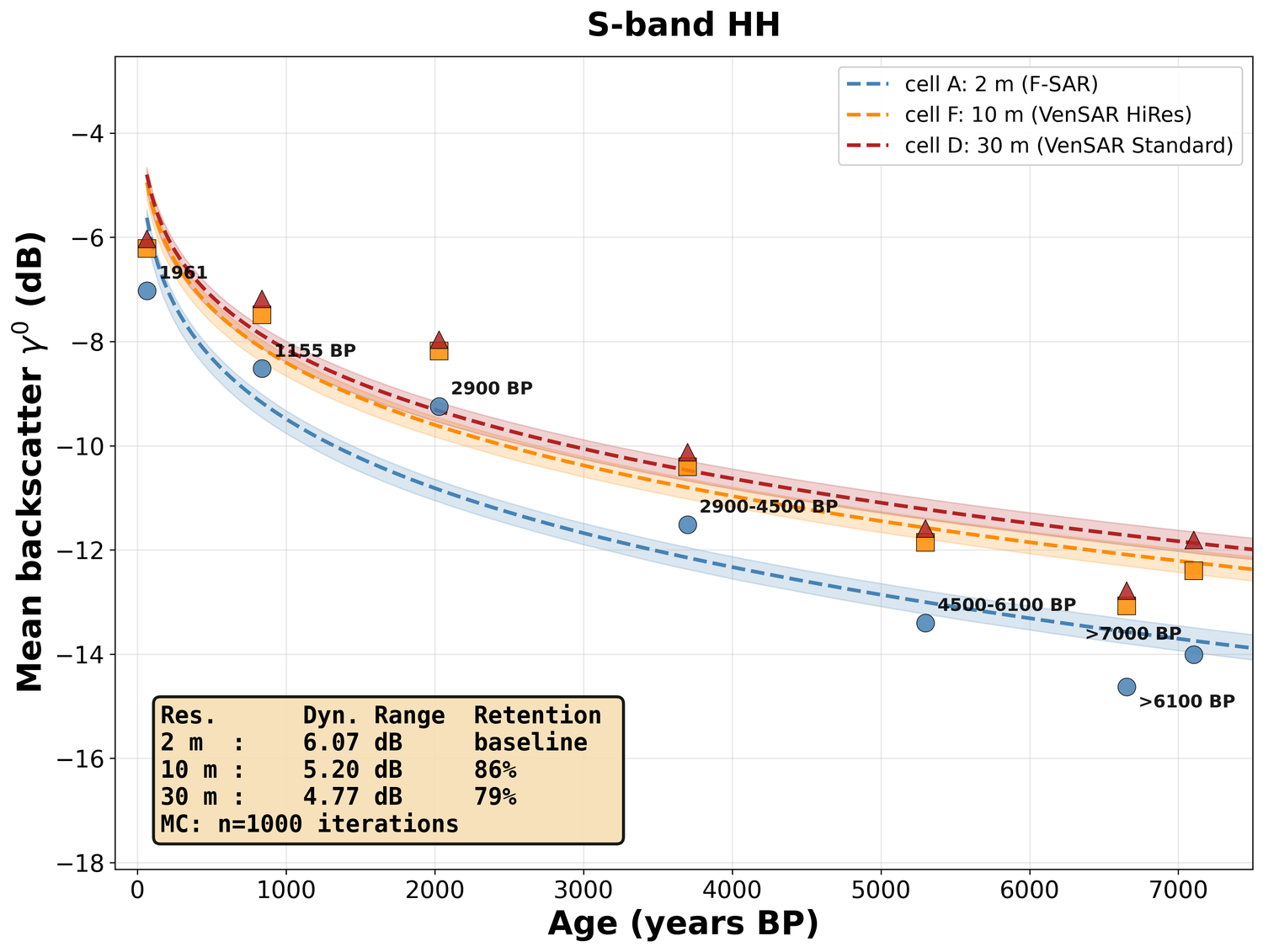
Figure 3. S-band HH γ0 versus flow age at three resolutions: F-SAR 2 m (blue), VenSAR 10 m (orange), VenSAR 30 m (red). Power-law fits with 95% Monte Carlo confidence intervals; inset gives dynamic range and retention per cell.
Wavelength comparison reveals progressive increase in age-discrimination dynamic range with wavelength. X-band, available only at VV polarisation, shows the smallest dynamic range (5.64 dB). S-band HH gives 6.07 dB versus 9.59 dB at L-band HH (8.49 vs 11.60 dB at HV). Polarimetric analysis differentiates surface scattering mechanisms and flow morphologies. Smooth pāhoehoe and mantled surfaces produce high HH and HH/HV ratios, reflecting predominantly single-bounce surface scattering. Rough a'ā flows produce high HV backscatter and large volume-scattering decomposition components: the clinker layer of angular rubble clasts acts as a randomly oriented scattering volume, generating multiple-bounce returns that decompose as volume power.
Differentiation between pāhoehoe and a'ā facies within a single flow appears in the decomposition, not in the raw intensity. Following the facies-separability protocol of Tolometti et al. [12], dual-pol Mascolo-Cloude m·v [8] matches or slightly exceeds quad-pol Freeman-Durden P_v [13] in discriminating Event 2 a'ā from pāhoehoe within Vikrahraun 1961 (Figure 4). Polarimetric facies discrimination is most powerful on young, well-preserved flow surfaces.
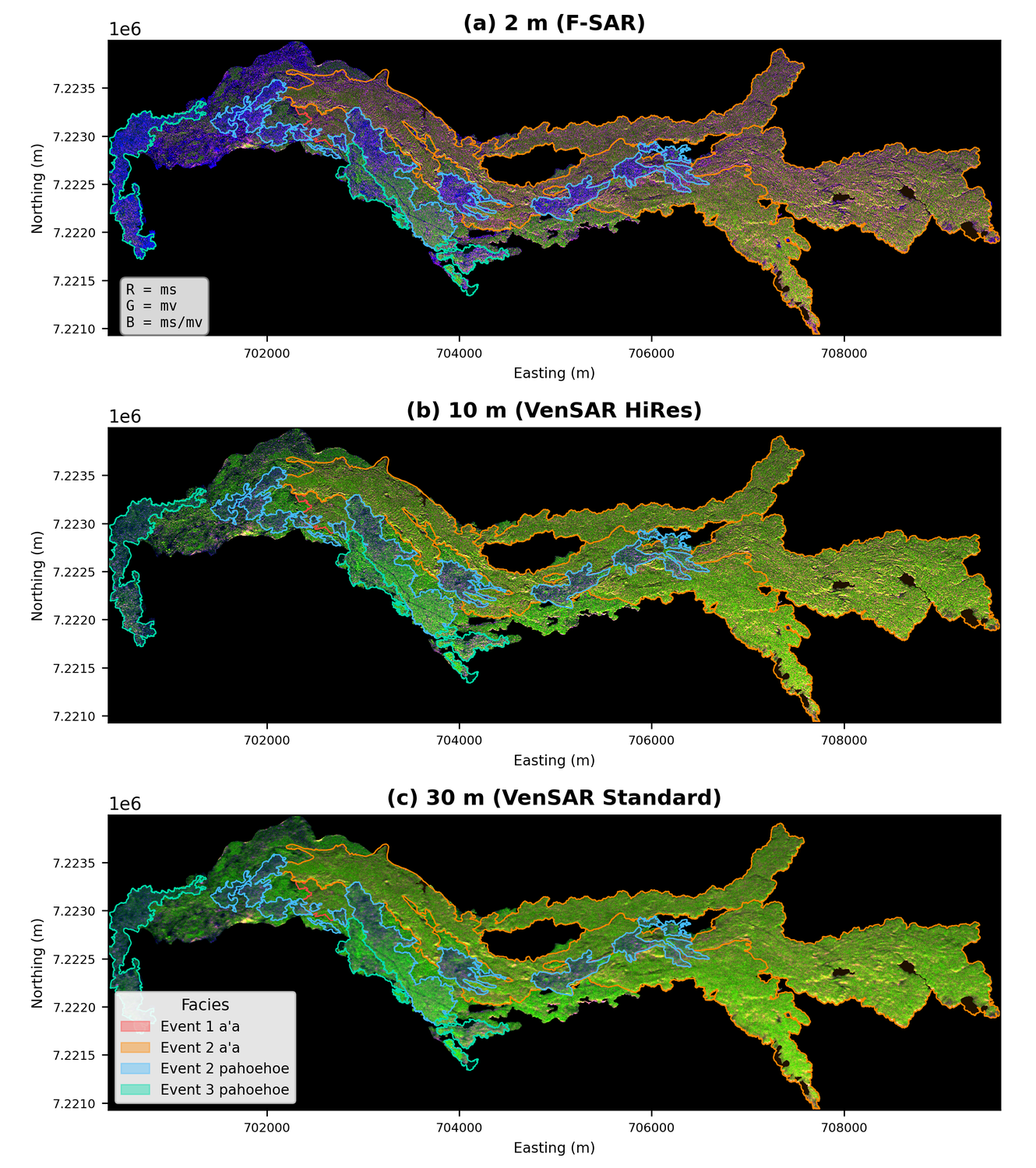
Figure 4. Dual-pol decomposition [8] (R = ms, G = mv, B = ms/mv) of Vikrahraun 1961 at 2 m, 10 m, and 30 m. Coloured polygons mark a'ā and pāhoehoe facies, classified following Blasizzo et al. [14]. Per-flow facies separability following Tolometti et al. [12]: MC m·v: O = 0.84, H = 2.6×10⁴; FD P_v: O = 0.89, H = 2.0×10⁴.
To address whether these signatures will be mappable in images captured by VenSAR, the 2 m F-SAR S- and L-band covariance was degraded via a slant-range pipeline: incoherent multilook, Gaussian filtering to the target resolution, Gamma speckle at the specified looks (16 at 30 m, 8 at 10 m), and exponentially-distributed thermal noise at the -20 dB NESZ specification. S-band HH retains 79% of the age-discrimination dynamic range at VenSAR 30 m (1.30 dB loss out of 6.07 dB) and 86% at 10 m (0.87 dB loss); regression slope flattens by 16% and 13% respectively. The HV channel is NESZ-limited: only 49% retention at 30 m and 51% at 10 m, with cross-pol signal on flows older than c.5,000 BP sitting within a few dB of the -20 dB floor. The 10 m mode does not rescue HV because NESZ is per-pixel rather than ensemble-averaged. The same asymmetry holds at L-band (74% HH, 44% HV retention at 30 m), indicating the mechanism is wavelength-robust. Quad-pol and dual-pol products at 30 m agree to within ±0.015 dB on per-flow γ0 statistics; VenSAR's HH/HV mode therefore preserves both the age-discrimination signal and the within-flow facies differentiation accessible to fully polarimetric F-SAR.
Age-backscatter correlations provide a quantitative dating framework, while polarimetric analysis enables morphological and textural discrimination. For VenSAR specifically, HH at 30 m and 10 m is optimal for age discrimination across the 60–7,000-year range, while HV is optimal for morphology discrimination.
References: [1] EnVision Red Book, ESA-SCI-DIR-RP-003, 2023; [2] Adeli et al., 2023; [3] Brossier et al., 2020; [4] Horn et al., 2017; [5] Keller et al., 2024; [6] Mason et al., 2024; [7] Raguso et al., 2025; [8] Mascolo, Cloude & Lopez-Sanchez, 2021, IEEE TGRS; [9] ÍSOR, 2024, Digital Geological Database of Iceland; [10] Sæmundsson et al., 2012, Geol. Map N. Volcanic Zone (N. Part), 1:100,000, ÍSOR; [11] Sæmundsson et al., 2015, Geol. Map N. Volcanic Zone (S. Part), 1:100,000, ÍSOR; [12] Tolometti et al., 2022, JGR Planets 127(6); [13] Freeman & Durden, 1998, IEEE TGRS 36(3); [14] Blasizzo et al., 2022, Earth Planets Space 74:168.
How to cite: Davidova, N., Gallardo i Peres, G., Ghail, R., Moreira, A., Jaeger, M., Benedikter, A., and Mason, P.: Scattering Properties of Lava Flows: Insights from Askja, Iceland, in support of EnVision mission science development, Europlanet Science Congress 2026, The Hague, The Netherlands, 7–11 Sep 2026, EPSC2026-918, https://doi.org/10.5194/epsc2026-918, 2026.


