
 1,3,3,4,2,3
- 1Institute of Mechanics, Materials and Civil Engineering, Université Catholique de Louvain (UCLouvain), Louvain-la-Neuve, Belgium
- 2Earth and Life Institute, Université Catholique de Louvain (UCLouvain), Louvain-la-Neuve, Belgium
- 3Royal Observatory of Belgium, Brussels, Belgium
- 4Instituut voor Sterrenkunde, KULeuven, Belgium
Since the space exploration missions of the past decades, Ganymede, the largest moon of our Solar System, is believed to host a global subsurface ocean beneath its ice shell. The recent launch of ESA’s Jupiter Icy Moons Explorer (JUICE) mission towards the Jovian system opens the possibility for a more detailed characterization of Ganymede. Especially during the planned orbital phase around the moon, JUICE aims to better characterize the physical properties of the subsurface ocean. In this context, the present work investigates the possibility of detecting signatures of tidally driven flows within Ganymede’s ocean through magnetic and gravity field measurements.
This study focuses on the ocean flows developing in response to Jupiter’s tides acting on the moon due to its eccentric orbit and to the obliquity of its spin axis. The resulting tidal flow may produce periodic perturbations in measurable quantities. In particular, the motion of the conductive saline ocean through the ambient magnetic field of Ganymede induces a secondary magnetic field. In addition, the pressure exerted by the flow at the interface between the ocean and the ice shell affects the gravity field through deformation of the crust. Here, we want to assess the possibility to detect these signatures with the instruments onboard JUICE.
To evaluate these signatures, we proceed in three distinct steps. First, the deformation at the top of the ocean resulting from tides is computed by solving the classical elasto-gravitational equations for a model of the moon subjected to a tidal potential. Then, the tidally forced flow is obtained by numerically solving the linearized Navier-Stokes equations in a rotating spherical shell, by imposing the periodic tidal deformation calculated in the first step at the top of the ocean. Finally, the associated signatures in magnetic and gravity fields are computed. Regarding the magnetic signature, we solve the linearized magnetohydrodynamics induction equation for the magnetic perturbation induced by the previously obtained flow. For the gravity field, the flow pressure acting on the ice shell is related to perturbations in the external gravity field through a Love number formalism, again relying on the solution of the elasto-gravitational equations. The parameter space relevant for Ganymede being out-of-reach numerically, we resort to an extrapolation approach when an asymptotic behavior is reached.
The periodic forcing of the ocean by Jupiter’s tide is found to be able to resonantly amplify the flow amplitude if the forcing frequency matches that of an inertial mode. These are periodic flows restored by the Coriolis force. Our results indicate that obliquity tides are capable of resonantly exciting a Rossby inertial mode, leading to significant flow amplitude. Under extrapolation to realistic parameters, the corresponding flow becomes sufficiently amplified for nonlinear effects and turbulence to appear. Within our linear approach, the effects of turbulence are handled by assuming it modifies the effective properties of the fluid through an effective viscosity in a way that may ultimately permit the excitation of a stable large-scale linear mode. Depending on the regime of parameters, both the magnetic and gravitational signatures associated with this resonant flow appear potentially detectable during the low-altitude orbital phase of JUICE, especially accounting for the long-duration of the orbital phase and the known spatial pattern of the signatures. This work therefore supports the plausibility of remotely probing the dynamics of Ganymede’s subsurface ocean through the detection of tidally driven flows signatures in the magnetic and gravity fields.
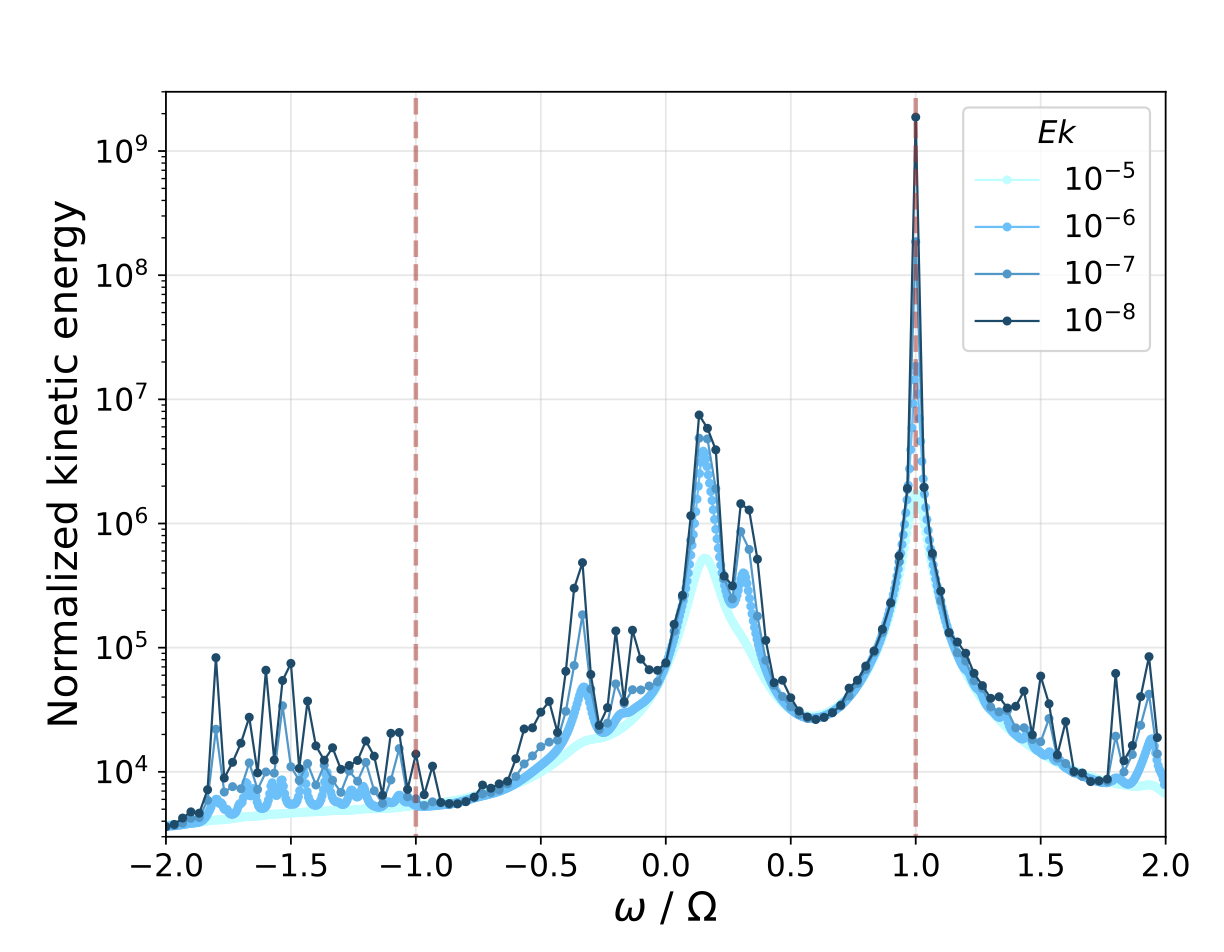
Figure 1: Integrated kinetic energy of the flow (normalized) over the whole range of frequencies. The excitation frequencies of Jupiter’s obliquity tides are shown by the red dashed lines. Computed for aspect ratio η= 0.9.
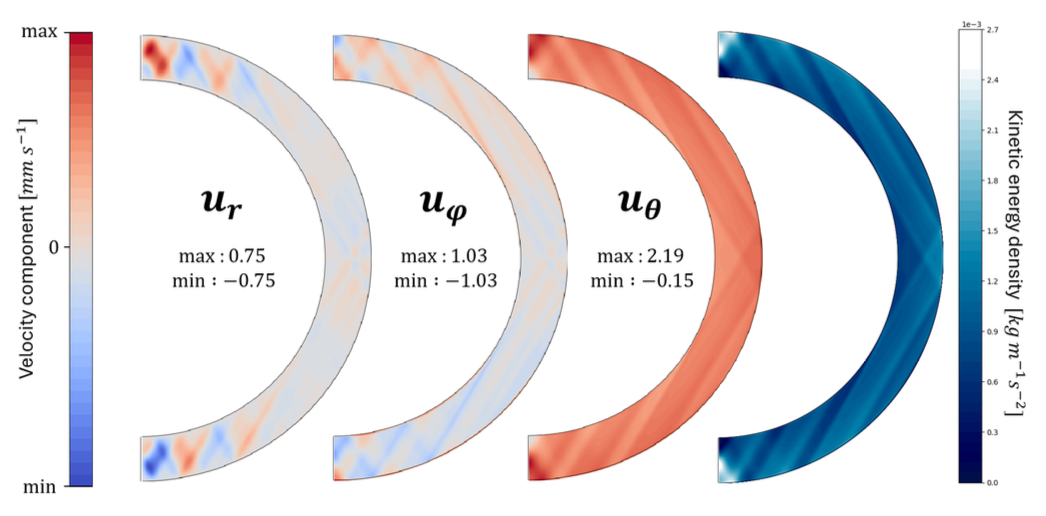
Figure 2: Meridional cut of the Rossby mode forced by the obliquity tide. Computed for Ekman number Ek= 10−6 and aspect ratio η= 0.8.
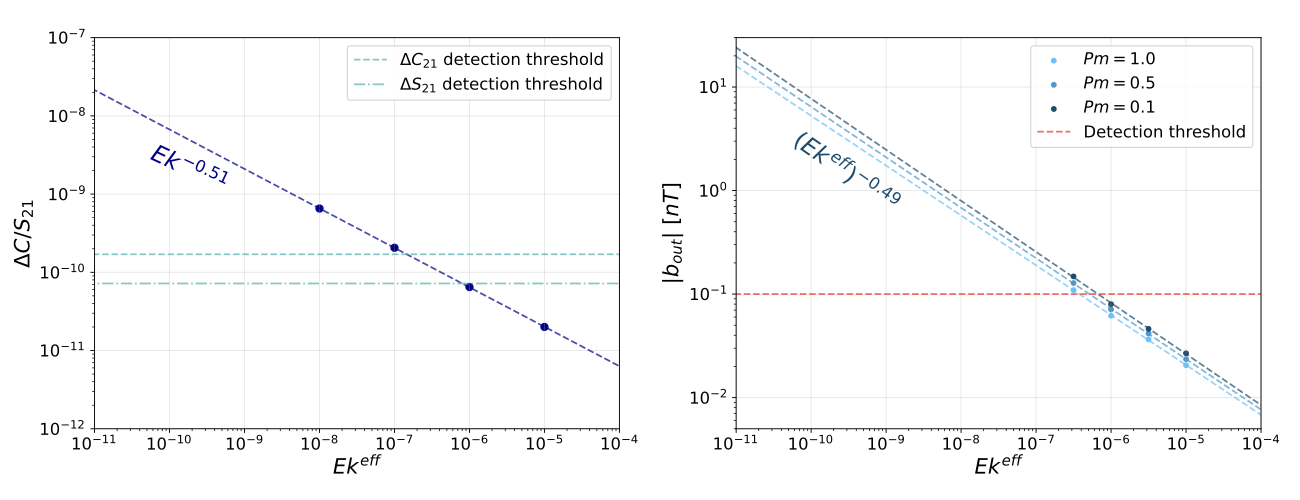
Figure 3: Gravity and magnetic signatures of the Rossby mode forced by the obliquity tide. We account for the effects of turbulence by introducing effective turbulent diffusivities. Computed for aspect ratio η= 0.9. The magnetic signature is shown 200 km above the surface, corresponding to the GCO200 orbital phase.
How to cite: Laariara, D., Rekier, J., Van Hoolst, T., and Dehant, V.: Gravity and Magnetic Signatures of Tidal Flow in Ganymede’s Ocean, Europlanet Science Congress 2026, The Hague, The Netherlands, 7–11 Sep 2026, EPSC2026-919, https://doi.org/10.5194/epsc2026-919, 2026.


