
 1,1,2,3,
- 1Univ Toulouse, CNES, CNRS, IRAP, Toulouse, France (florian.mourlin@utoulouse.fr)
- 2Department of Earth, Atmospheric, and Planetary Sciences, Purdue University, West Lafayette, IN, USA
- 3Institute of Optical Sensor Systems, German Aerospace Center (DLR), Berlin, Germany
Introduction: Laser-induced breakdown spec-troscopy (LIBS) is versatile and is now widely used in the laboratory and in the field on Earth, as well as on the Martian surface for over a decade. This tech-nique has already led to a significant improvement in our knowledge of the geological history and context of the areas explored by the Curiosity and Persever-ance rovers, which are equipped with the ChemCam [1, 2] and SuperCam [3, 4] instruments, respectively. Efforts to develop LIBS for lunar exploration are also emerging, such as with the Chandrayaan 3 mis-sion by the Indian Space Research Organisation (ISRO), which successfully deployed and collected the first LIBS spectra on the Moon. IRAP and its partners are currently developing μLIBS: a 1.5 kg elemental mapper capable of scanning observations with 30 x 30 LIBS shots at a centimeter-scale work-ing space, with a 100 μm footprint per spot [5]. Sev-eral studies have shown that, under vacuum condi-tions, LIBS produces a weaker signal than that pro-duced under Martian conditions [6], but it is still highly useful for scientific investigation [7]. Rock mapping analysis using LIBS has also been success-fully carried out in laboratory experiments under vacuum and Martian conditions, allowing elemental quantification [8, 9]. However, the study of Chan-drayaan 3 LIBS data suggests that the laser focus could be a challenging factor in such an environ-ment, as many of their spectra contain significant noise and low signal intensity [10].
Methodology: Based on these observations, we are developing a calibration method, the robustness of which we will test with respect to focus variation and geometry. Specifically, we have selected four rock samples which compositional ranges and min-eral assemblages encompasses most common Moon samples. We obtained thin sections of these rocks and measured their composition using X-ray fluores-cence at a microscale (microXRF). The μLIBS pro-totype will perform 30x30 rasters providing ele-mental signals for each ablation spot. A Python rou-tine we have developed enables us to compare these LIBS measurements with microXRF analysis by superimposing a profilometric map of the craters onto the microXRF maps (Figure 1).
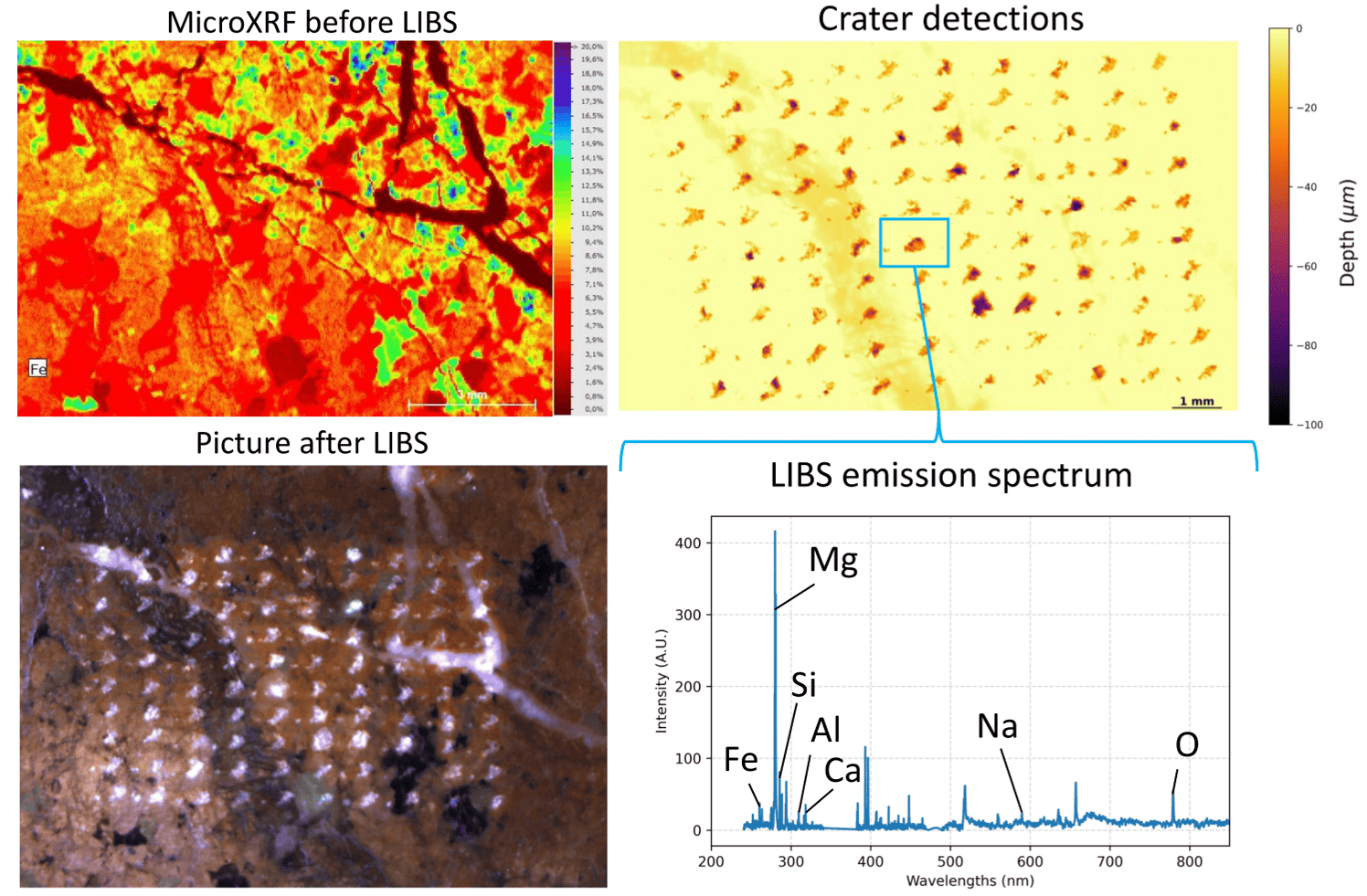
Figure 1: Steps of the calibration method. A python pipeline superposes the three images precisely to retrieve crater com-position enabling a direct comparison of the composition measured by both techniques.
Results: The first laboratory experiments using the assembled μLIBS prototype are expected in July 2026. So far, to test this methodology, we used the ChemCam qualification model available at IRAP to create a 10x10 μLIBS map with two shots per spot on a thin section of altered lherzolite in a vacuum chamber at 10⁻⁴ mbar. In both LIBS and microXRF, we used the oxygen signal to normalize to overall signal for each ablation spot. We observed agree-ment between LIBS and microXRF with regard to the major elements (Fe, Mg, Si, Ca, Al and Ti), as well as some of the minor elements (Na and Ni) (Figure 2). Other minor elements observed with mi-croXRF in this sample, such as S, P, Ba and Zn, have a weak signature in the spectrum and could easily be confused with the background noise
As μLIBS laser spot diameter that is three times smaller than ChemCam, we could expect more irra-diance on the target providing a more intense signal that may help with the detection of minor elements. We will also improve our sample characterisation before performing LIBS by combining Elemental Dispersive Spectroscopy (EDS) and XMapTools, a powerful numerical tool for quantitative petrology [11]. Once a μLIBS calibration is established using these cross correlated abundance maps, we plan to vary the experimental conditions, as mentioned ear-lier, specifically the laser focus, to define precision criteria required to perform LIBS on the Moon. To ensure the effectiveness of this method on the select-ed samples, we will also perform LIBS shots using ChemCam with varying laser focus on a homogene-ous basaltic glass. Measuring the variation in com-position according to the distance between the true and optimal laser spot focus will help us understand the variation observed in the next μLIBS map exper-iments.
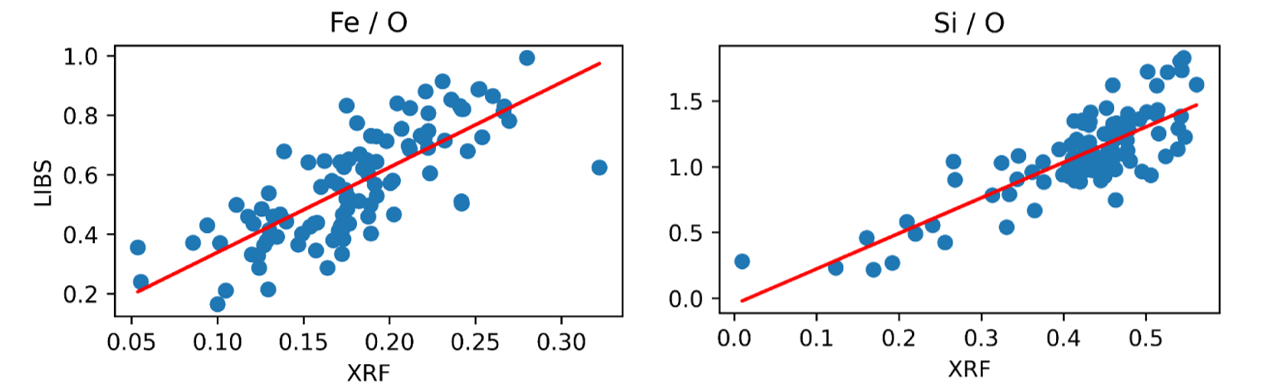
Figure 2: Comparison of LIBS signal under vacuum and cor-responding XRF quantification with O normalization for Fe and Si.
Conclusion: We are developing a new LIBS instru-ment that is seven times lighter than its predecessors, ChemCam and SuperCam, and capable of scanning samples to perform micro-scale elemental maps. This development builds on the legacy of these two instruments, which have been working on Mars for years. The Moon poses a new challenge for the LIBS technique, as its airless environment is less favoura-ble than the Martian atmosphere. However, we are developing a calibration method by correlating LIBS measurements on natural samples with the composi-tional maps obtained by non-destructive analysis (microXRF, EDS and XMapTools). The final goal is to test the robustness of the LIBS airless calibration with variations in other experimental parameters and define acceptable working conditions. Further results will be presented at the time of the conference.
References: [1] S. Maurice et al., Space Sci. Rev., 2012, [2] R.C. Wiens et al., Space Sci. Rev., 2012, [3] S. Maurice et al., Space Sci. Rev., 2021, [4] R.C. Wiens et al., Space Sci. Rev., 2021, [5] W. Rapin et al., EPSC-DPS, Helsinki, 2025. [6] F. Seel et al., Icarus, 2025, [7] J. Lasue et al. Journal of Geophysi-cal Research: Planets, 2012, [8] Manelski et al., LPSC, 2026, [9] Lee et al, LPSC, 2026, [10] F. Mourlin et al. Spectrochimica acta Part B, 2026 (un-der review). [11] Lanari et al., Computers and Geo-sciences, 2013
How to cite: Mourlin, F., Rapin, W., Maurice, S., Lasue, J., Forni, O., Cousin, A., Meslin, P.-Y., Dubois, B., Cheval, J.-F., Yana, C., Wiens, R. C., Manelski, H., Lee, D. J., Schröder, S., and Krybus, N.: EXPLORING THE CAPABILITIES OF μLIBS, A NEW LIGHTWEIGHT IN-SITU ELEMENTAL MAPPER FOR THE MOON., Europlanet Science Congress 2026, The Hague, The Netherlands, 7–11 Sep 2026, EPSC2026-925, https://doi.org/10.5194/epsc2026-925, 2026.


