
 1,1,1,2,3,1,
- 1The Open University, School Of Physical Sciences, United Kingdom of Great Britain – England, Scotland, Wales (maisie.rashman@open.ac.uk)
- 2Leiden Observatory, Leiden University, Leiden, the Netherlands
- 3Physique des Interactions Ioniques et Moléculaires, CNRS, Aix Marseille Université, Marseille, France
- *A full list of authors appears at the end of the abstract
Stars and planets form in dense cores within molecular clouds. These cosmic nurseries are where we see the first formation of interstellar ices. Composed mainly of H2O, CO2 and CO, these ice species and their reaction products are the likely precursors to the complex organic molecules (COMs) that enable the development of life on planets such as our own. Yet their origin and evolution, and the survival of the volatile material trapped within them through the violent star formation process, remain poorly understood. This fundamentally limits our ability to determine how molecules of great astrobiological significance are delivered to planetary bodies.
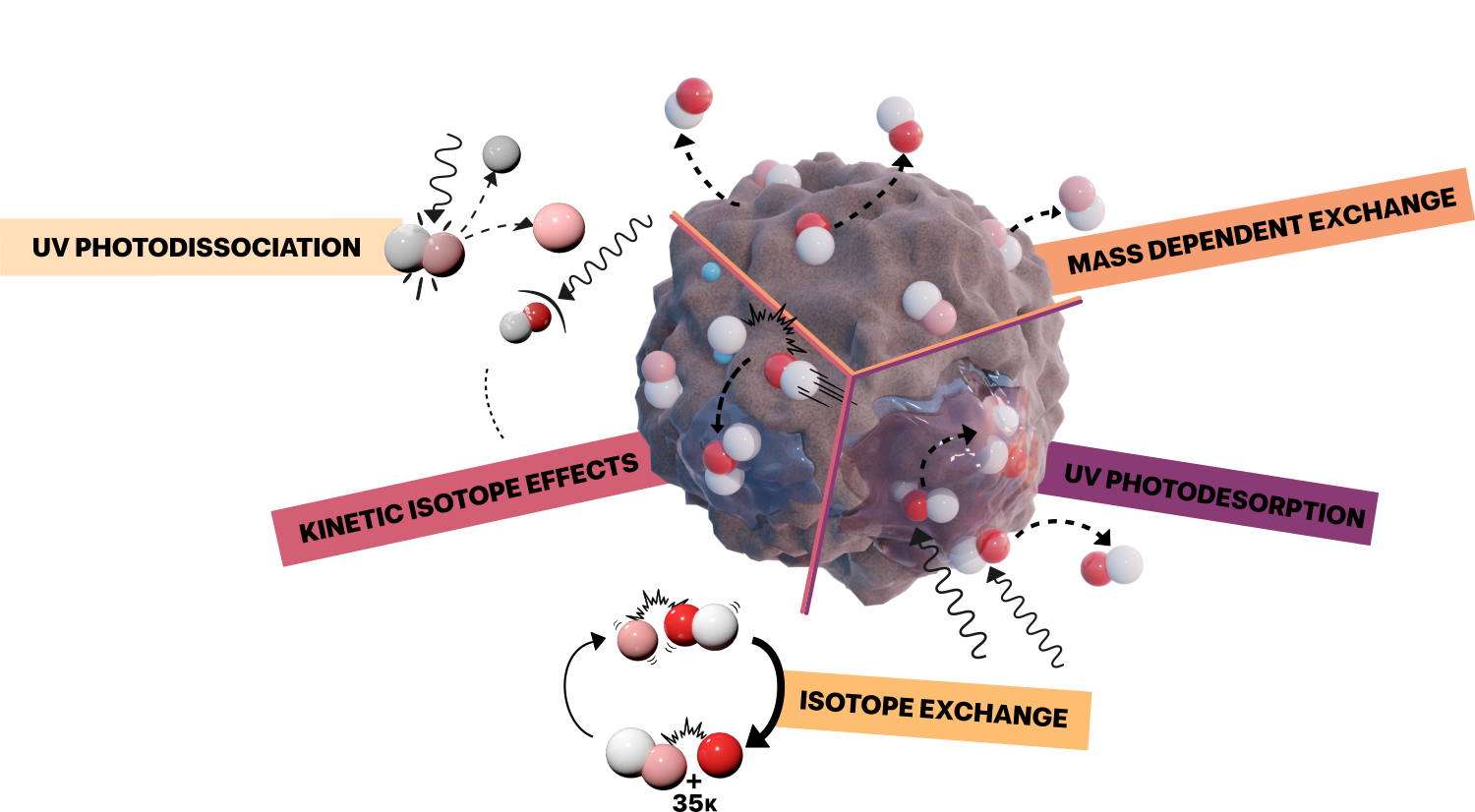
Figure 1: The likely dominant fractionation mechanisms that determine the carbon isotope ratio imprinted in the ice observed in pre- and protostellar environments.
The 12C/13C ratio is a sensitive probe of the physical and chemical conditions under which carbon-bearing ices form and evolve. The initial ratio is set by the distinct origins of the two isotopes: 12C is produced rapidly in massive stars, while a fraction of 12C is converted to it’s weaker counterpart 13C via the CNO cycle in later stellar generations. After injection into the interstellar medium (ISM), fractionation processes enrich or deplete one isotope relative to the other. In star-forming regions the isotope fractionation is driven by a combination of gas-phase and grain-surface processes that dominate during different physical and chemical epochs. For the abundant carbon-bearing ices, CO and CO2, the isotope ratio is therefore thought to preserve a chemical memory of the environment in which they formed, making it a valuable diagnostic of chemical evolution across the star-forming process. Understanding carbon isotope fractionation can shine a light on the inheritance or in-situ formation of molecules during different stages of star and planet formation. If the fractionation patterns established in molecular clouds are preserved through the protostellar phase, they may be inherited by protoplanetary disks and ultimately by planetary bodies. Conversely, if isotope ratios are significantly reprocessed during star formation, they instead reflect local conditions rather than primordial inheritance. Distinguishing between these scenarios has important implications for tracing the chemical origin of complex molecules across evolutionary stages, from cold molecular clouds to protostellar environments and planetary systems.
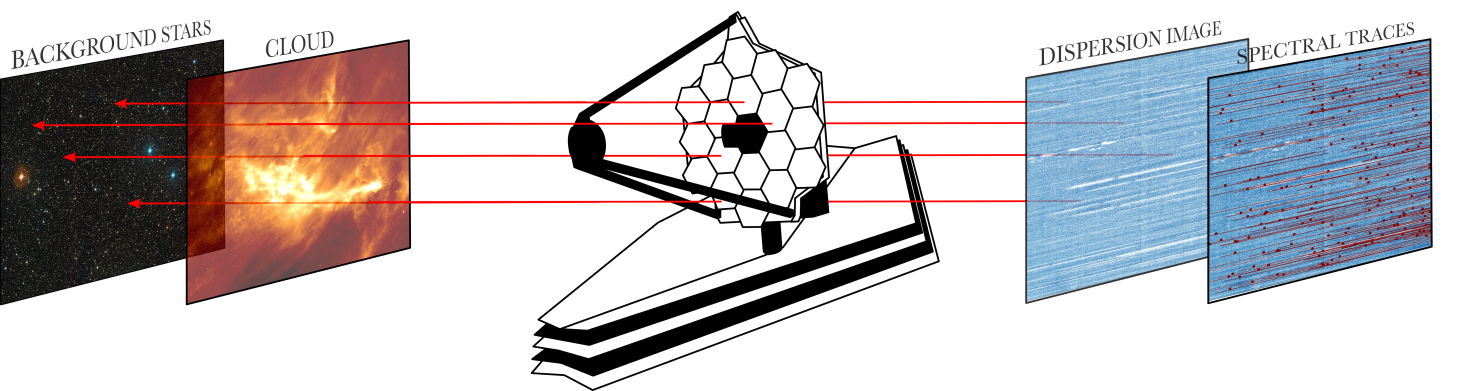
Figure 2: JWST WFSS observations allow us to obtain spectra along lines of sight towards tens to hundreds of background sources in a single observation.
The unrivalled sensitivity and multiplexing capabilities of The James Webb Space Telescope (JWST), now allows us to probe the chemical environment across star-forming regions with a resolution like never before. I will present 12C/13C ratios derived from JWST NIRCam Wide Field Slitless Spectroscopy (WFSS) observations towards the Chamaeleon I molecular cloud, obtained as part of the Ice Age Early Release Science programme (PID 1309; P.I. M. McClure). Spectra were extracted for 33 background sources along pencil-beam lines of sight through the cloud, in the vicinity of the deeply embedded class 0 protostar Cha MMS1, providing the largest sample of co-spatial ice isotope measurements within a single star-forming region to date. I will examine whether the carbon isotope ratio varies between ice species, whether it shows spatial dependence across the cloud, what this tells us about the chemical evolution across the region, and how the values derived in this study relate to those observed across the broader star and planet formation sequence.
Adwin boogert Eeichi Egami Emmanuel Dartois Takashi Shimonishi Fengwu Sun
How to cite: Rashman, M., Dickinson, H., Fraser, H., Smith, Z., McClure, M., Noble, J., Demaria, L., and Tsiakaliari, E. and the Ice Age Consortium: Using JWST to Map the Carbon Isotope Ratio in Ice across the Chamaeleon I Molecular Cloud Complex, Europlanet Science Congress 2026, The Hague, The Netherlands, 7–11 Sep 2026, EPSC2026-929, https://doi.org/10.5194/epsc2026-929, 2026.


