
 1,1,1,1,2,5,1,1,1,1,
- 1INAF-Osservatorio Astronomico di Padova, Padova, Italy (giovanni.munaretto@inaf.it)
- 2School of Geography and Planning, University of Sheffield, Winter Street, Sheffield S3 7ND, UK
- 3University of Arizona, Tucson, USA
- 4Laboratoire de Planétologie et Géosciences, Nantes Université, Univ. Angers, Le Mans Université, CNRS UMR 6112, 44300, Nantes, France
- 5Department of Geosciences, University of Padova, IT
- 6Physikalisches Institut, University of Bern, CH
Introduction
Eskers are elongated sinuous ridges formed by sediment deposition within subglacial channels, generated by meltwater draining beneath or within glaciers [1,2]. Their identification on Mars [3,4,5,6] provides a unique opportunity to investigate the planet’s glacial history and past water availability [3], because they trace specific thermal or climatic events enabled the production of meltwater in the past [3,4,5,6]. Martian eskers have been predominantly identified in the planet’s mid-latitudes, often associated with Amazonian-aged Lobate Debris Aprons (LDAs) which are interpreted as debris-covered glaciers. Key regions include Phlegra Montes [4], Tempe Terra [e.g, 5-8] and NE Hellas [9]. These studies suggest that even during the predominantly cold and arid Amazonian epoch, locally elevated geothermal fluxes (suggested by the presence of tectonic and/or impact structures), combined with strain heating due to ice flow, enabled subglacial melting. Here, we identify three new candidate eskers associated with LDAs in the Deuteronilus Mensae region of Mars. By analyzing their morphology, morphometry, geologic context and cratering record, we aim to test whether they are indeed eskers and discuss their possible formation scenarios.
Data & methods
We relied on CTX global mosaics, HiRISE orthophotos and digital terrain models (DTMs), CaSSIS color imagery and DTMs, MOLA topography, and THEMIS nighttime infrared mosaics to examine the ridges and their surrounding geologic contexts. Impact craters were digitized to derive crater size-frequency distributions (CSFDs) and model crater retention ages with Craterstats 2.0 software. Ridge morphometry was quantified by measuring crestline-parallel transects on HiRISE DTMs and detrending each profile from basal topography to estimate ridge height and base width, and comparing the resulting distributions to those published for other Martian eskers [4,6,8]. Thermal properties were assessed qualitatively from THEMIS nighttime infrared mosaics.
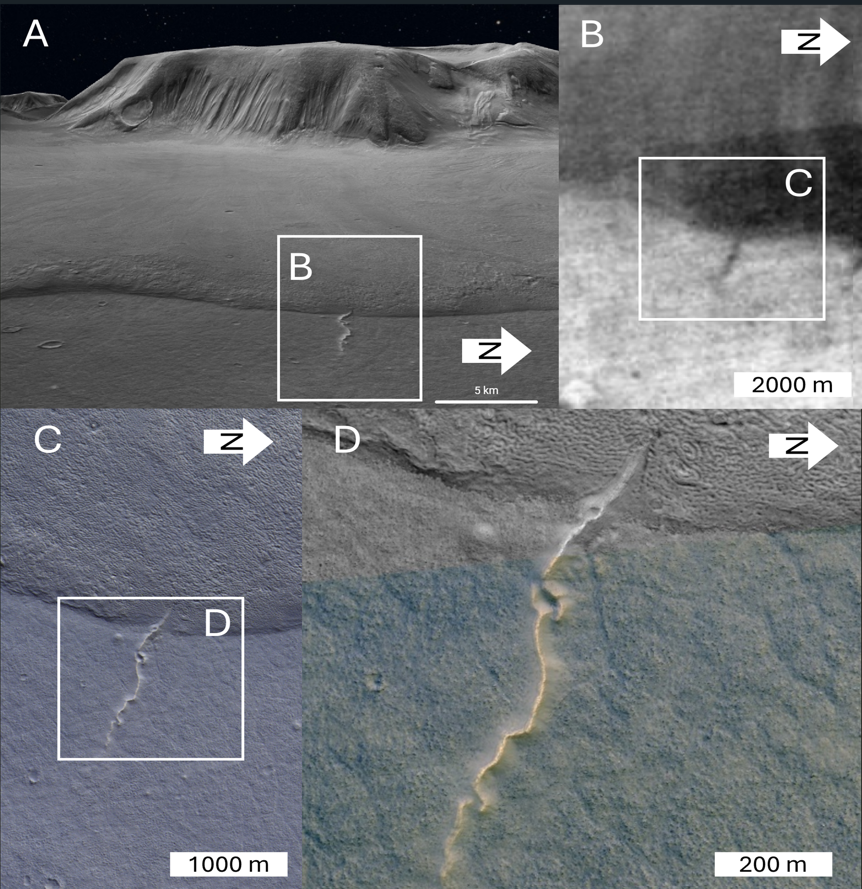
Fig. 1. A) Context 3D view of the R1 ridge from the CTX global mosaic draped over the MOLA DEM B) THEMIS night-time infrared emission map. C) RGB colour composites from CaSSIS image MY38_032747_042_0. D) HiRISE image ESP_079083_2230.
Results
Three sinuous ridges, (R1, R2, and R3) were identified emerging from the termini of LDAs in Deuteronilus Mensae. An example (R1) is in Fig. 1. THEMIS observations indicate that R1 and R2 have thermal inertia similar to the LDAs and lower than the surrounding bedrock (Fig. 1C), indicating unconsolidated material rather than indurated sediments.
The morphometries of R1 and R2 are consistent with other Martian eskers (Fig. 2C, D), while R3 is somewhat larger but still within the other Martian esker height vs width trends (Fig 2C,D). Crater counting (Fig. 3) indicates a Hesperian-aged plains substrate, and LDA crater retention ages of approximately 460–480 Myr for larger craters and 220–230 Myr for smaller crater populations.
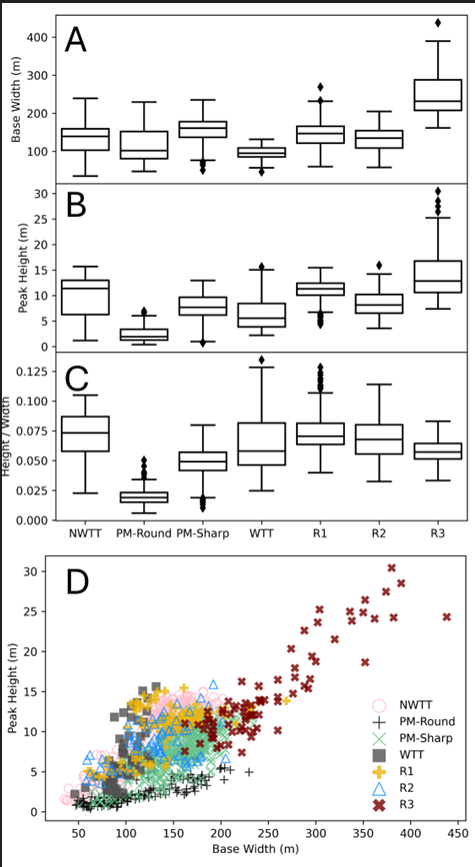
Fig 2. Comparison of ridges base width (A) and peak height (B) and their ratio (C) distributions, shown as box-plots, with the other martian eskers. (Data for North-West TempeTerra (NWTT) are from [8], Phlegra Montes (PM ) from [4] and West Tempe Terra (WTT) from [6]). D) Base width vs Peak height comparison between R1-R3 ridges and the martian eskers
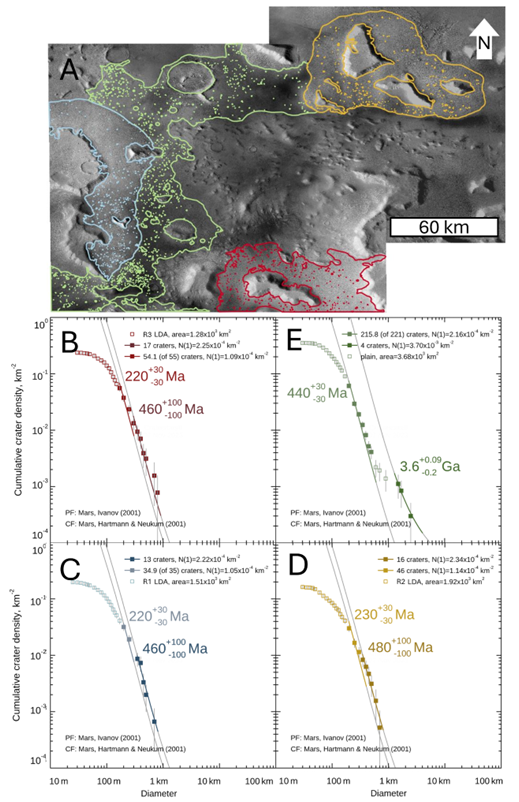
Fig. 3. A) CTX global mosaic showing the crater counting areas (coloured outlines) and the mapped impact craters. Crater CSFDs of the LDAs associated with ridges R1-R3 (panels B-D) and plains units (E).
Discussion & conclusions
A moraine (either terminal, lateral or medial), inverted river [10] and esker hypothesis have been considered to explain the ridges formation. The combined assessment (that will be presented in detail at the conference) of geologic context, morphometric measurements and thermal data suggest that the most plausible interpretation is that R1–R3 are eskers deposited by meltwater flowing within or beneath polythermal glaciers and exposed The study region lacks volcano-tectonic features that might indicate localized geothermal anomalies, making geothermal heating an unlikely primary driver for meltwater production by glaciers. Obliquity-driven climate variations [11, 12] represent a potentially interesting mechanism. Climate modelling indicates that at high obliquities, annual accumulation of snow and ice occurred in the mid-latitudes [13,14] together with increased temperature swings and a more humid atmosphere than the present-day [14,16], providing a qualitatively plausible thermodynamic environment for esker formation.
The discovery of eskers in Deuteronilus Mensae expands the known geographic extent of late Amazonian wet-based or polythermal glaciation on Mars and shows that episodic meltwater drainage occurred in a region previously thought to record mainly cold-based ice activity.
Acknowledgements
CaSSIS is a project of the University of Bern and funded through the Swiss Space Office via ESA’s PRODEX programme. The instrument hardware development was also supported by the Italian Space Agency ASI (ASI-INAF agreement no. 2020-17-HH.0), INAF–Astronomical Observatory of Padova, and the Space Research Center CBK in Warsaw. Support from SGF Budapest, the University of Arizona Lunar and Planetary Lab., and NASA are also gratefully acknowledged. Operations support from the UK Space Agency under grant STR0030251 is also acknowledged. We gratefully acknowledge support from the Italian Space Agency ASI with ASI-INAF agreements n. 2022-8-HH.0 and n. 2024-40-HH.0. AGG kindly acknowledges support from the Région Pays de la Loire under project RPL-GELMARS. FB acknowledges a Royal Society University Research Fellowship.
References
[1] Shreve, R. L. (1985). Geological Society of America Bulletin, 96(5), 639–646. [2] Storrar,et al., (2014). QSR, 105, 1–25. [3] Butcher FEG, et al., (2022) Annals of Glaciology.2022;63(87-89):33-38. [4] Butcher, F.E.G., 2019. Wet-Based Glaciation on Mars (PhD Thesis). The Open University, Milton Keynes, UK. [5] Butcher, F. E. G. et al., (2017). JGR: Planets, 122(12), 2445–2468. [6] Woodley, S. Z., et al., (2022). Icarus, 386, 115147. [7] Butcher, F.E.G. et al., (2021), Icarus 357, 114131[8] Butcher, F. E. G. et al., (2020). EPSL, 542, 116325. [9] Grau Galofre et al., 2024 Icarus, 420, p.116211 [10] Dickson et al., (2021) Geology, 49(5):504–509. [11] Laskar, J. (2004). Icarus, 170, 2,343-364 [12] Niu, S. et al., (2025) JGR: Planets, 130, e2024JE008883. [13] Madeleine, J. et al., (2009). Icarus, 203(2), 390–405 [14] Madeleine, J. et al (2014). GRL,41, [15] De Haas, T., et al. (2015). Nature Communications, 6, 7543 [16] Naar, J. (2023). Phd Thesis.
How to cite: Munaretto, G., Bertoli, S., Tusberti, F., Tullo, A., Butcher, F., Byrne, S., Grau Galofre, A., Cremonese, G., Massironi, M., Re, C., Rossi, C., Pajola, M., Lucchetti, A., and Thomas, N.: Evidence of recent warm-based glaciation and meltwater drainage from eskers at Deuteronilus Mensae, Mars, Europlanet Science Congress 2026, The Hague, The Netherlands, 7–11 Sep 2026, EPSC2026-935, https://doi.org/10.5194/epsc2026-935, 2026.


