
 1,2,1,1
- 1Nantes Université, Univ Angers, Le Mans Université, CNRS, Laboratoire de Planétologie et Géosciences, LPG UMR 6112, 44000 Nantes, France
- 2Charles University, Faculty of Mathematics and Physics, Department of Geophysics, Praha, Czech Republic
Abstract
Europa is a primary candidate for habitability due to the presence of a liquid subsurface ocean in direct contact with its rocky mantle [1]. Chemical exchanges favored by hydrothermal activity associated to magmatic phenomena could bring compounds suitable for the ocean’s habitability [2]. The occurrence and timescale of magmatic activity at the seafloor of Europa, however remains debated. Some studies suggested a hot scenario, where partial melting in Europa’s mantle occur during most of the moon’s history, with melt generation triggered and sustained by radioactive heating and tidal dissipation alongside limited heat removal by thermal convection [3]. Other studies proposed that Europa had a colder thermal evolution [4], implying delayed magmatism and much more modest amounts of melt. Even if magmatism is significant at depth, it might not result in seafloor volcanism [5]. However, the feedback of melting on mantle rheology as well as the different modes of extraction or retention of the melt were not entirely investigated. Such effects might have considerable implications on the dynamics of convection and thermal evolution of Europa’s mantle.
In this study, the thermal evolution and melt production in Europa’s silicate mantle is investigated using a three-dimensional (3D) numerical model that solves for thermal convection considering radiogenic and tidal heating [6], [7]. The timescale and location of melt production in the mantle is analyzed by considering several melt treatments as well as the feedback of melting on mantle rheology and solidus temperatures [8]. Melt treatments involve (1) instantaneous melt extraction once the temperature is above the solidus with removal of excess thermal energy; (2) melt retention where melt is advected with the solid matrix and can crystallise once the temperature drops below the solidus; (3) an intermediate melt extraction where melt migrates upward and can heat its surroundings within one convection time step. Our results show that melt generation and production rates in Europa’s mantle strongly depend on the considered melt treatment and the subsequent effect on mantle rheology. In the instantaneous melt extraction case, melting predominantly occurs at great depths below a thick lithosphere with relatively low melting rates. If the melt stays with the solid matrix, the average melting rate can be ten times higher, with local partial melting up to 20% under favorable conditions. The retention of melt, even in small fractions, impacts the vigor of convection as local buoyancy and viscosity are respectively increased and decreased. As such, upwelling plumes develop more quickly and can significantly affect the thermal structure of the stagnant lid (Figure 1). We show that these hot plumes could be able to erode the cold lithosphere, thus considerably reducing the local thickness of the stagnant lid and allowing melt to be generated closer to the seafloor. This effect is even more prominent in the reactive melt extraction treatment, which may suggest that melt could be generated at shallower depths than previously anticipated. Tidal dissipation, amplified in partially molten regions, could further enhance this effect. The weakening of the stagnant lid rheology due to the penetrating plumes could potentially favor dyke development and the transport of melt at the seafloor of Europa.
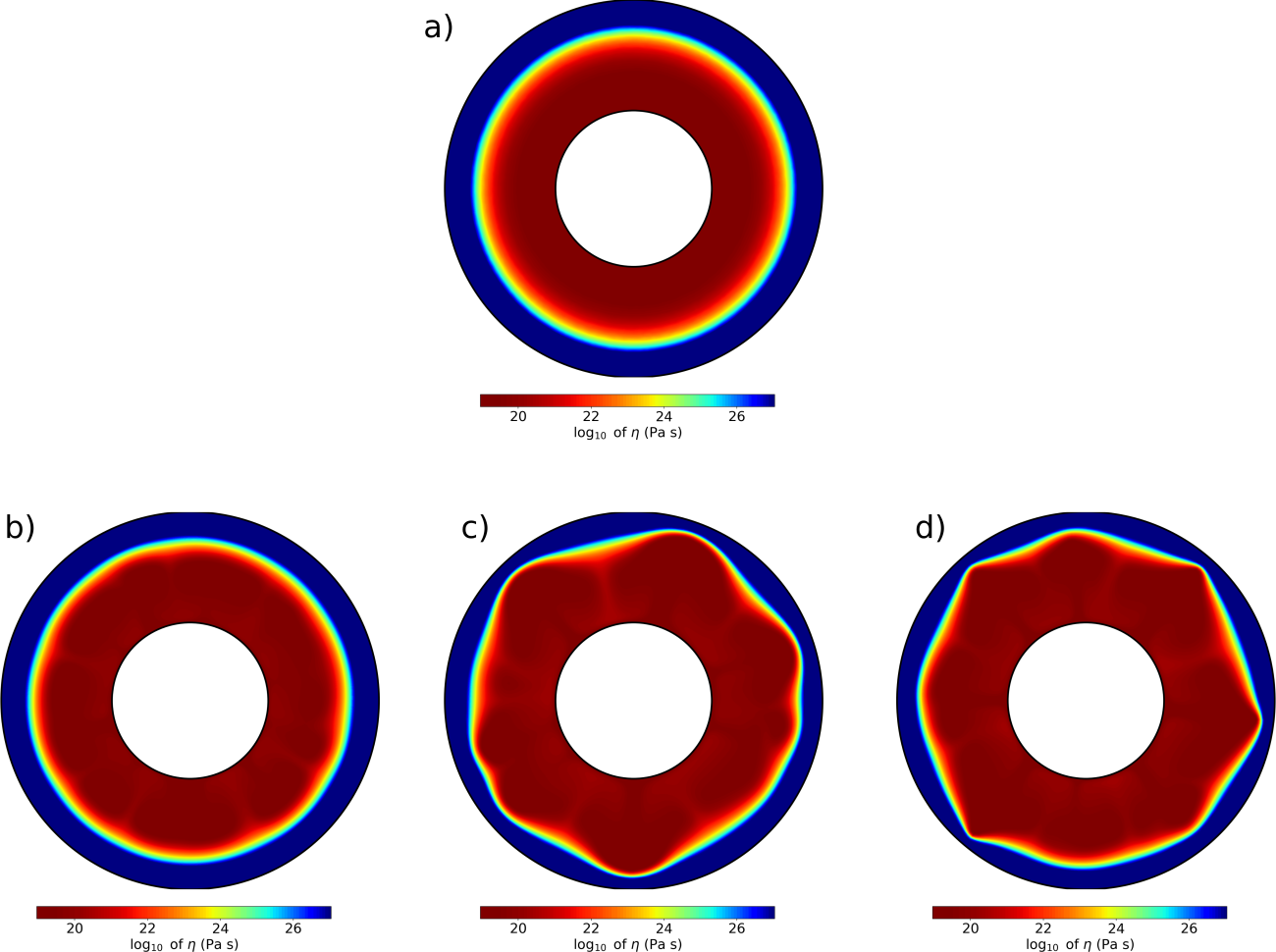
Figure 1: Vertical cross-sections of Europa’s mantle viscosity. a) Initial state. b) Instantaneous melt extraction case. c) Case where melt remains and is advected with the solid matrix. d) Melt percolation case.
References
[1] W. B. Moore, H. Hussmann (2009). Thermal evolution of Europa's silicate interior, in: R. T. Pappalardo , W. B. McKinnon, K. K. Khurana (Eds.). Europa, University of Arizona Press, Tucson,, pp. 369–380. doi: https://doi.org/10.2307/j.ctt1xp3wdw.21
[2] Vance, S. D. et al. (2016). Geophysical controls of chemical disequilibria in Europa. Geophysical Research Letters 43 4871–4879. doi: https://doi.org/10.1002/2016GL068547
[3] Běhounková, M. et al (2021). Tidally induced magmatic pulses on the oceanic floor of Jupiter's moon Europa. Geophysical Research Letters, 48, e2020GL090077. https://doi.org/10.1029/2020GL090077
[4] Petricca, F. et al. (2025). Partial differentiation of Europa and implications for the origin of materials in the Jupiter system. Nature Astronomy, pages 1–11. doi: https://doi.org/10.1038/s41550-024-02469-4
[5] Green, A. P et al.. (2025). No magmatic driving force for Europan sea-floor volcanism. Nature Astronomy 9 (2025) 640–649. doi: https://doi.org/10.1038/s41550-025-02508-8
[6] G. Choblet (2005). Modelling thermal convection with large viscosity gradients in one block of the ‘cubed sphere’. Journal of Computational Physics 205 269–291. doi: https://doi.org/10.1016/j.jcp.2004.11.005
[7] Choblet, G. et al. (2007). ŒDIPUS: a new tool to study the dynamics of planetary interiors, Geophysical Journal International 170 9–30. doi: https://doi.org/10.1111/j.1365-246X.2007.03419.x
[8] Běhounková, M. et al (2010). Coupling mantle convection and tidal dissipation: Applications to Enceladus and Earth-like planets, Journal of Geophysical Research: Planets 115 2009JE003564. doi:https://doi.org/10.1029/2009JE003564.
Acknowledgments
This work was supported by the Agence Nationale de la Recherche (ANR, project OSSO-BUCO, ANR-23-CE49-0003 to BR). This research utilized the resources of the GLiCID Computing Facility (Ligerien Group for Intensive Distributed Computing, www.glicid.fr, Pays de la Loire, France). The work of M.B. was supported by the Czech Science Foundation (project No. 26-21877S).
How to cite: André, V., Běhounková, M., Tobie, G., Choblet, G., and Kervazo, M.: Europa’s seafloor may not be silent, Europlanet Science Congress 2026, The Hague, The Netherlands, 7–11 Sep 2026, EPSC2026-94, https://doi.org/10.5194/epsc2026-94, 2026.


