
 1,2,3,4,5,1,6
- 1Dipartimento di Fisica e Astronomia, Università di Padova, Vicolo dell'Osservatorio 3, 35122 Padova, Italy (andrea.farina.2@studenti.unipd.it)
- 2Institute of Space Science – INFLPR Subsidiary, 409 Atomișilor Street, 077125 Măgurele, Ilfov, Romania
- 3University of Craiova, Alexandru Ioan Cuza 13, 200585 Craiova, Romania
- 4Instituto de Astrofísica de Canarias, C/Vía Láctea s/n, E-38205 La Laguna, Tenerife, Spain
- 5Departamento de Astrofísica, Universidad de La Laguna, C/Astrofísico Francisco Sánchez s/n, E-38205 La Laguna, Tenerife, Spain
- 6INAF – Osservatorio Astrofisico di Arcetri, Largo Enrico Fermi 5, 50125 Firenze, Italy
HyperScout-H (HS-H) is the hyperspectral imager onboard ESA's Hera spacecraft, designed to acquire spatially resolved reflectance spectra of the binary near-Earth asteroid (65803) Didymos–Dimorphos in the 0.65–0.95 µm wavelength range (Popescu et al. 2025). The in-flight radiometric calibration of HS-H has followed a progressive path: a pre-flight characterisation (Popescu et al. 2025) established the baseline instrument response under laboratory conditions, while an in-flight calibration (Prodan et al. 2026) refined the sensitivity coefficients and geometric distortion correction using stellar observations and a preliminary comparison with CRISM data over five Martian surface regions.
Building on this foundation, we present a comprehensive cross-calibration of HS-H using data acquired during the Mars flyby of 12 March 2025, comparing HS-H observations against two well-established Mars orbital instruments: OMEGA onboard Mars Express (Bibring et al. 2004) and CRISM onboard MRO (Murchie et al. 2007). Three HS-H images acquired at spacecraft–Mars distances of 14,521–20,925 km (spatial resolution 7.4–11.6 km per macropixel) were analysed. A total of 34 surface regions were selected across the Martian surface, sampling a wide variety of terrain types including crater floors, bright and dark terrains. For each region, median spectra were extracted from HS-H, OMEGA and CRISM using latitude–longitude boundaries, yielding 171 independent observations per instrument (figure 1).
Wavelength-dependent correction factors were derived for all 25 HS-H spectral bands in both normalised and absolute flux. The normalised correction factors are consistent with unity for bands 3–25 (0.688–0.952 µm), with standard deviations below 1% for both the OMEGA and CRISM comparisons, confirming excellent agreement in spectral shape across the full operational wavelength range. Bands 1–2 show a systematic deficit of approximately 4–5%, attributed possible to a thermally-induced wavelength drift of the Fabry-Pérot filter transfer functions consistent with the temperature difference between ground calibration (+20°C) and in-flight operating conditions (−12°C). The absolute flux correction factors reveal a systematic offset of approximately 9% between HS-H and OMEGA, while HS-H and CRISM agree to better than 1%. Both offsets are wavelength-independent from bands 3 to 25, indicating that the radiometric discrepancy is multiplicative in nature and does not distort the spectral shape. The mutual offset between OMEGA and CRISM (~8.8%) is consistent with differences in their independent absolute radiometric calibrations.
The cross-calibration demonstrates excellent repeatability and reliability, with mean inter-image standard deviations of 0.21%/0.26% for the normalised correction factors and 1.93%/1.99% for the absolute flux correction factors with respect to OMEGA and CRISM respectively, across three images acquired at significantly different distances and viewing geometries. These results confirm the radiometric stability of HS-H and provide a reliable calibration framework directly applicable to the future scientific observations of the Didymos–Dimorphos system.
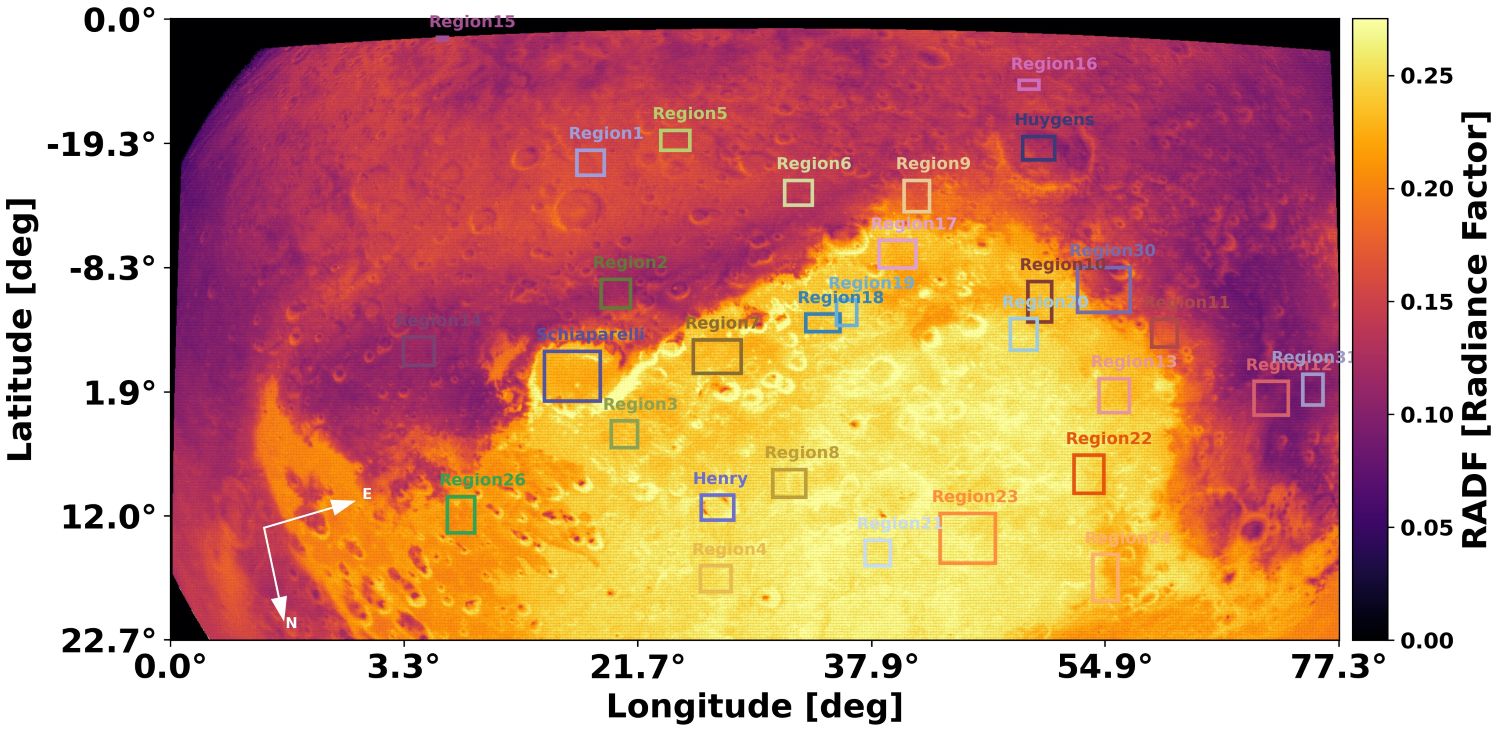
Figure 1. HyperScout-H image 04 of the Martian surface acquired on 12 March 2025, at a spacecraft–Mars distance of 20,925 km (spatial resolution 11.6 km per macropixel). The coloured rectangles indicate the 34 surface regions selected for the cross-calibration analysis, sampling a wide variety of terrain types including crater floors, bright and dark terrains.
References
[1] Bibring J.-P. et al. (2004), ESA SP-1240
[2] Murchie S. et al. (2007), J. Geophys. Res., 112, E05S03
[3] Popescu M. et al. (2023), Space Science Reviews, 221, 8
[4] Prodan G. et al. (2026), submitted to Icarus
How to cite: Farina, A., Popescu, M., Lazzarin, M., De Leon, J., Prodan, G. P., Dumitru, B., La Forgia, F., and Poggiali, G.: Cross-Calibration of Hera/HyperScout-H with MEx/OMEGA and MRO/CRISM Using Mars Observations, Europlanet Science Congress 2026, The Hague, The Netherlands, 7–11 Sep 2026, EPSC2026-941, https://doi.org/10.5194/epsc2026-941, 2026.


