
 2,
2,- 1ELI Beamlines, The Extreme Light Infrastructure ERIC, Za Radnicí 835, 252 41 Dolní Břežany, Czech Republic;
- 2J.Heyrovsky Institute of Physical Chemistry, CAS, Prague, Czechia
- 3Laboratoire de Physique et Chimie de l’Environnement et de l’Espace (LPC2E), UMR7328 CNRS/Université d’Orléans, 3A, Avenue de la Recherche Scientifique, 45071 Orléans, France
- 4Institute of Chemical Technology Leipzig University, Linnéstraße 3, 04103 Leipzig, Germany
The recently announced L4 program is intended to be a flagship ESA mission that includes the Enceladus orbiter and lander modules with the capability of in-situ detection of prebiotic complex organic molecules (COMs) in the water ice. The preparatory study of the L4 payload [1], [2] defines an ultra-high resolution, up to mass-defect detection, Orbitrap-based mass spectrometer [3]that allows unambiguous identification of detected molecules by their exact molecular mass and isotopic pattern [4]. The Orbitrap-based spectrometer with the compatible laser ablation surface sampling system optimized for water ice, and laser parameters matching the Orbitrap detector operation sequence are suggested as key devices for the L4 payload.
The laser development process must include a comparative study of the laser spectrum, pulse duration, and energy, to ensure detection of ions by the Orbitrap system, with optimal ion signal intensity, stability, and minimized discrimination of the sample compounds. This research will provide input data for the design of the minimalistic architecture laser system with optimized power, mass budget, and mergeable with the actual high TRL Orbitrap mass spectrometer, and pulse durations and wavelengths matching water ablation requirements.
The definition of the L4-compatible laser requires laboratory measurements of the composition of the water ice samples with traces of Enceladus-relevant minerals and COMs, with the developed Laser-Orbitrap system, and verification of the possibility to adjust mass spectrometers with the resulting ion source. Parameters of the laser plasma are required to be adjusted to provide optimal ion bunch charge and pulse duration to utilize the detector dynamic range, while avoiding saturation and resulting nonlinear effects. The ion source time and kinetic energy structure defines the ion trapping (squeezing) [5] process, which may affect isotopic ratio measurement accuracy, and so must be adjusted and verified. Currently available laser systems are neither optimized to work with Orbitrap (pumping, pulse duration, and repetition rate requirements), remaining at low power and mass budget, nor is the absorption spectrum optimal for water ice. A simple diode-pumped solid-state laser with an active Q-switch with a fundamental medium emission spectrum is an optimal base for the development of such an Orbitrap-compatible sampling system.
As a system performance evaluation and calibration tool, a recently developed multi-parametric Orbitrap output signal processing and analysis software will be used to verify the resulting performance and stability of parameters.
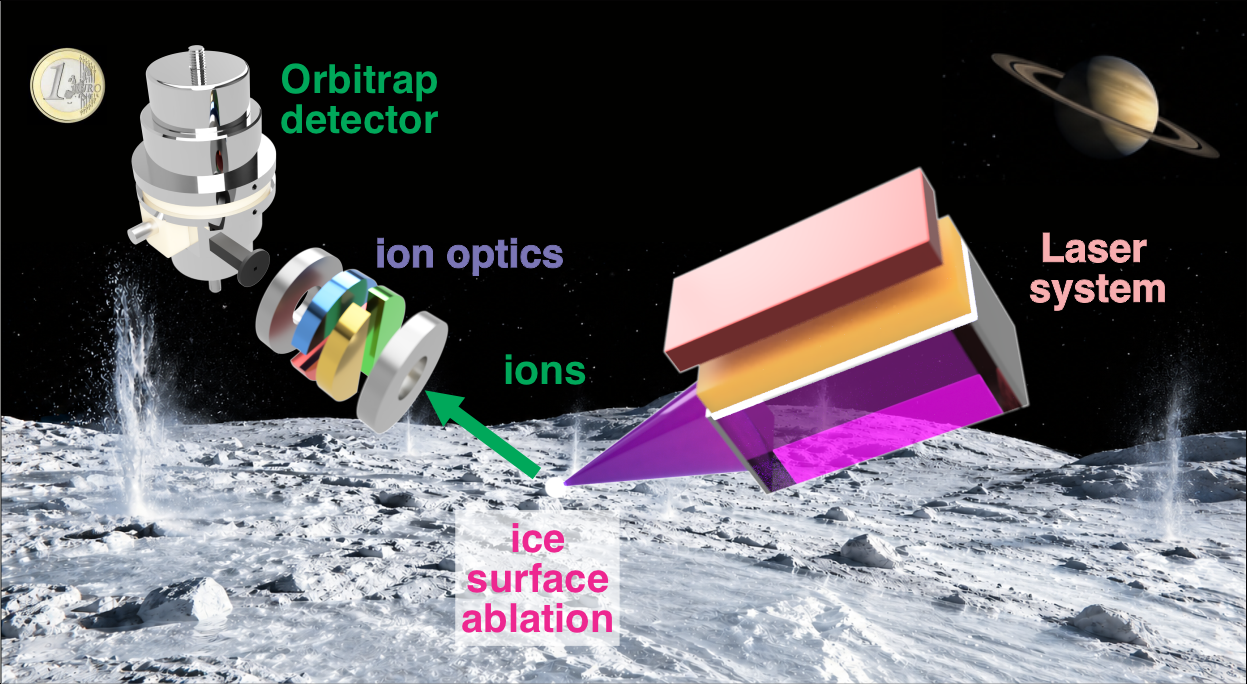
Figure 1 – Concept of the laser ablation ice surface sampling for Orbitrap-based mass analyzer
The joint team of the ELI ERIC, the European largest laser and laser-driven radiation facility, with the group of Professor Bern Abel (Leipzig University and Heyrovsky Institute, Prague), will deliver a prototype of the laser optimized for Enceladus surface and Orbitrap detector, combining its unique experience on icy moon exploration, laser and radiation technology development. The proposed multi-institutional work group has demonstrated experience with the development of the best-in-class and world’s most intense lasers, and participation in space missions (Cassini-Huygens and Europa Clipper mission teams). Technical and research capabilities of ELI ERIC, on top of laser systems and laboratories, include unique radiation sources representing the radiation environment of Saturn’s radiation belts, and instrument development support infrastructure, such as clean rooms, optical, vacuum, and thermal validation instrumentation.
References
[1] V. A. Martins, “Report of the Expert Committee for the Large-class mission in ESA’s Voyage 2050 plan covering the science theme ‘Moons of the Giant Planets,’” 2025.
[2] J. Helbert, T.-M. Bründl, M. Haag, M. Lindner, B. Ordoubadian, and S. Wittig, “The Mission to Enceladus – The ESA L4 mission ,” Jul. 09, 2025. doi: 10.5194/epsc-dps2025-1307.
[3] I. Zymak et al., “A High-Resolution Mass Spectrometer for the Experimental Study of the Gas Composition in Planetary Environments: First Laboratory Results,” Aerospace, vol. 10, no. 6, 2023, doi: 10.3390/aerospace10060522.
[4] F. Klenner et al., “Developing a Laser Induced Liquid Beam Ion Desorption Spectral Database as Reference for Spaceborne Mass Spectrometers,” Earth and Space Science, vol. 9, no. 9, p. e2022EA002313, Sep. 2022, doi: https://doi.org/10.1029/2022EA002313.
[5] Q. Hu, R. J. Noll, H. Li, A. Makarov, M. Hardman, and R. Graham Cooks, “The Orbitrap: a new mass spectrometer,” Journal of Mass Spectrometry, vol. 40, no. 4, pp. 430–443, Apr. 2005, doi: https://doi.org/10.1002/jms.856.
How to cite: Zymak, I., Green, T., Lebreton, J.-P., Maleckova, M., Žabka, J., Charvat, A., and Abel, B.: Laser development and research facility capabilities for the L4 mission at ELI Beamlines, Europlanet Science Congress 2026, The Hague, The Netherlands, 7–11 Sep 2026, EPSC2026-942, https://doi.org/10.5194/epsc2026-942, 2026.


