
 ,,,,,
,,,,,- INAF, Astronomical Observatory of Padova, Italy (riccardo.lagrassa@inaf.it)
Introduction
The lunar polar regions, specifically those latitudes exceeding 70° North and South, harbor permanently shadowed regions (PSRs) that function as cold traps for volatile species. These environments are critical for reconstructing the impact history of the Moon and understanding the delivery mechanisms of water ice in the inner Solar System. However, the characterization of small-scale crater populations within PSRs remains a formidable challenge due to the extreme dynamic range of lighting and the limitations of traditional topographic datasets. This study proposes a multimodal approach that bridges the gap between computer vision and planetary geomorphology. Building upon the foundational detection capabilities of YOLOLens (1) and our previous large-scale mapping of Lunar and Hermian global crater catalogs (2, 3), we introduce YOLOLens2.0. By synthesizing high-resolution ShadowCam imagery with this refined architecture and an advanced 3D thermo-physical model, we investigate the morphometric evolution of polar terrains and their capacity to preserve volatile deposits over geological timescales.
Deep Learning Framework: YOLOLens2.0 and Super-Resolution
A primary obstacle in polar geomorphologic analysis is the degradation of signal-to-noise ratios in secondary-light-illuminated terrains. To address this, we utilize YOLOLens2.0, an end-to-end deep learning framework specifically engineered for the detection and characterization of craters in challenging illumination environments. At the core of this system is a Dense-Residual-Connected Transformer (DRCT) module designed for multimodal super-resolution (SR). Unlike standard SR techniques, YOLOLens2.0 employs detection-driven supervision, where the reconstruction of high-frequency topographic details is guided by the semantic requirements of the detection head. Our experimental results demonstrate that this architecture leads to an absolute recall increase from 76.90 % to 89.20% when the super-resolution is activated and a significant gain in mAP@50-95 (reaching 0.605). By sharpening gradients and reconstructing meter-scale features from upscaled Kaguya and DTM data, the SR module provides discriminative features that allow for the identification of sub-kilometer craters with unprecedented precision. The application of this framework to ShadowCam imagery (0.9 m/pixel) facilitates the creation of high-fidelity, georeferenced crater catalogs, providing the statistical robustness required for subsequent morphometric analysis.
3D Thermo-Physical Modeling and Environmental Simulation
To contextualize the observed morphology, the illumination and thermal evolution of the polar terrains were simulated using a three-dimensional thermo-physical model (4). This framework, originally developed for the extreme environments of Mercury’s polar craters, was rigorously adapted to lunar boundary conditions. The model integrates high-resolution digital terrain models (DTMs) derived from LOLA topography with time-dependent solar illumination calculations. We evaluate local incident fluxes under realistic Sun–terrain geometries, where shadowing effects produced by complex crater morphology and surrounding ridges are explicitly computed through facet-based ray-tracing techniques. The resulting illumination fields serve as the primary input for a one-dimensional thermal model that solves the surface energy balance and subsurface heat conduction for each terrain facet. By reconstructing the spatial and temporal evolution of surface and subsurface temperatures, we can delineate the precise boundaries of thermal stability for various volatile species.
Morphometric Analysis and Geological Implications
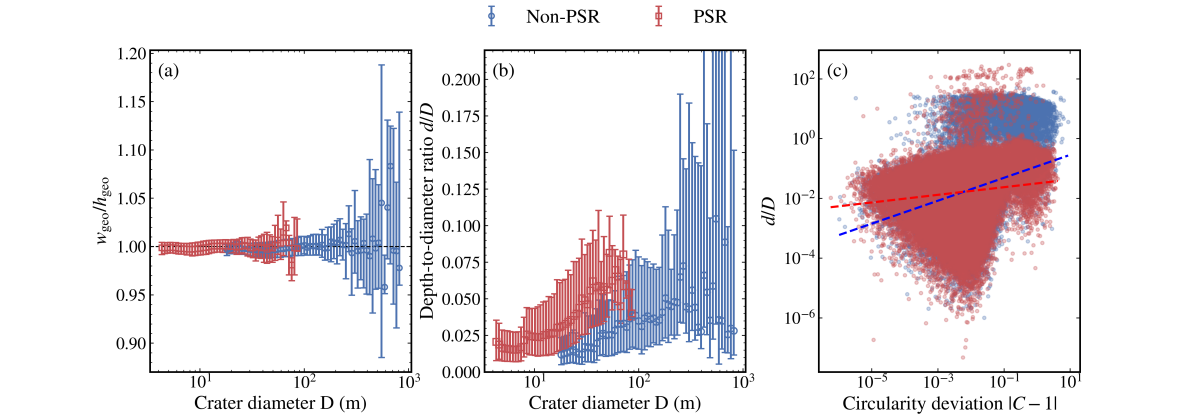
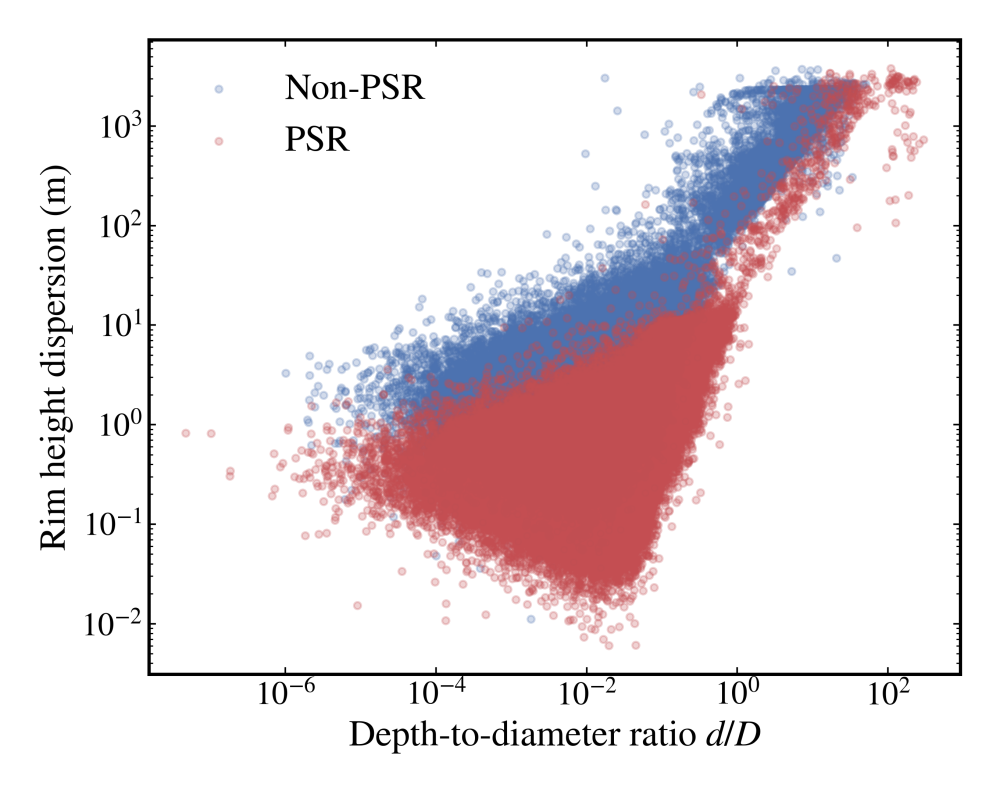
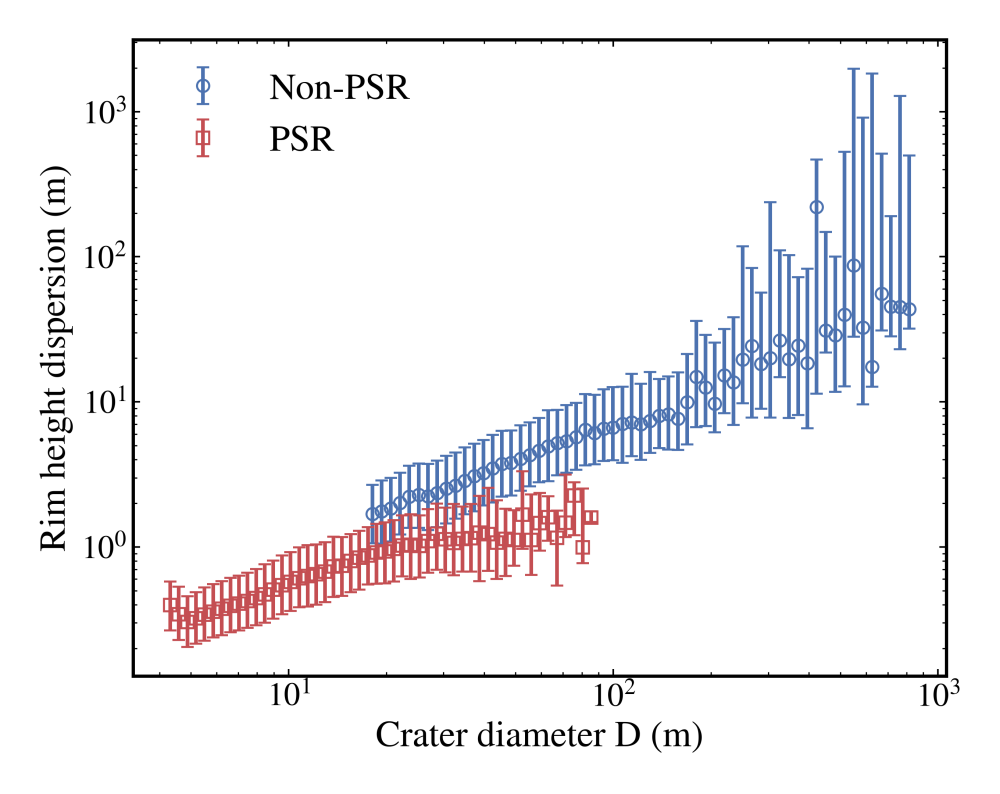
The investigation focuses on the morphometric properties of craters across the 70˚ to 90˚ latitude bands. We focus on depth-to-diameter (d/D) ratios, rim heights, and interior slope distributions to quantify the state of topographic degradation. Our findings indicate a significant scale-dependent divergence in crater morphology between PSR-hosted populations and those in sunlit regions. While large-scale craters (>1 km) typically exhibit advanced degradation states consistent with long-term mass wasting and micrometeoroid gardening, small-scale craters (<1 km) within PSRs show anomalously high d/D ratios. These fresh signatures suggest that the extreme cold-trapping environment may actively suppress certain degradation mechanisms. Specifically, the absence of extreme diurnal temperature swings within PSRs likely inhibits thermal fatigue, a process known to drive regolith mobilization and slope failure on sunlit lunar surfaces. Furthermore, our analysis suggests that these morphologically fresh, deep craters are not randomly distributed but are frequently localized within regions where our 3D model predicts maximum thermal stability. This correlation suggests that the presence of subsurface volatiles or the specific mechanical properties of ice-cemented regolith may play a role in preserving crater geometry. By comparing the d/D distributions of PSR craters against Non-PSR (Figs. 1, 2), we can identify populations that deviate from expected degradation tracks, marking them as high-priority targets for future in-situ volatile prospecting missions.
 |
 |
 |
Discussion and Conclusions
AI-driven detection integrated with physical modeling enables multi-layered polar terrain interpretation. The YOLOLens2.0 framework prevents lighting bias in crater statistics, while thermal models provide essential environmental context. Preserved sharp rims and steep slopes serve as geomorphological proxies for volatiles, as thermal stability slows crater degradation. Despite limited DTM resolution and boundary identification uncertainties, this scalable methodology proves that morphological freshness in small-scale craters indicates local thermal and volatile history. This comprehensive framework demonstrates that PSR crater morphometry specifically higher depth-to-diameter ratios links fundamentally to the thermal environment. These findings advance lunar geomorphology and provide a robust, data-driven methodology for selecting Artemis landing sites.
References
- La Grassa R, et al. "YOLOLens: A deep learning model based on super-resolution to enhance the crater detection of the planetary surfaces." Remote Sensing 15.5 (2023).
- La Grassa R, et al. "LU5M812TGT: An AI-Powered global database of impact craters≥ 0.4 km on the Moon." ISPRS Journal of Photogrammetry and Remote Sensing 220 (2025).
- La Grassa R, et al. "From the Moon to Mercury: Release of Global Crater Catalogs Using Multimodal Deep Learning for Crater Detection and Morphometric Analysis". Remote Sens.
- Cambianica P, et al. "The thermal impact of the self-heating effect on airless bodies. The case of Mercury’s north polar craters." Planetary and Space Science 253 (2024).
How to cite: La Grassa, R., Cambianica, P., Re, C., Cremonese, G., Tullo, A., Vergara Sassarini, N. A., and Simioni, E.: Integrative Morphometric and Thermo-Physical Characterization of Lunar Polar Craters: Leveraging YOLOLens2.0 Deep Learning and 3D Thermal Simulations for Volatile Trap Analysis, Europlanet Science Congress 2026, The Hague, The Netherlands, 6–11 Sep 2026, EPSC2026-949, https://doi.org/10.5194/epsc2026-949, 2026.


