
 1,1,1,2,1,1,1
- 1German Aerospace Center (DLR), Institute of Space Research, Berlin, Germany (Nicolai.Krybus@dlr.de)
- 2Univ Toulouse, CNES, CNRS, IRAP, Toulouse, France
Introduction
Understanding the geological history of planetary surfaces profits from linking the chemical composition of samples to their texture at fine scales. In the context of planetary exploration, this has been demonstrated, for example, by the mapping x-ray fluorescence instrument PIXL onboard NASA's rover Perseverance [1,2,3].
Another technique that has proven valuable for in-situ elemental analysis on the Martian surface is Laser-Induced Breakdown Spectroscopy (LIBS) [4,5,6,7]. By focusing a pulsed laser beam onto a target, a small plasma is generated whose emission spectrum yields information on major and minor elements including light elements such as H. LIBS requires no sample preparation, removes surface dust, and can be operated at standoff distances of several meters.
While the first generation of planetary in-situ LIBS instruments [4,5,6,7] were designed for point-to-point analysis at several meters, current efforts focus on developing LIBS instruments capable of resolving submillimeter heterogeneity by performing multiple LIBS measurements in a raster [8,9] at smaller working distances.
As a partner for the µLIBS development led by CNES and IRAP [8,9], DLR developed a particularly lightweight scanning unit (<130 g) to acquire dense elemental grids on geological samples at sub-millimeter resolution. The main drivers for the design were the low mass and volume budgets. The DLR scanner prototype allows for 2D scanning by using a two-axes configuration and was developed to TRL6 for Mars in 2024.
Here, we show its integration into a LIBS setup with an imager and a vacuum chamber to simulate extraterrestrial low pressure environments analog to Mars or airless bodies. The configuration of the setup is described and first measurements obtained on a natural heterogeneous rock are reported.
Setup
The LIBS setup with the prototype scanner is shown schematically in Figure 1. A Nd:YAG laser (1064 nm, 5 ns) delivers pulses of ≈8 mJ. After beam expansion, the laser is transmitted through a dichroic beam splitter and focused. The two-axes prototype scanning mirror directs the focused beam through an optical window onto the sample. The system achieves a maximum scan area of 8×8 cm at a working distance of ≈25 cm, and a minimum repeatable step size for grid points of 0.73 mrad in the tilt-axis direction and 1.46 mrad in the rotary-axis-direction.
The plasma emission is collected coaxially along the same optical path, ensuring that the collection efficiency remains uniform across the entire scan field and that each spectrum corresponds to the exact location addressed by the scanning mirror. So far, the setup requires adjusting the focus manually or bringing the sample into the focus distance. Plasma emission and light collected by the camera are separated from the laser line by the dichroic and filtered by a short-pass with an effective cut-off near 765 nm. A 10:90 beamsplitter divides the light between two detection channels: the larger fraction is coupled to a compact spectrometer (350–900 nm, 0.4 nm) via an optical fiber, while the remaining fraction is imaged onto a commercial camera. Each spectrum is co-registered with a context image of the ablation position and it is possible to define a precise pixel coordinate in contextual images for each spectrum.
While the sample chamber will allow for measurements in low pressures, the first results presented below were acquired in ambient air.
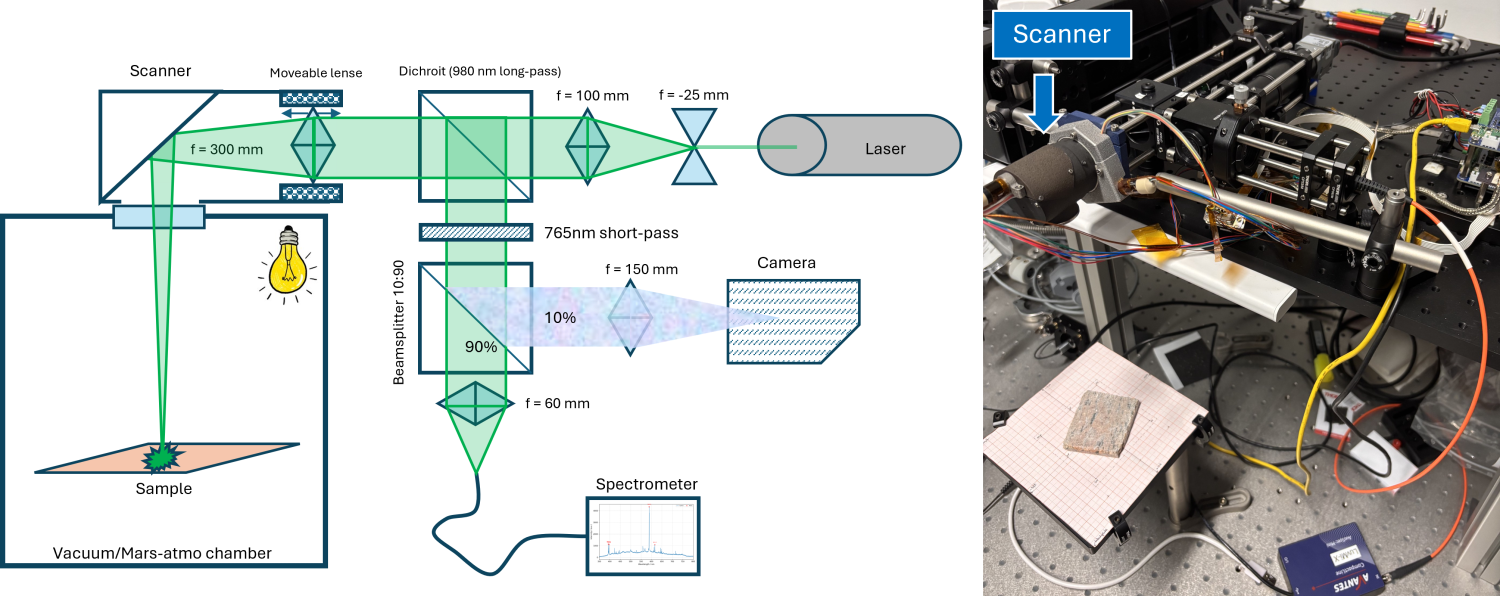
Figure 1: Left: schematic drawing of the µLIBS-Scanner-Setup. Right: Picture taken of the setup in the lab.
First results
5x5 grids of LIBS measurements with a scanner step size of down to 1.46 mrad step size were acquired on flat, heterogeneous natural rock samples (Figure 2). At each point, 30 LIBS spectra were recorded using an integration time of 300 µs and averaged. Typical characteristic atomic and ionic emission lines can be seen, confirming the presence of several major and minor elements (Si, Al, Ca, Na, Fe, Mg, H, N, O, Li). N emission comes from the ambient atmosphere.
To demonstrate the elemental mapping capability without having a quantification in place, we are indicating the major emission of two major elements in the LIBS spectrum per raster position with a colored circle. We chose Na as felsic indicator of the light toned matrix and Ca emission as an indicator of the darker mafic material.
Raman spectroscopy revealed quartz and plagioclase on the light-toned areas and Ca amphibole (hornblende) from the darker areas.
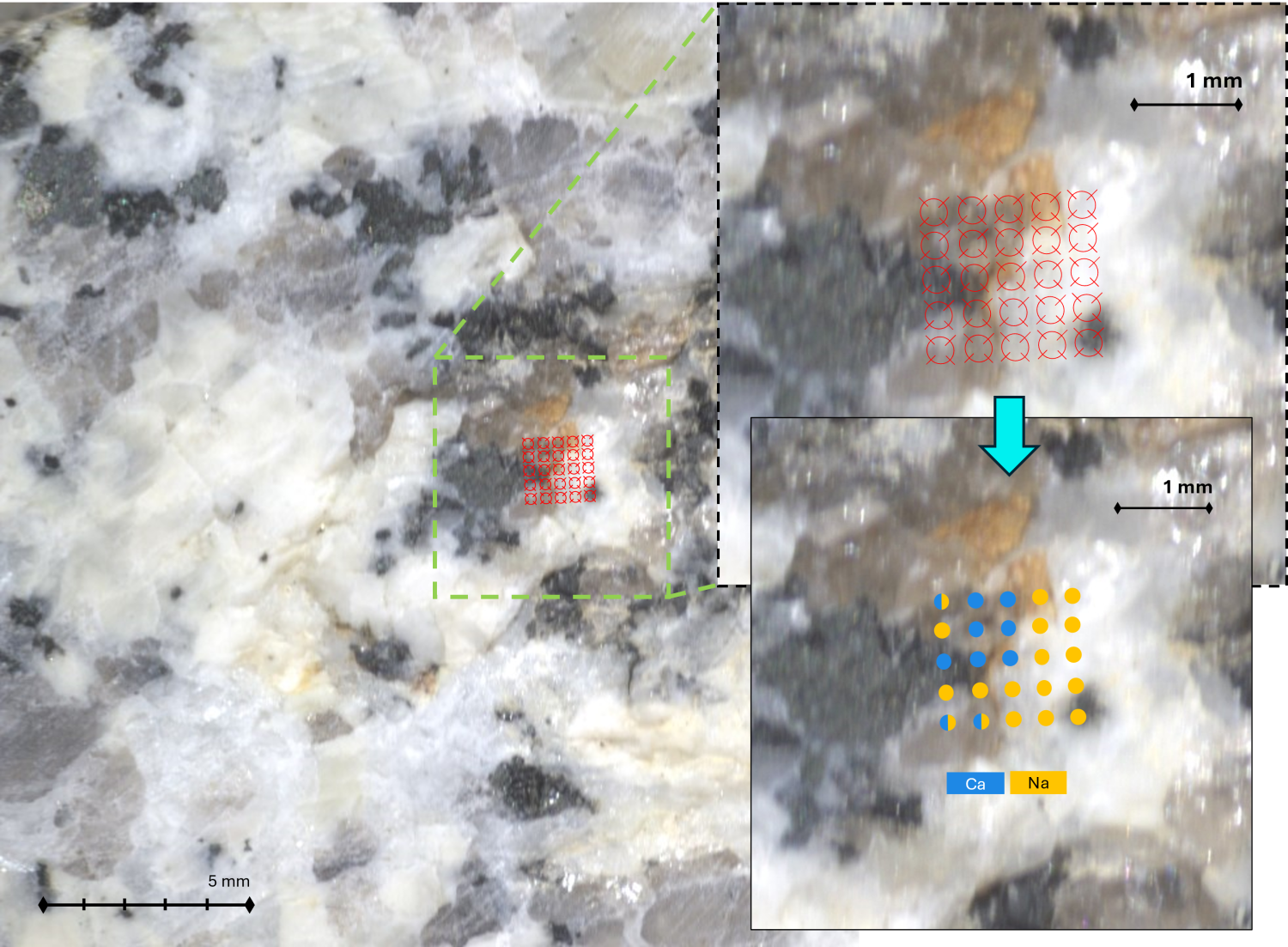
Figure 2: Left: Full scale context image where red circles mark the 5x5-LIBS grid. Top right: Zoomed-in view. Bottom left: Color markers placed on each grid point for the dominant Ca or Na lines.
Summary and outlook
We show the implementation of a particularly small and lightweight scanning unit prototype (TRL6) into a laboratory LIBS setup that also hosts a co-aligned imaging system. Using a vacuum chamber, Martian atmospheric conditions can be simulated. The system can ignite suitable plasmas within a raster of 8x8 cm on flat samples without refocusing. Minimal reproducible angle between measurement positions is 1.46 mrad which translates to distances of ≈0.35 mm on the sample surface.
First measurements on a heterogeneous natural rock sample demonstrate the setup's ability to identify compositional variation at submillimeter scale. Ongoing work includes the acquisition of LIBS data at simulated Martian atmospheric and airless conditions and advance data processing and analytical methods in combination with image data for improved insights on geochemically heterogeneous targets including potentially limiting operational aspects.
References
1. Liu Y. et al. (2022) Science 377, 1513–1519.
2. Kizovski T. et al. (2025), nature communications, 16, 6470
3. Christian J. et al. (2026) Icarus, 453, 117060
4. Maurice S. et al. (2021) Space Sci Rev 217,
5. Wiens R. C. et al. (2022) Adv. 8, eabo3399.
6. Beyssac O. et al. (2023) JGR: Planets, 128, 7
7. Xu W. et al. (2021) Space Sci. Rev. 217, 64.
8. Rapin W. et. Al (2024) LPSC 2024, 2670
9. Rapin, W. et al. (2025) EPSC-DPS2025-1829
How to cite: Krybus, N., Schröder, S., Dietz, E., Bergen, T., Buder, M., Egerland, C., Mourlin, F., Rammelkamp, K., Rapin, W., Schrandt, F., Seel, F., Walter, I., and Hübers, H.-W.: Advancing LIBS for geochemical micro-mapping with lightweight prototype scanner, Europlanet Science Congress 2026, The Hague, The Netherlands, 7–11 Sep 2026, EPSC2026-959, https://doi.org/10.5194/epsc2026-959, 2026.


